Google Is Making Rank Tracking Harder, What Rank Tracking Solutions are there?
Rank tracking is still one of the first things clients ask me about. It is easy to understand, simple to chart and useful for seeing whether important search terms are moving. The trouble st
Rank tracking is still one of the first things clients ask me about. It is easy to understand, simple to chart and useful for seeing whether important search terms are moving. The trouble starts when we treat a small, preselected keyword list as if it represents a website's entire organic performance.
This has been a long running issue with ranking reports in general, a small number of a websites overall served queries are used to benchmark performance - and that's, well, a fallacy in itself.
BUT, rank tracking still does have value, because it's one of the many indicators within SEO that can help a client to understand progress and trajectory, and its one of the reasons why we built rank tracking into SEO Stack, because SEOs, freelancers and agencies still report to clients with ranking reports.
Most ranking reports and rank trackers tend to track 50-100 keywords, some more up to 500-1000 keywords, but beyond that it can become a headache for clients, most clients will have their minds focused on a handful of their most valuble keywords - they won't nessescarily want to look at 1000 keywords.
So, imagine if your website is served for 1000s of keywords, rank tracking and focusing on 50-100 keywords ISN'T a great indicator of progression. Imagine a client being frustrated that their rankings for say 20 of their tracked keywords went down whilst the overall website/domain started being served for hundreds/thousands of new keywords.
But, that being said, rank tracking IS still important and a lot of SEOs continue to track rank and report it to clients, usually in weekly or monthly reporting, but, its not uncommon for websites to have thousands of served keywords, so it's always worth being mindful with clients and explaining that performance evaluation can include both ranking reports and the total volume of keywords a domain is served for - for example, one of our agencies clients tracks 500 keywords in SEO stack, but, their domain is served for over 879,000 keywords!!!!
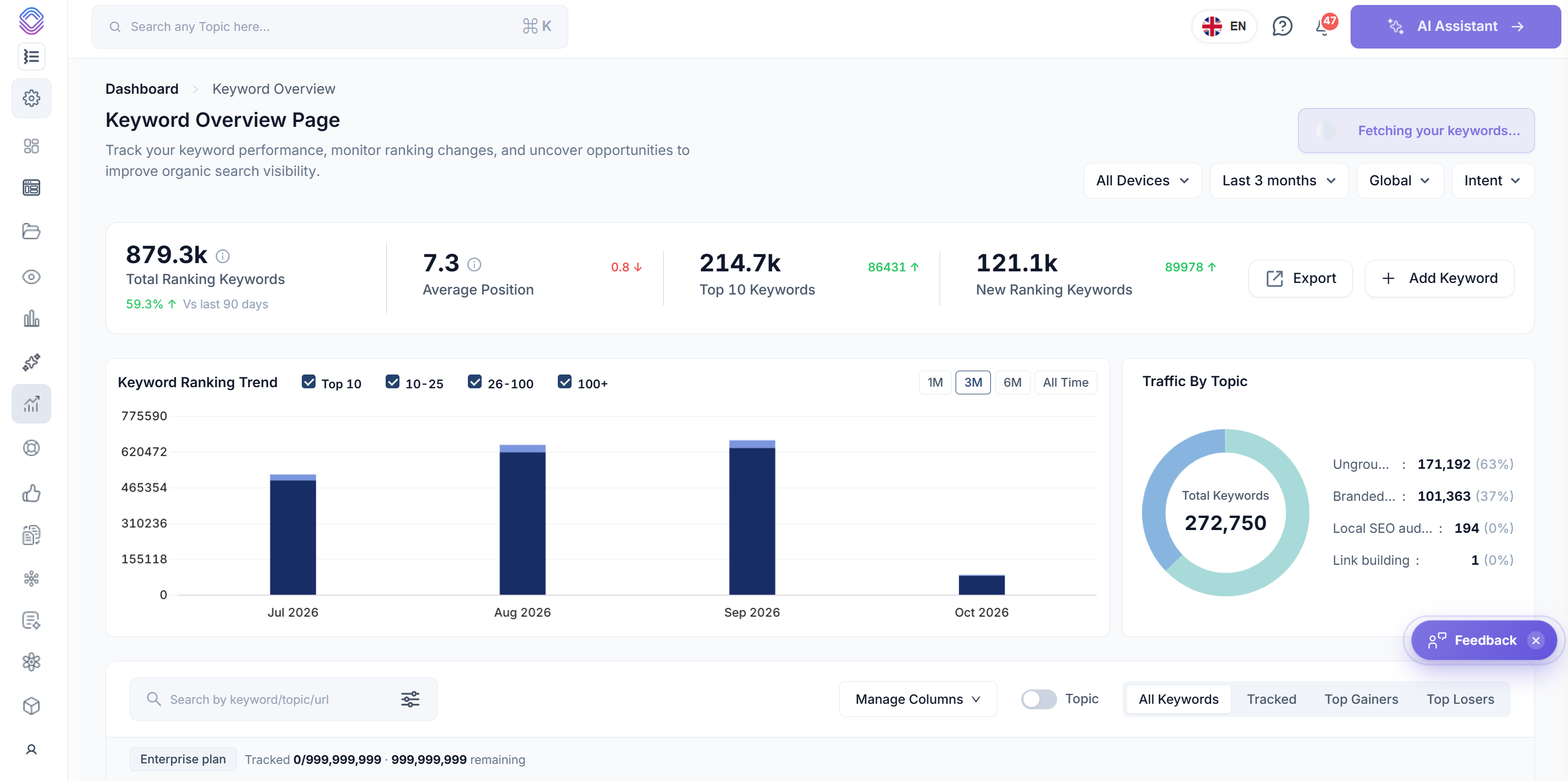
Even small websites can be served for thousands of keywords, so its worth being mindful of this, we would typically say rank tracking and ranking reports can be used for higher value queries - perhaps queries most associated with sales or conversions.
Even small sites can have a large served keyword footpint:
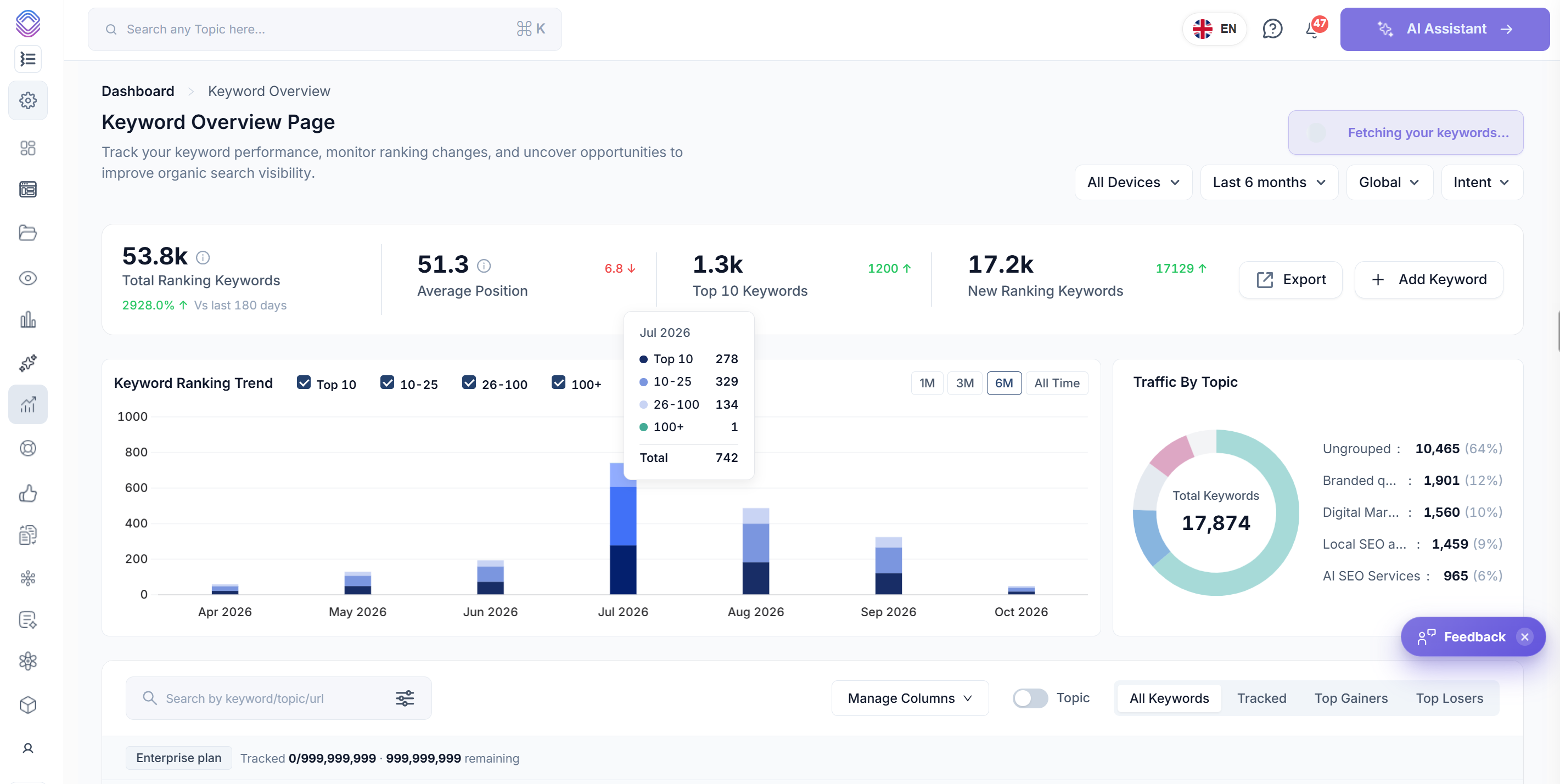
So imagine if your rank tracking is only reporting on say 1% of all served queries, you don't want your clients to get too hung up on just relying on rank tracking alone.
Now, back to ranking reports, in short a ranking report:
A ranking report answers a clients general question: where did this rank tracking tool find a page for these selected keywords/queries, in this place, on this device, at this time?
That is useful information, but It is not the same as knowing every query Google is serving your site for, or how your organic search performance is changing overall - and that's why we say your 2 key deliverable focuses should be:
Ranking reports where the tracked keywords are of higher value
Keyword overview - so you can demonstrate to clients the growth in served keywords over time
What rank tracking tells us
Traditional rank tracking monitors a chosen set of keywords over time. Depending on the tool, you can specify a search engine, country or city, device, and sometimes a precise local search area. You can then see whether a target query/page moves up or down in the SERPS, compare competitors on the same terms and monitor SERP features.
I still see a clear use for that, If a business needs to know whether its main service page is visible for a commercially important phrase in a particular town, a location-specific check is a useful diagnostic.
Ultimately, rank tracking tells us the "trajectory" of performance based on the tracked keyword pool, it's a "performance indicator" and a client deliverable. However, rank tracking alone is NOT a sole performance indicator because, as mentioned above it's not just about looking at a small portion of keywords, its about looking at the bigger picture too.
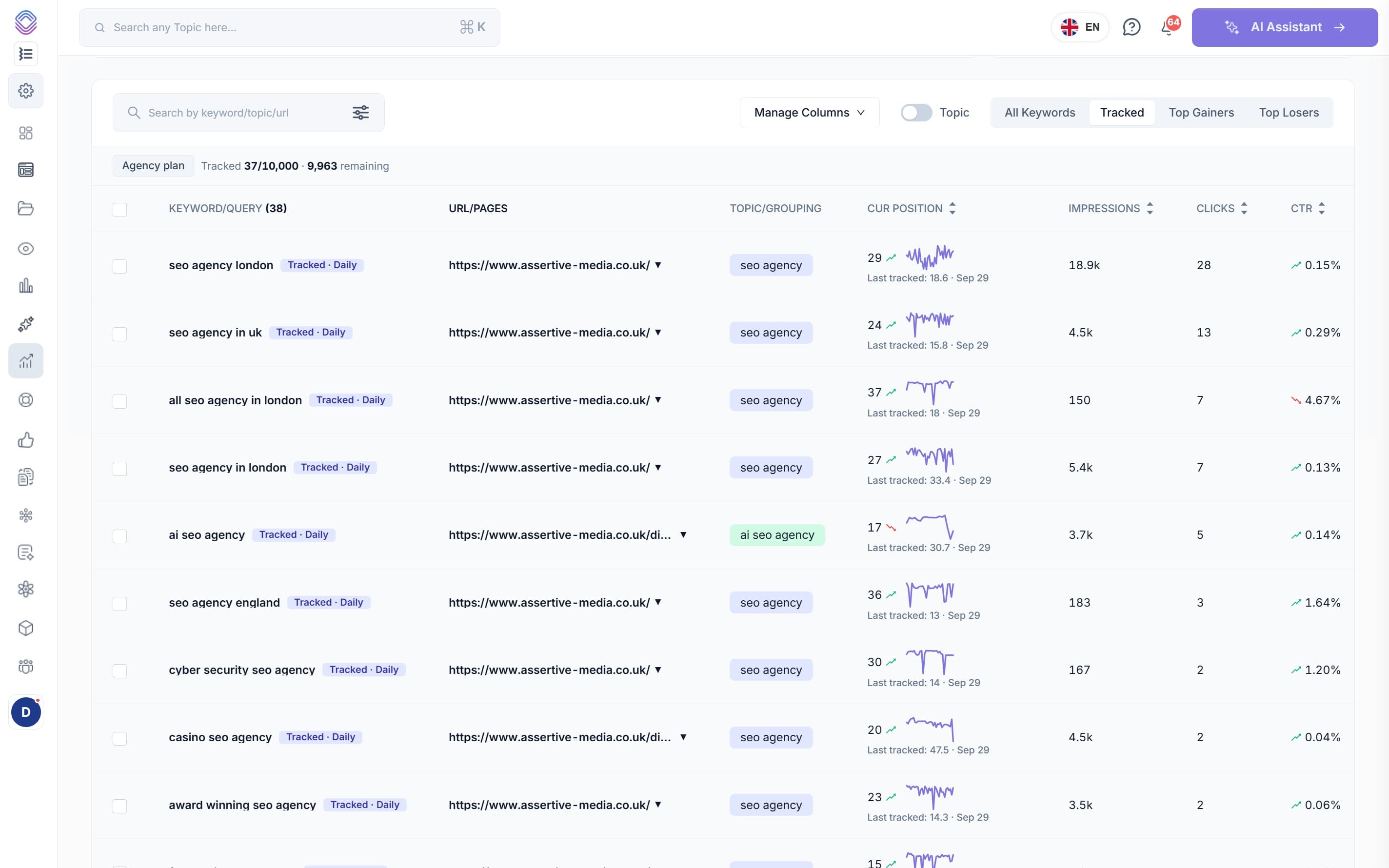
So for example, Assertive Media (London based SEO agency) naturally wants to see how it ranks for SEO agency terms (with and without location) - so in SEO stack we can set up specific keyword tracking by adding our own keywords or pulling the keyword data from Google search console data:
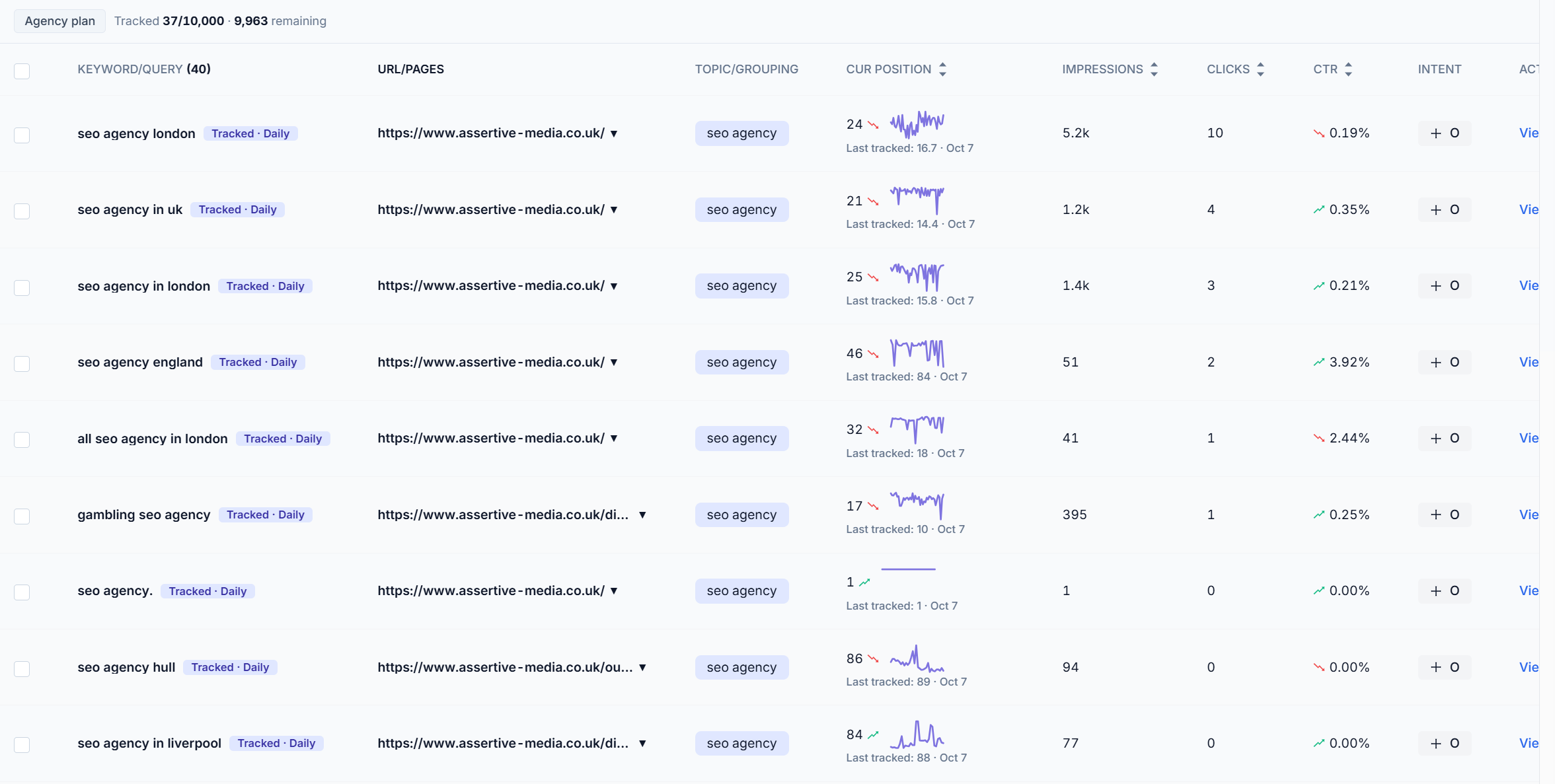
Like traditional rank tracking, SEO Stack lets you see your keyword, served URL and the overall performance trajectory over time -
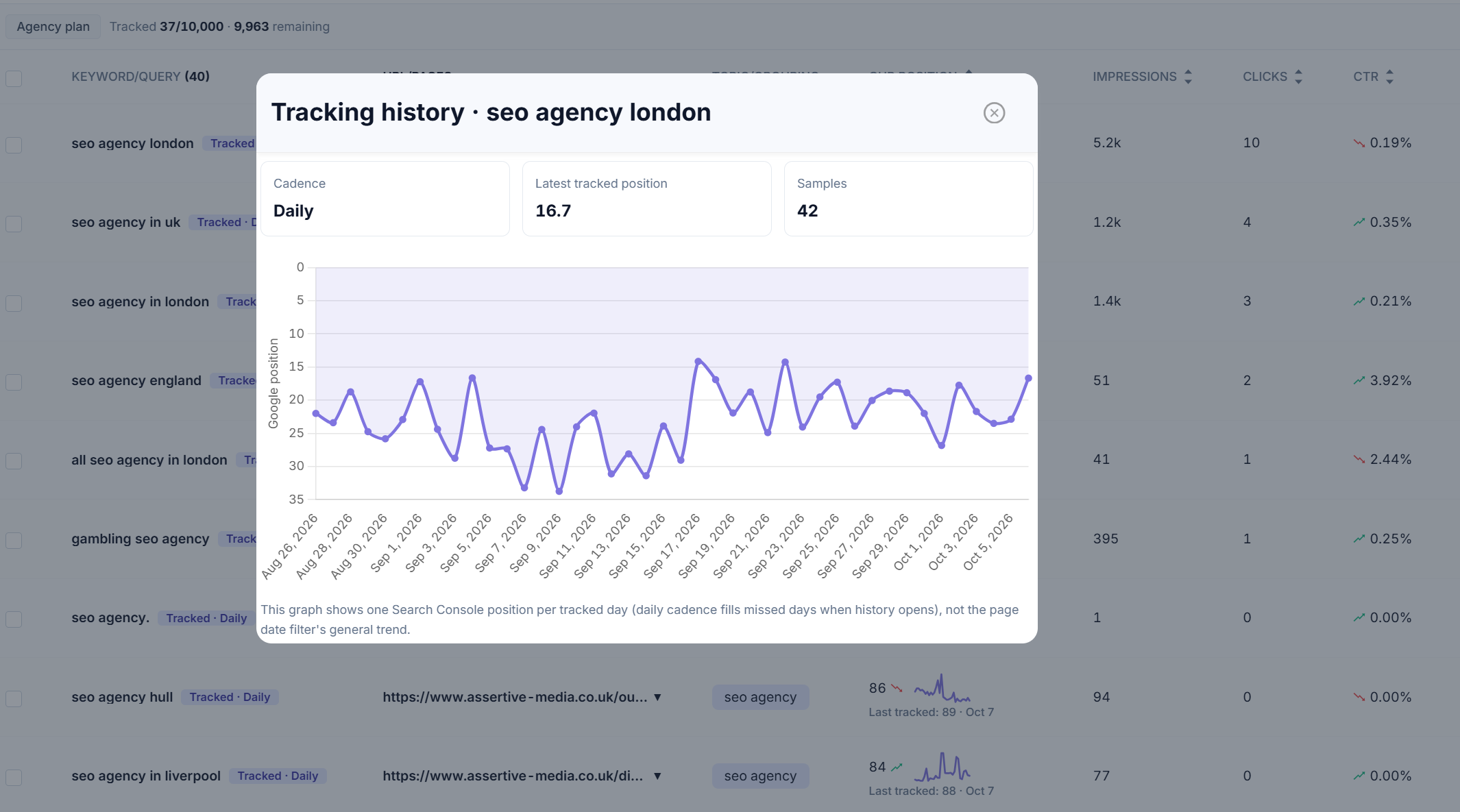
So above, we see a day by day performance snapshot of SEO Agency London as a keyword for Assertive Media, we can see this side by side with performance data such as impressions, clicks and CTR, intent etc.

What rank tracking also tells us is how URLS are performing for keywords - but, we can apply filters to narrow performance down further.
For example, if I am looking at tracking seo agency london as a keyword, clearly it would make sense for me to apply a country level filter, which, is what we can do in SEO stack quickly and easily:
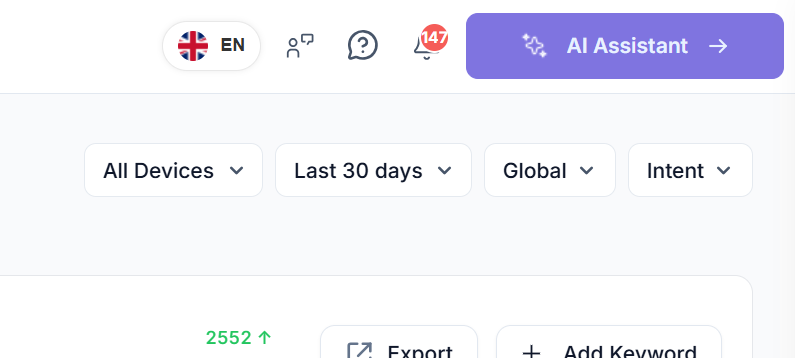
We simply select the locator drop down (GLOBAL) and then pick a country/countries of our choice:
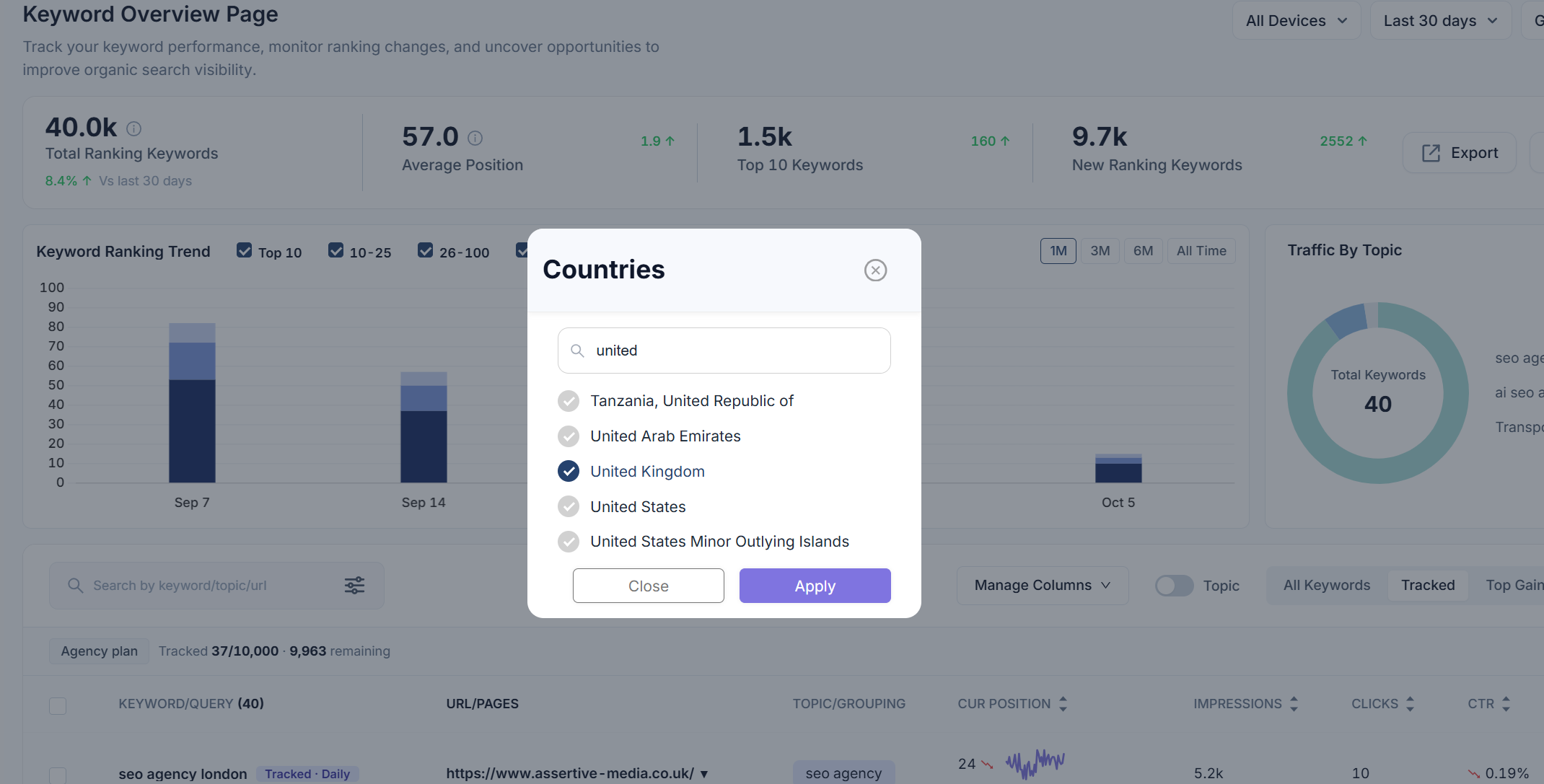
And then we can see rank performance based on the applied filers:
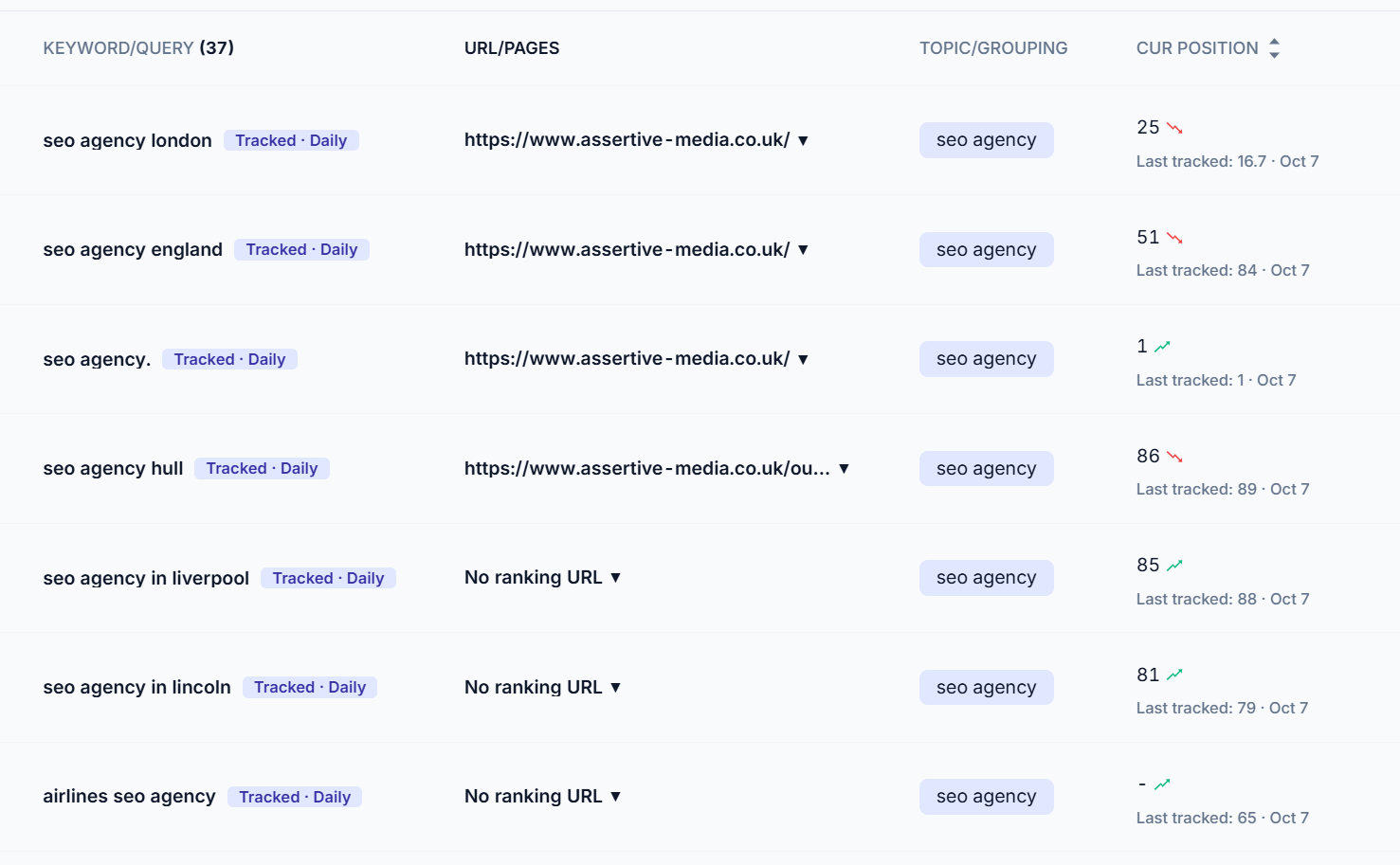
It's that simple!.
The 100-keyword fallacy
A website can appear for thousands of different searches while an SEO team tracks only its 100 highest-priority terms. Those 100 are usually chosen deliberately: head terms, commercial phrases, known products or services, and keywords with enough search volume to look important in a planning document - typically SEOs will derive the keywords from client feedback or PPC data where conversions back up the value of the keyword.
Usually, rank tracking will prioritise keywords either based on search volume or commercial value/relevance - however the right keywords to track are really dependent on multiple factors from conversion potential to client priority.
Think of a furniture retailer tracking “dining table”, that 1 phrase tells us little about the site's visibility for “small oak dining table”, “extendable table for 6”, or a more specific question about dimensions and delivery. Some of those searches might bring a handful of impressions each month, others may become important as demand or content changes. They can still add up across a large site.
Google Search Console gives website owners another view: the queries, pages, impressions, clicks, click-through rate and average position that Google has recorded for their property. Google's average position is calculated across impressions, so it will not match 1 person's live search in every location, its more generic and not so bespoke and doesn't account for personalisation. It is a measure of observed performance, not a universal ranking for every searcher.
Google explains the position metric here:
https://support.google.com/webmasters/answer/7042828?hl=en
SEO Stack is a Google Search Console data warehouse, this allows us to count queries accurately and at scale for every domain you import - this is how we're able to give you keyword overview volume data, this should be intrinsic in your SEO reporting -
Because you can show clients progress i.e.
We can look at the keyword volumes over a specifc timeframe i.e. last 3 months
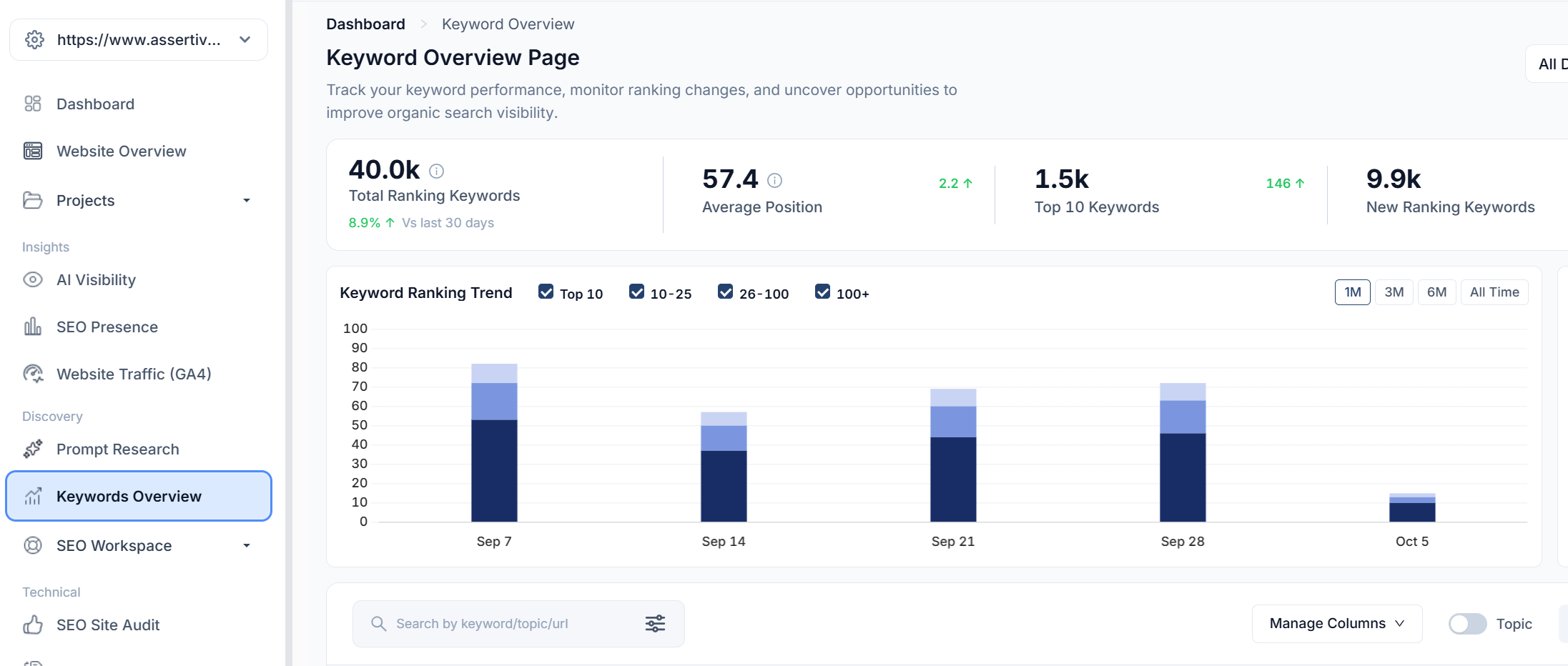
But then we can report over a longer timeframe i.e.
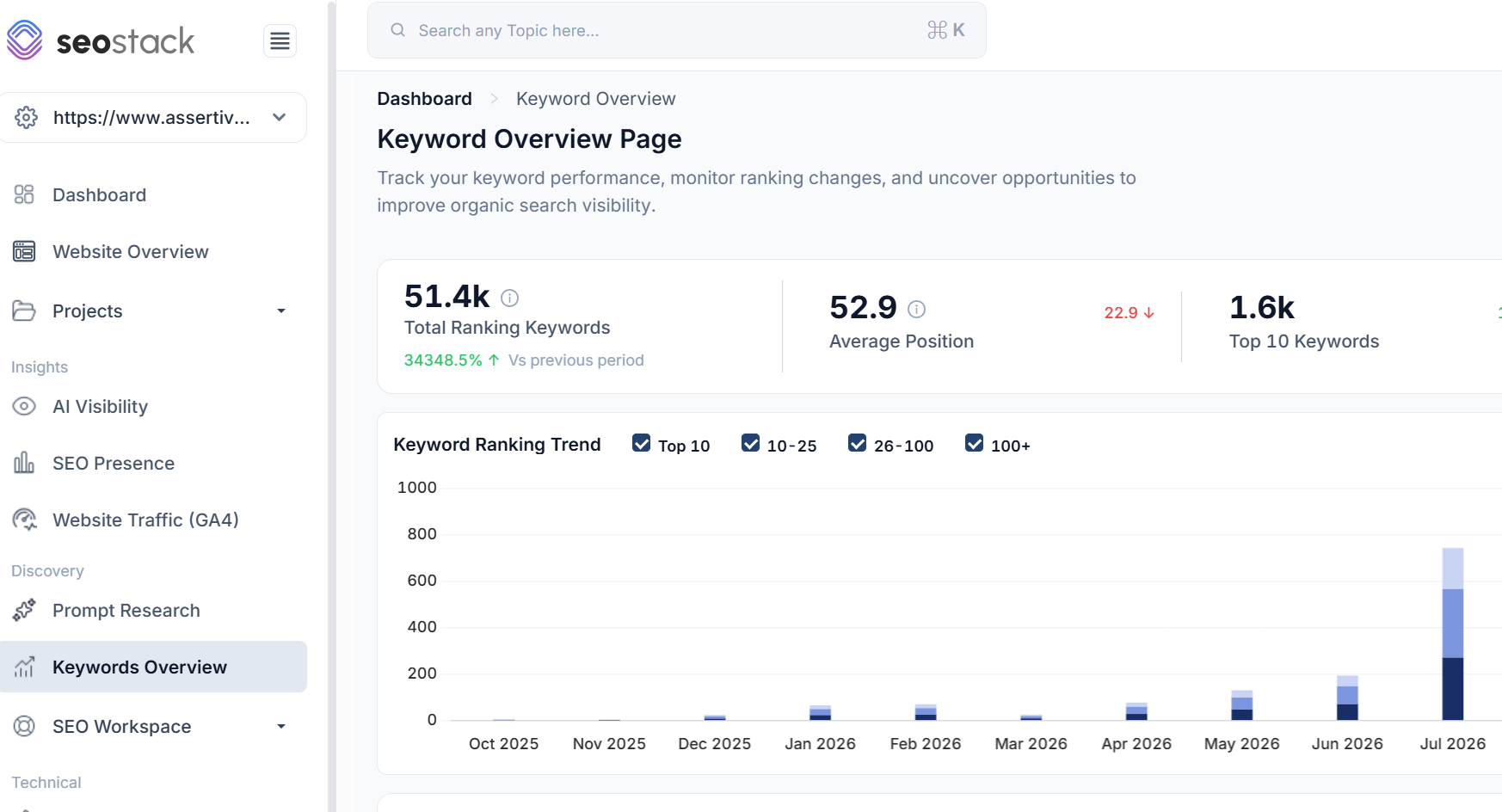
This is useful alongside rank tracking, because we're showing the total volume of ranked keywords by position group, which is good for clients.
Google has changed how easy SERPs are to collect - well, it's made it a lot harder for 3rd party tools
For years, rank tracking providers have needed a way to retrieve search results at scale. Some operate their own collection systems, others tend to rely on 3rd-party SERP data providers such as DataforSEO, SERPAPI etc. Either way, when Google changes how its results are served, the tools that depend on those results have to adapt - and, as we've seen in recent months Google has been exceptionally aggressive against 3rd party scrapers.
So what things has Google been doing?
The &num=100 change
The &num=100 parameter was widely used to request 100 Google results in one page load. In September 2025, SEOs, tool providers and practitioners reported that Google had stopped honouring it consistently. Collecting deeper results could then require more requests, and some tools showed missing or reduced ranking depth while they changed their systems. Search Engine Journal reported on the disruption.
This was not only disruptive, but, it made requests more expensive overall, because rather than 1 request yielding 100 results, it would now be 10 requests for 100 results, making getting the data and keeping it up to date more expensive.
The effect was not identical across providers. Ahrefs said the change reduced how many results it could check beyond page one, then reported a gradual restoration of top-100 data later in 2025, with a small proportion of queries still not returning the full depth. That is a useful reminder: the change exposed a dependency and created extra work, but it did not make every rank tracker permanently unusable. Ahrefs' update is here.
We do see however a large volume of analysed sites where total organic position counts drop, but aren't nessescarily because of ranking declines or losses, but perhaps in a reduction of available data?
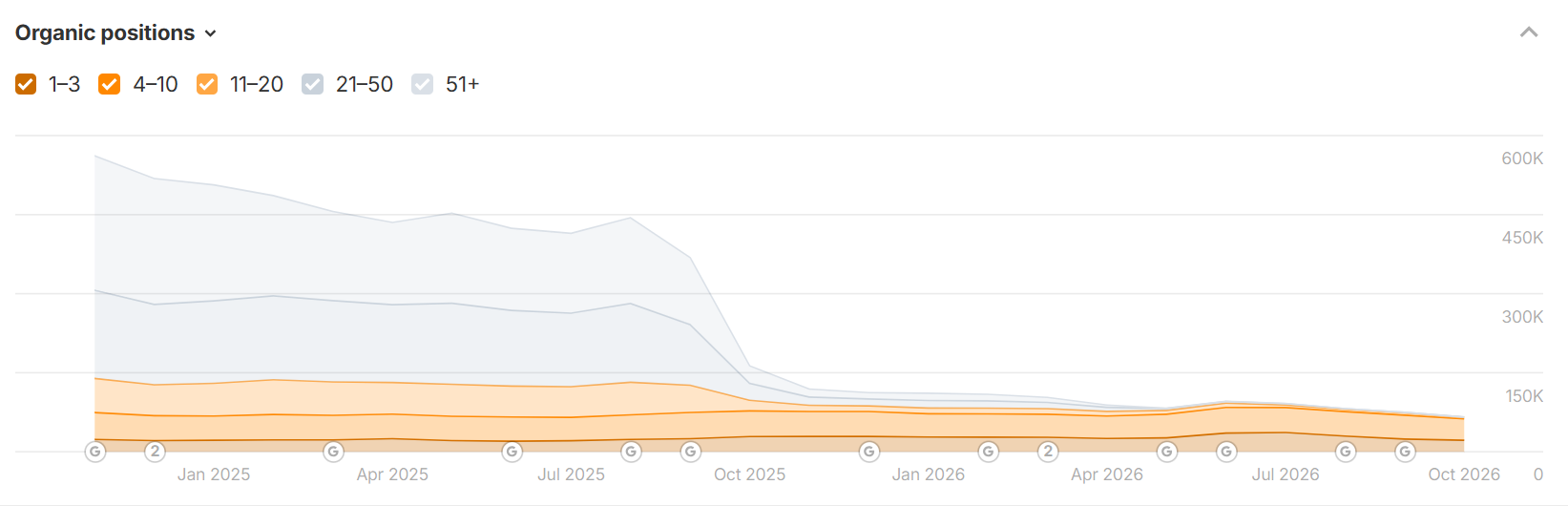
Google's /goto result links
In August 2026, Google confirmed it was rolling out google.com/goto passthrough links on Search results. Instead of exposing a direct destination URL in the result link, the page can route through a Google URL before reaching the destination. For a scraper, that adds a URL-resolution step. It does not mean the page's ranking changed; it changes how the result link is presented and retrieved. Search Engine Roundtable reported Google's confirmation.
What is key to understand is that GOTO URLS appear on logged out sessions, so if you look at the SERP result when signed in to a Google account Google has no reason to obfuscate the URL i.e.
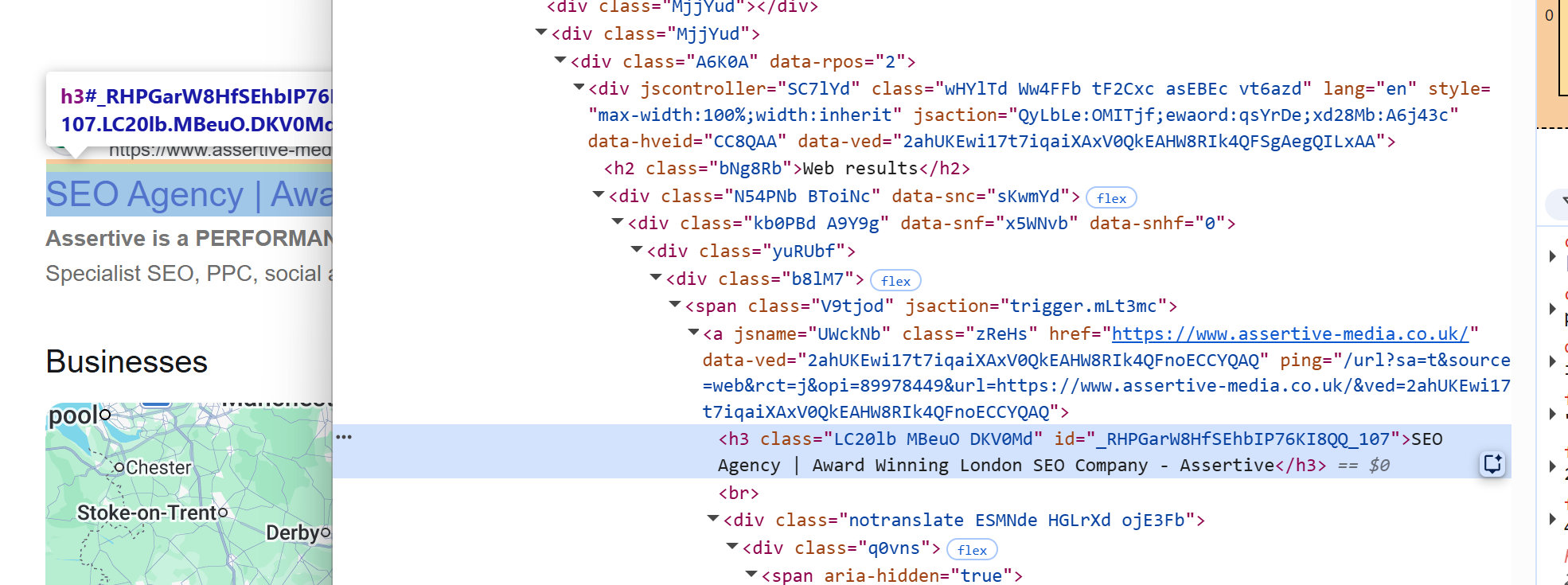
But, as soon as you are signed out or incognito you will see the GOTO URLS:
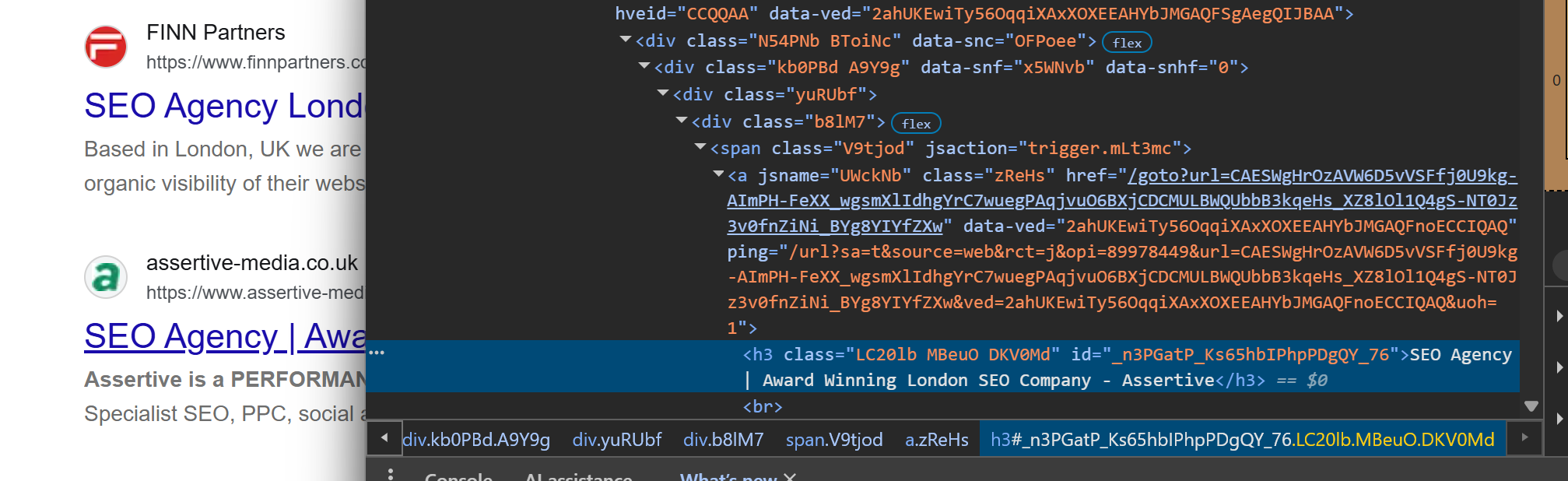
So, clearly this is just another way Google is making it harder for 3rd parties to scrape to get data including rank tracking data.
SERP providers can build ways to resolve these links, DataForSEO, for example, says its API resolves the destination for 99.99% of the organic SERPs it returns. That is the provider's own reported figure, not a claim about every tool on the market. It does show that vendors can adapt, while also making clear that coverage depends on each provider's implementation. DataForSEO's update explains its approach.
Daily data is useful, but cadence is not the whole difference
It would be misleading to suggest that third-party rank trackers cannot provide daily updates. Semrush says its Position Tracking tool monitors specific keywords daily and can segment them by location and device. Those are real strengths when the job is to follow a fixed campaign or compare competitors in a specific market. Semrush's documentation describes those features.
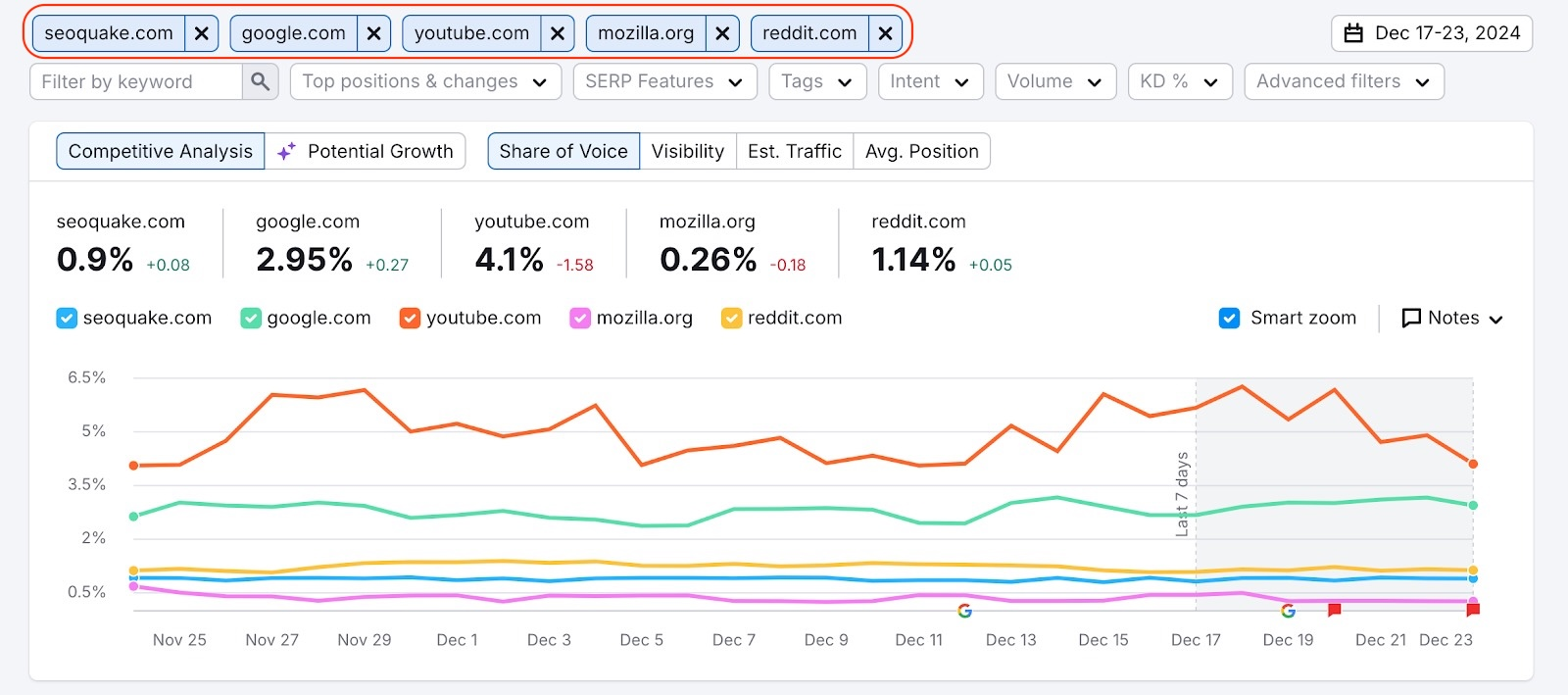
Semrush's Position Tracking report illustrates the value of a configured keyword set and competitor comparison. Screenshot source: Semrush Help Centre.
The distinction is the data model, a SERP tracker / ranking tracking tool checks selected terms in a controlled setup. This is what sets SEO Stack apart from other rank trackers, SEO Stack reports the average position Google recorded for your own property, query by query, alongside impressions, clicks and CTR.
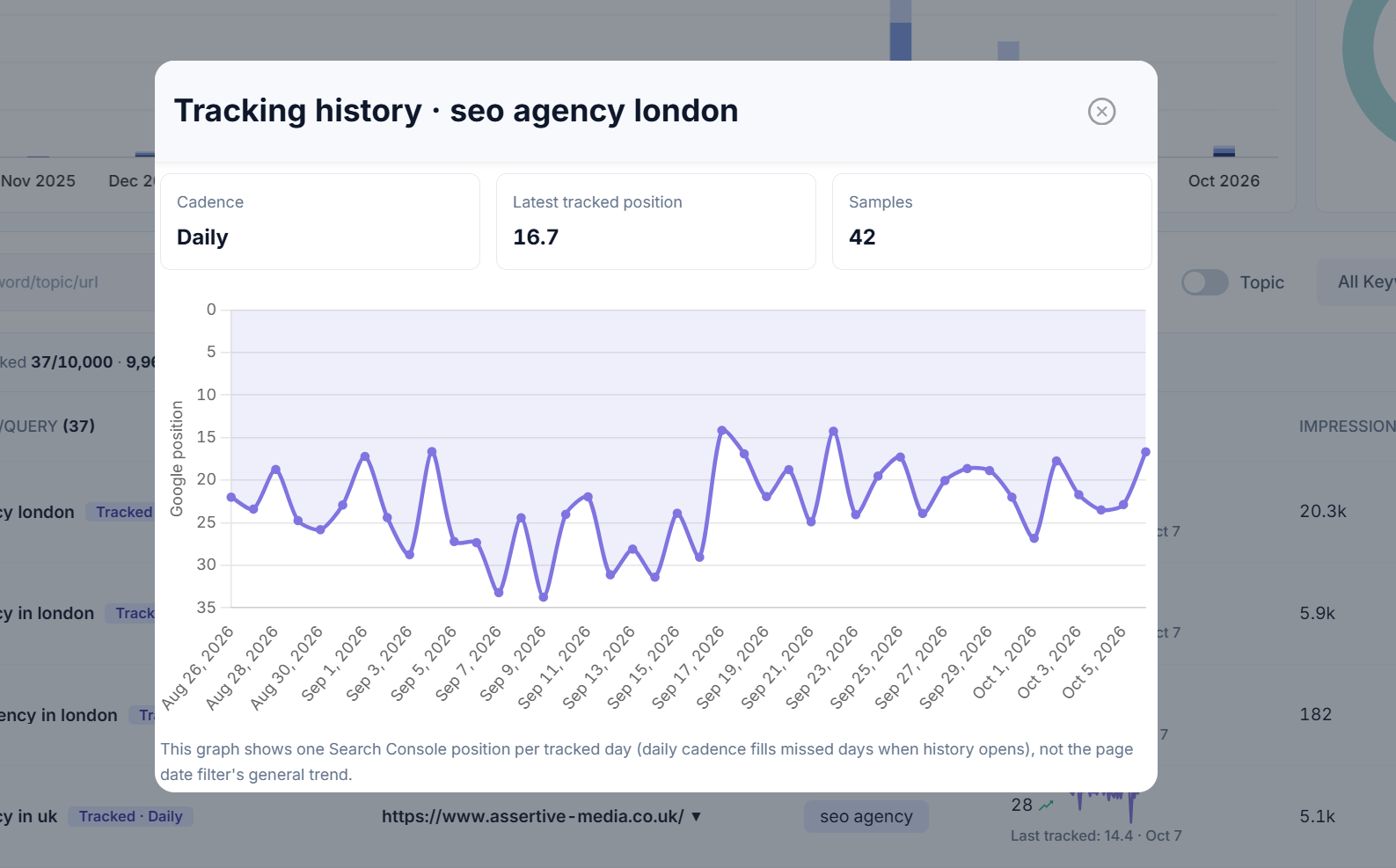
We store the daily history and let you segment it by the dimensions available in Search Console. The Search Analytics API supports date, query, page, country and device dimensions, plus filters for those dimensions. Google's API documentation sets out how that works.
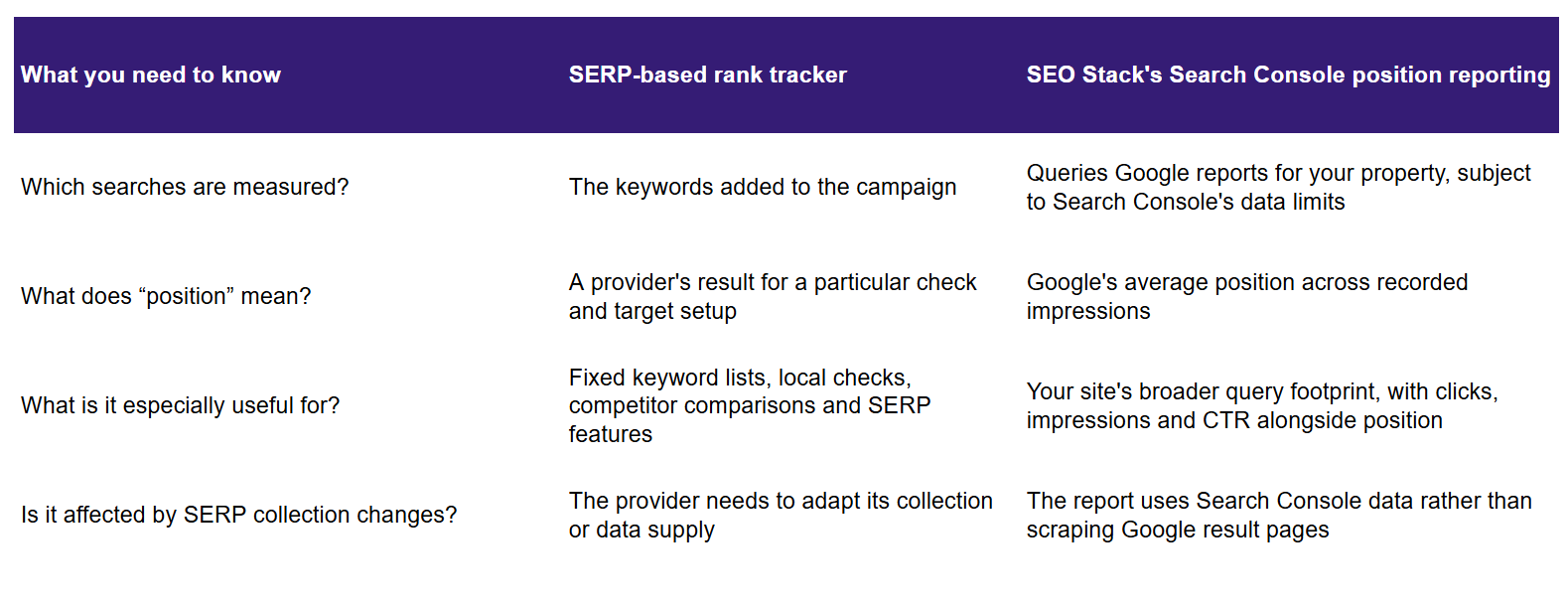
How SEO Stack avoids the scraping dependency
SEO Stack is built around the Search Console data Google already records for a connected property, We simply pre-filter that data at source, then use the matching query, page, date, country and device rows to build a repeatable reporting view. That means we are not trying to rediscover your own site's positions by repeatedly collecting Google result pages.
The practical benefit is breadth, you do not need to decide in advance that only 100 terms deserve a place in the report. You can start with the queries Google has served your site for, see how their positions and impressions are changing, and then create a tighter tracked-keyword group for the terms that matter commercially.
You can create your own topic groups/keyword groups for say high conversion keywords, client high value keywords etc, plus you can sort by metric i.e. impressions or clicks >
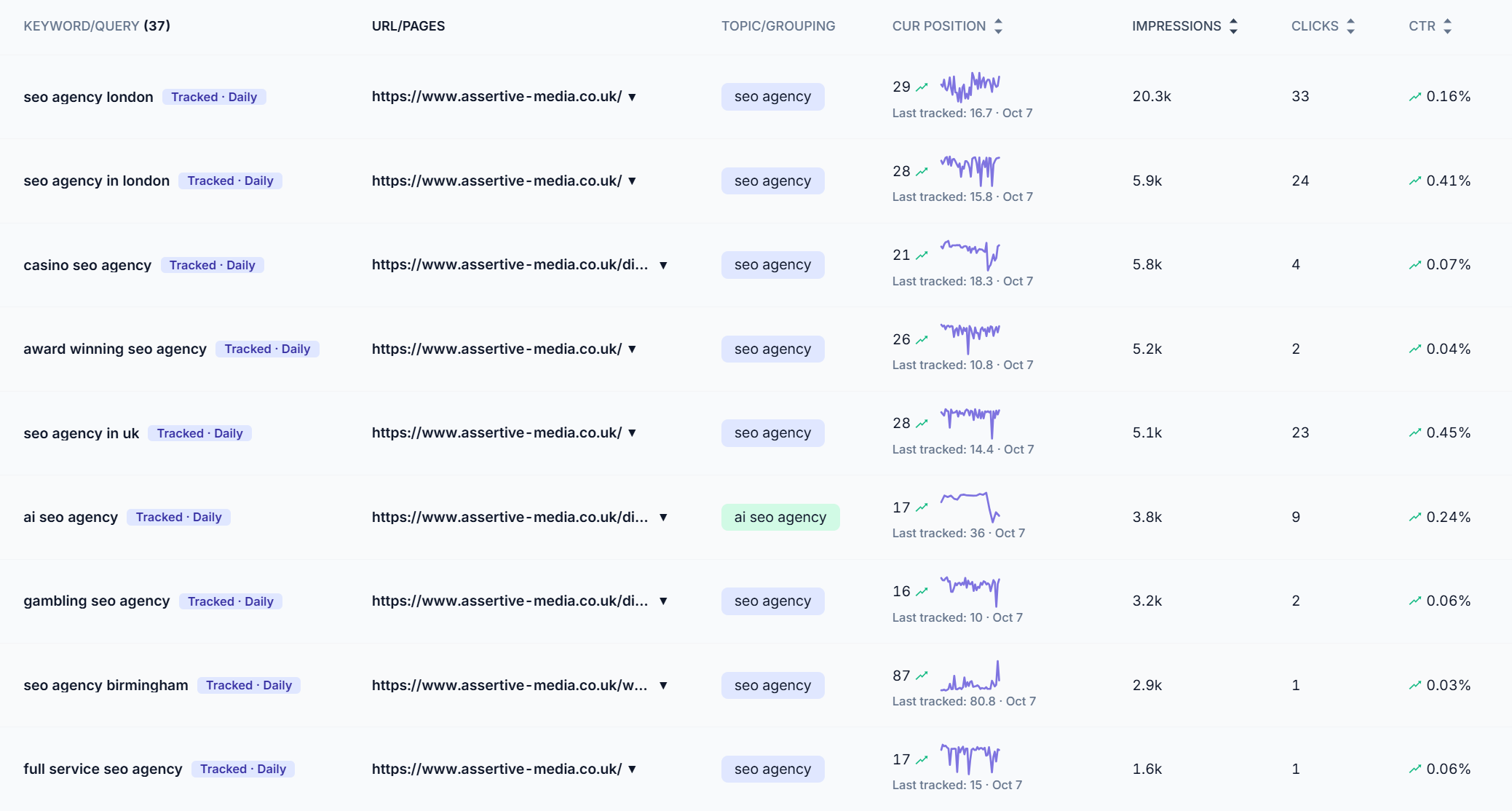
SEO Stack supports a deliberate tracked-keyword list as a focused watchlist, alongside the wider Search Console query data. Image source: SEO Stack Rank Tracking.
Because SEO Stack does not scrape Google's SERPs to produce this position series, the &num=100 parameter and /goto links do not determine whether the site's Search Console data can be reported. We can keep presenting the daily position history Google supplies without fetching ten pages of results for each keyword or resolving every result link first.
Daily position does not mean one exact live rank that will be identical for every person. It is Google's average for the impressions it records that day. Location, device, result layout and the mix of searches can affect the average, so the useful comparison is the trend, interpreted alongside the query's impressions, clicks and landing page.
A 1st-party data source still has limits
Search Console is not an unlimited, perfect record of every search, Google omits anonymised queries from query tables for privacy, and its Search Analytics API says it does not guarantee every data row will be returned. The API allows up to 25,000 rows per request and supports pagination, but filtering and warehousing cannot recover terms Google withholds. Google documents those limits.
However because SEO Stack is a data warehouse for your GSC data, we aren't constrained by the API limitations or by other limitations faced by other rank trackers - we have pure data that can quickly be filtered and sorted to give accurate ranking insights.
There is also a specific historical issue to account for, Google says a logging error prevented accurate reporting of impressions from 13th May 2025 to 27th April 2026. Impressions, CTR and average position were affected, while clicks were not. If you are comparing position trends across that period, annotate it and avoid treating every movement as a change in SEO performance. Google's Search Console data-anomalies page records the issue.
That is the honest boundary: SEO Stack can make better use of the 1st-party data Google exposes, retain the daily history and show a much wider set of queries than a small manual keyword list. It cannot make anonymised searches visible or correct a reporting error in Google's source data.
Use both views for the question each can answer
A focused rank tracker still has a place when you need a controlled local check, competitor positions or SERP feature monitoring. For your own website, a Search Console-based view answers a broader question: which of your websites keywords actually produced any meaningful visibility, how did keyword average position move, and did that movement lead to impressions and clicks?
That is why SEO Stack's rank tracking is built on your own GSC data, the goal is not to make a 100-keyword watchlist disappear. It is to stop mistaking that watchlist for the whole picture, and to give you a daily, first-party position series that does not depend on the latest way Google serves a scraped results page.
How popular rank trackers package their tracking
If you are comparing tools, look past the headline keyword allowance. Check how often positions refresh, whether the allowance is shared across projects, how each tool counts locations, and how deep into Google it reports. Prices below are USD list prices checked on 7th October 2026; annual billing, tax and regional pricing can change the amount you pay.
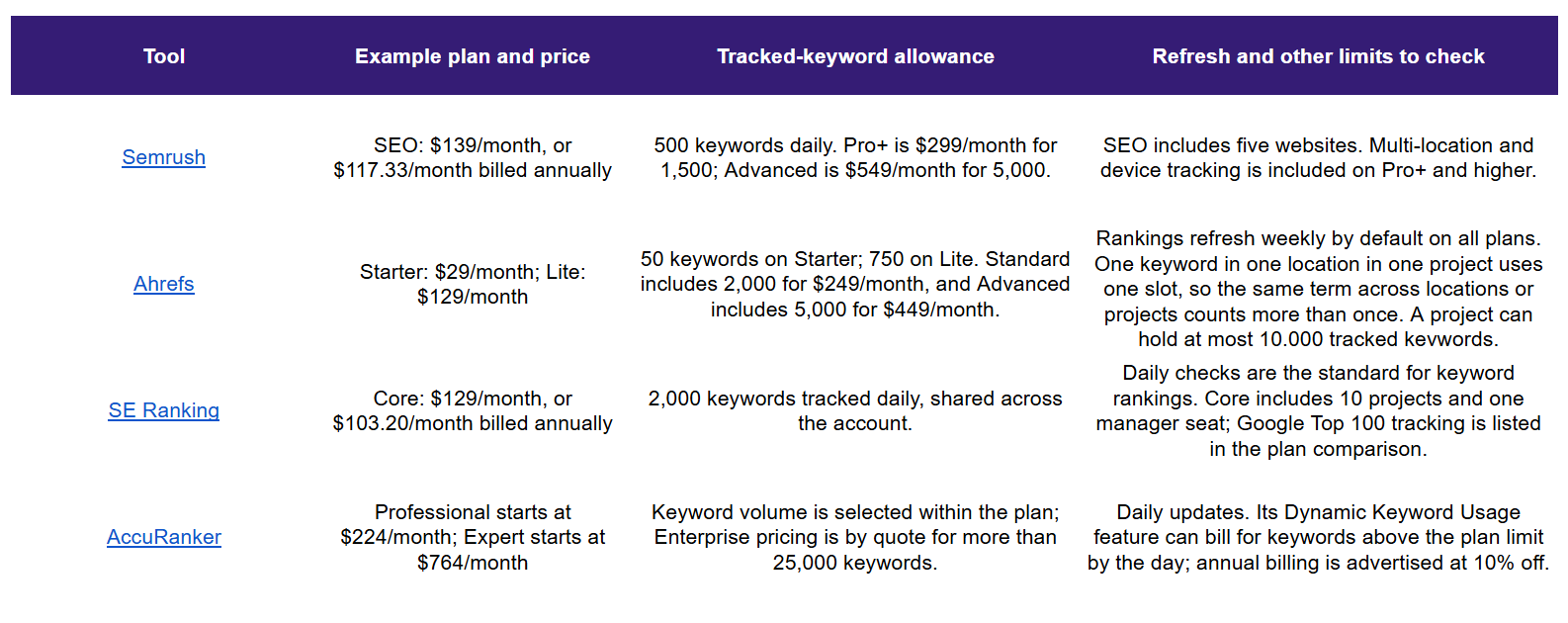
These are all useful for monitoring a defined keyword set, but the allowances are not directly interchangeable, so a keyword tracked in two places, devices or projects can consume multiple allocated volumes, & refresh cadence ranges from daily to weekly. Even the largest standard plan still tracks a chosen keyword list, rather than every query that brings impressions to a site.
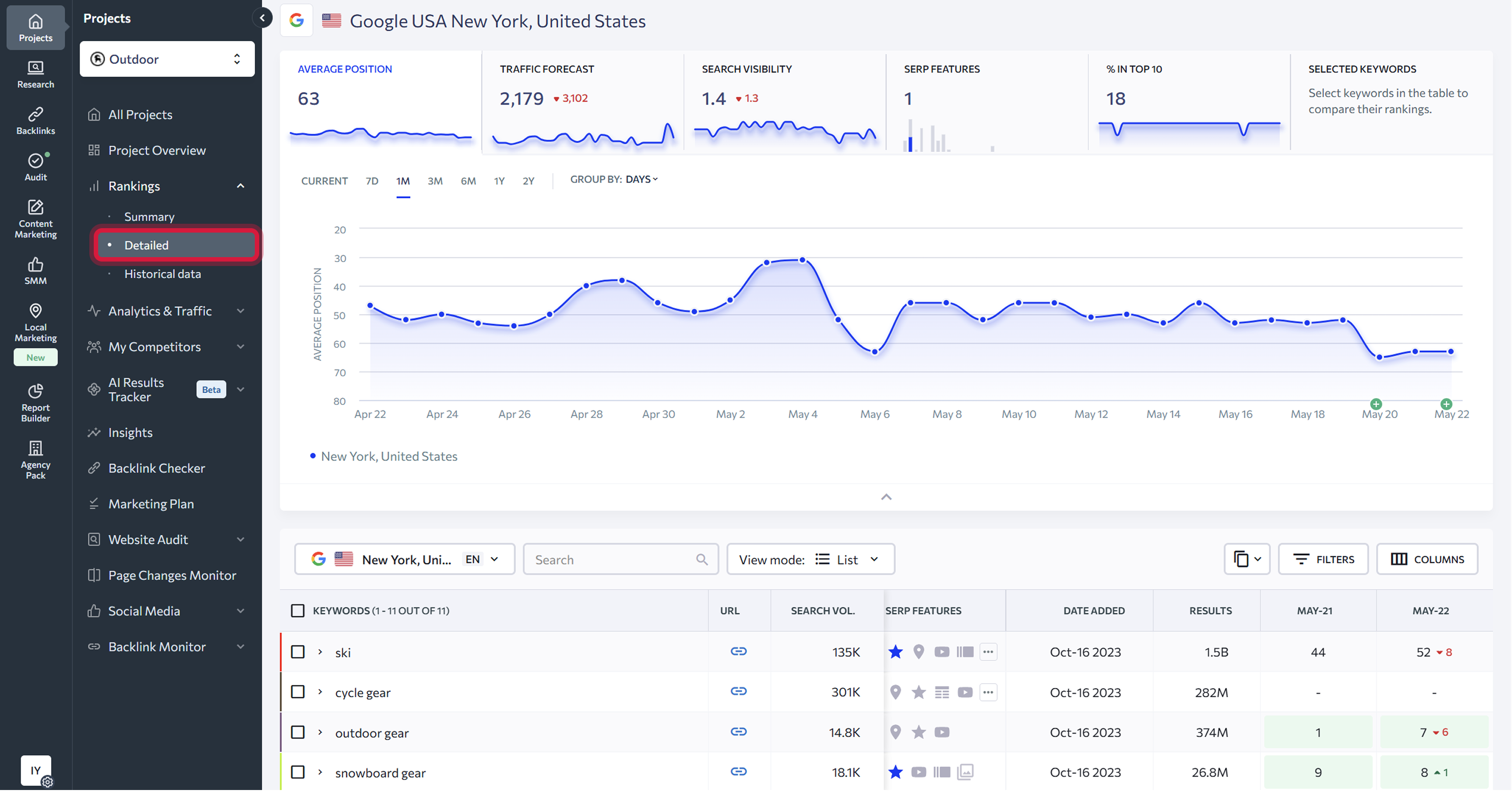
SE Ranking's Rankings module shows the position history for its configured keywords. Screenshot source: SE Ranking Help Centre.
The distinction is the data model, for example a SERP tracker checks selected terms in a controlled setup whereas SEO Stack reports the average position Google recorded for your own property, query by query, alongside impressions, clicks and CTR.
We store the daily history and let you segment it by the dimensions available in Search Console. The Search Analytics API supports date, query, page, country and device dimensions, plus filters for those dimensions. Google's API documentation sets out how that works.
Why is Google so persistent about blocking scrapers?
Google has published a fairly direct reason, It classifies automated searches as machine-generated traffic, explicitly including scraping results to check rankings, and says this activity consumes resources and interferes with its ability to serve users (but we know this is really just dutch speaking for - we don't want other tools profiting from our data). #
Google's help page also names search scrapers and software that sends Google searches to find where a site ranks, when Google sees unusual traffic, it can interrupt access with a reCAPTCHA. In other words, repeated automated requests look very different from a person searching occasionally, and Google treats that volume as a service-abuse and availability issue. (Google's Spam Policies; Google's unusual-traffic guidance)
That does not prove every change to Google's result pages or URLs was introduced specifically to target SEO tools, but you can easily draw that conclusion. Google has not said that the &num=100 behaviour or /goto links were a campaign against rank trackers (but why else would they do it? especially after the SERPAPI case). I would describe them as changes that can make automated collection less predictable, while keeping Google's stated reason separate: Google says large-scale automated rank checking consumes resources and interferes with Search.
Does Google care about rank trackers?
Yes, when we are talking about how they collect the data, Google explicitly includes scraping search results for rank-checking in its machine-generated traffic policy and says automated access without express permission violates its spam policies and Terms of Service.
Its Search help page is just as specific and that is software that sends searches to Google to find how a site ranks is one of the activities it considers automated traffic. (Google Search Central; Google Search Help) But, for a long time, whilst it has been touted as something that Google does not permit, most rank trackers have had it easy for a long time.
The distinction matters because Google's wording is about automated queries sent to Google, it does not say that a business site is demoted simply because its owner uses a rank tracker - and as you would expect people in SEO are going to want to track rankings.
Personally, I would not turn the policy into a claim about a site's ranking penalty. Google does, however, caution that 3rs -party tools do not have access to its internal ranking data and recommends Search Console for first-party information about a connected site.
That makes the source and method behind a ranking report worth checking, especially when the report is presented as a definitive view of what every searcher sees. (Google's guidance on third-party SEO tools)
How are rank tracking companies adapting?
The full collection process is usually proprietary, so I would be cautious about claiming that every tracker uses the same workaround - each rank tracking platform is going to have its own technical approach to overcoming these obstacles.
Some companies operate their own SERP collection processes whilst others rely on external data providers. Ahrefs said the &num=100 change affected both its own monitoring and 3rd-party data suppliers, and reduced the depth it could check beyond Google's first page.
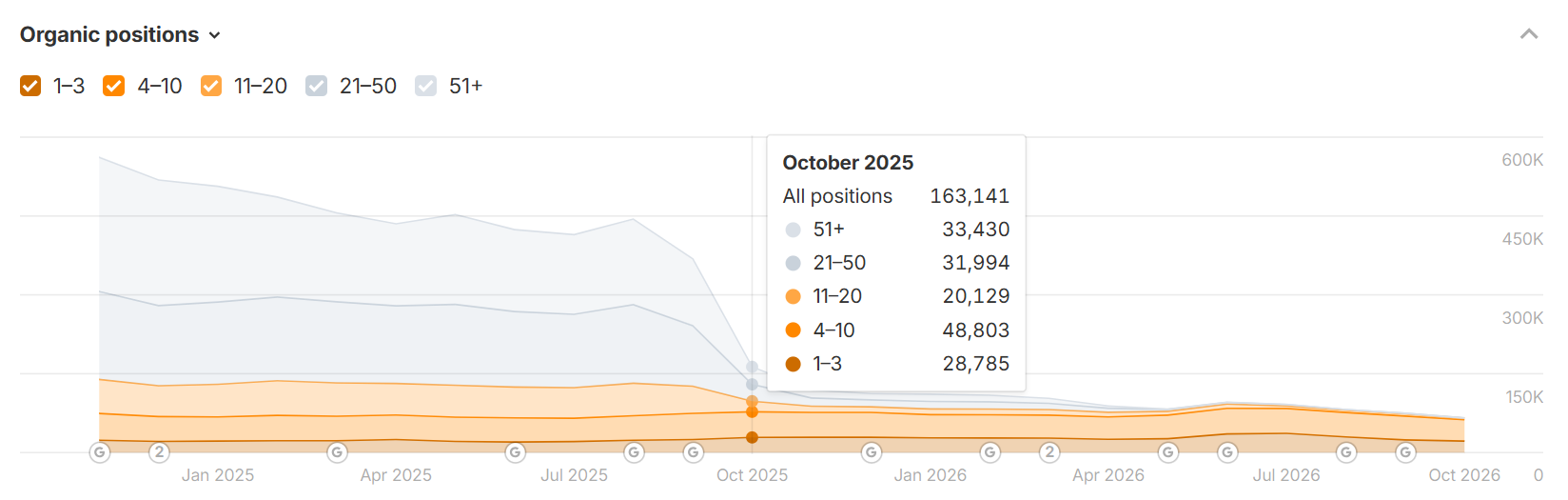
That points to the practical work involved which involves adapting the request and data pipeline, checking what depth is still available, and changing how results from multiple pages or suppliers are assembled. (Ahrefs' update on SERP monitoring)
The /goto change is a parsing problem as well as a collection problem, If a result points 1st to a Google passthrough URL (redirection to you and me), the tool/platform has to identify and resolve the destination before it can reliably report the ranking URL. DataForSEO says it added a resolver for Google's new URLs and reported that 99.99% of the organic SERPs returned through its API had direct destination URLs at the time of its update. That is DataForSEO's own reported coverage, not a figure we can apply to every provider. (DataForSEO's /goto update)
This ongoing adjustment is why “daily updates” should be read as a specific rank providers scheduled check frequency, not a guarantee that every keyword will always return a complete, identical SERP - something that rank trackers have had to contend with on top i.e. personalisation, localisation etc.
Changes to access or result markup can mean extra collection work, patchy depth, or delays while providers adapt - and it likely facilitates more cost which will eat into the margins of rank trackers.
In SEO campaigns, rank trackers obviously remain useful for specific keyword, location and competitor checks/tracking, for a site's own observed query performance, SEO Stack uses Search Console data and does not have to scrape Google's result pages to produce that position history.

Founder, SEO Stack
Daniel is the founder of SEO Stack. He has spent over 2 decades working on technical SEO and search data, and built SEO Stack after hitting the same Search Console limits on client work one time too many.
Daniel has extensive SEO experience having built SEO agencies, audit businesses & a thriving consultancy, in his spare time Daniel likes to run SEO experiments & to share findings.
Published 7 October 2026