Discovery & Opportunity
Reliable rank tracking, built on your own Search Console data
SEO Stack tracks your keyword rankings using the average positions Google recorded in Search Console rather than positions scraped from the search results, so you get reliable reporting all the way down to position 100, across every keyword your site ranks for rather than a limited set you had to choose in advance.
Built from
- 100% data privacy
- 99.99% uptime
- Nothing to configure
- Export anytime, no limits
Trusted by leading companies
The problem
Conventional rank trackers scrape Google and charge you per keyword, so you end up tracking a few hundred terms you picked yourself while the rest of your rankings go unmeasured, and the positions you do get are sampled from one location at one moment rather than measured across real searches.
The basics
What rank tracking is, and why it still matters
Rank tracking is simply the practice of monitoring where your pages appear in the search results for the keywords that matter to your business, and watching how those positions move over time. It is one of the oldest measurements in SEO and it is still one of the most useful, because position is the thing that sits directly upstream of everything else, if a page moves from position 14 to position 4 then impressions, clicks and revenue all follow it.
It matters for SEO because it is the earliest signal you get that something is working or that something has broken. Clicks and conversions are lagging indicators, they tell you about a change weeks after it happened, whereas a keyword slipping from page one to page two shows up almost immediately and gives you time to react while it is still cheap to fix.
It is also how most SEO work gets justified. Whether you are reporting to a client, a marketing director or a board, being able to show that a set of commercially important keywords has moved up is usually a far more convincing argument than a traffic chart that could be explained by seasonality, brand spend or anything else that happened that month.
Against conventional rank trackers
Why tracking Search Console keywords works better
Conventional rank trackers were built for a world where you had to go and fetch positions yourself. If you own the website, you no longer do, because Google is already recording all of it and handing it back to you.
| Consideration | Scraped rank trackers |  SEO Stack SEO Stack |
|---|---|---|
| How many keywords you can track | You pay per keyword, so you pick a few hundred in advance and everything else goes unmeasured. The keywords you did not think to add are invisible by definition. | Every keyword your site was returned for is already in your Search Console data, so there is nothing to choose in advance and nothing left out. |
| Where the position comes from | A crawler checks the search results from one location on a schedule and records where it found you at that moment. | The average position Google recorded across every real impression your site received, which is the same figure your performance is actually measured on. |
| Reliability | Scraping depends on being able to keep reading the search results, so coverage and depth are at the mercy of changes Google makes to how those results are served. | Nothing is scraped, so none of that applies. The data comes through the Search Console API and keeps working. |
| Long tail and zero volume keywords | Rarely tracked, because they are not in the provider's keyword database and nobody wants to spend tracking credits on terms with no reported volume. | Included automatically. A keyword with no reported search volume that still brings you customers is treated exactly the same as any other. |
| Which URL is ranking | Usually available, but only for the keywords you are paying to track. | Visible on every keyword, which is how URL switching and cannibalisation become obvious rather than something you go hunting for. |
| Depth | Deep positions cost more to track and are checked less often, so the bottom of the range is where coverage thins out first. | Reliable reporting all the way down to position 100, on every keyword, at no extra cost. |
The two measure slightly different things and it is worth being clear about that. A scraped tool gives you a position at a moment in time from one location, whereas Search Console gives you the average position across all of the real searches that actually happened. For measuring your own website, the second is the one that matches how your performance is judged.
Inside the tool
Tracked keywords, movement, and the story behind each one
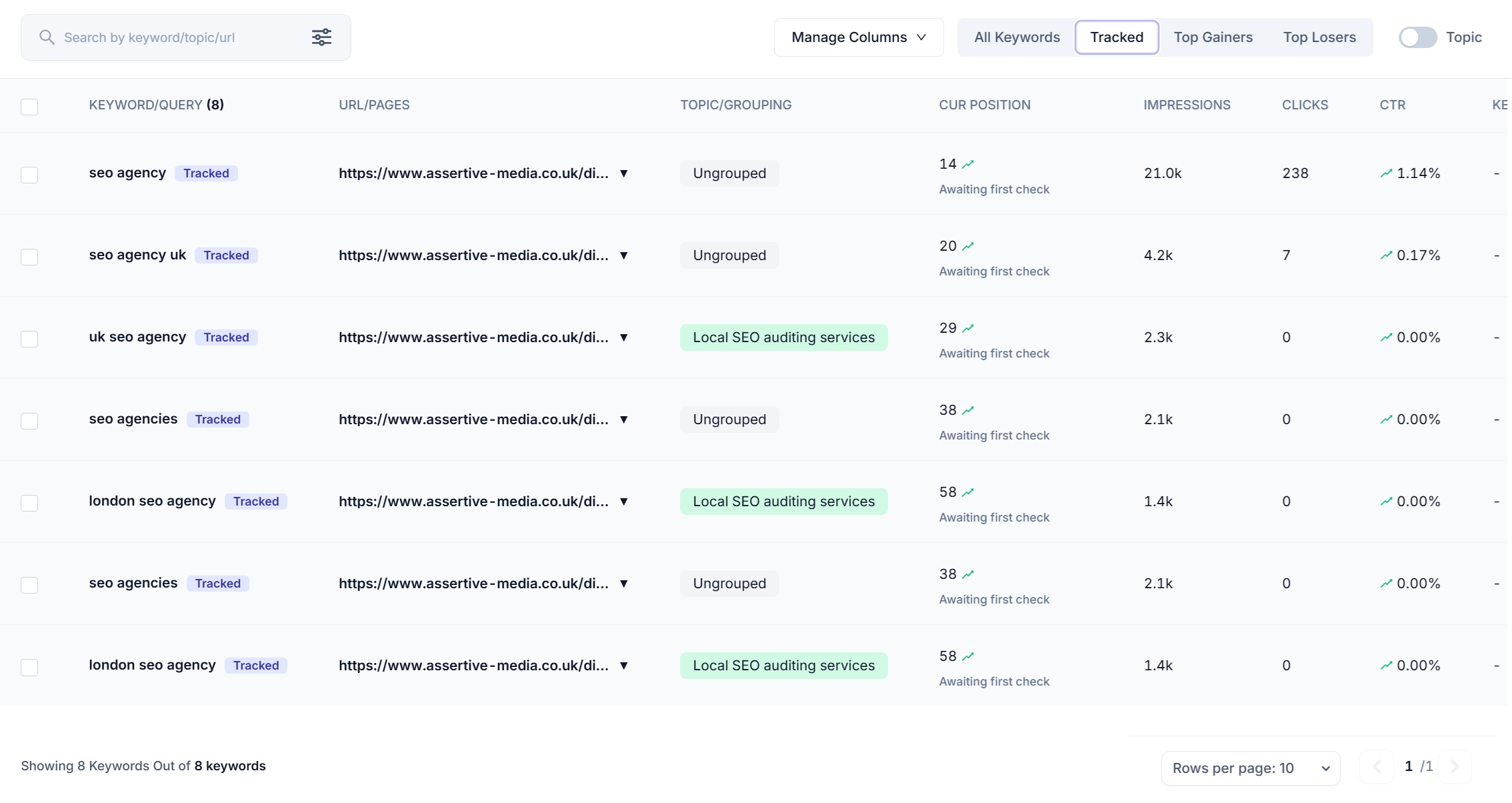
Track the keywords that matter commercially
- Set up specific keywords and keyword groups for tracking, so the terms the business actually cares about are monitored properly
- Current position, impressions, clicks and CTR on every tracked keyword
- The URL Google is returning shown against each one
- Group by topic or your own group names so reporting is organised the way you talk about the site
- Everything else keeps being recorded in the background, so an untracked keyword is never lost data
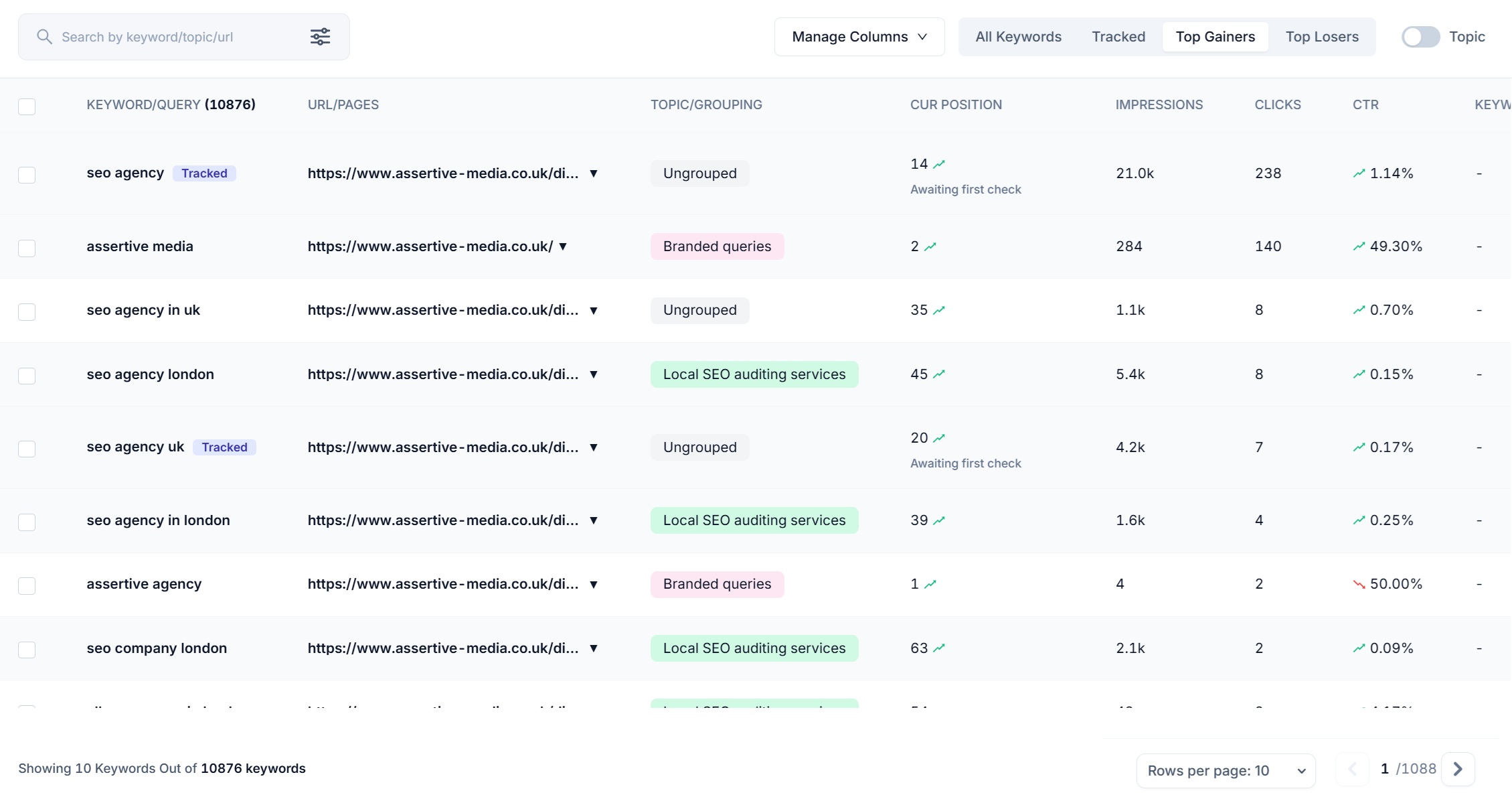
See which keywords are climbing
- Top gainers within whatever timeframe you have set, ranked by how far they have moved
- Position change shown alongside impressions, clicks and CTR, so you can see whether a better position is actually converting into traffic
- Useful for working out which of your recent changes did something, and which did not
- Often the fastest way to find a page worth investing more in, because momentum is already there
Catch the keywords slipping away
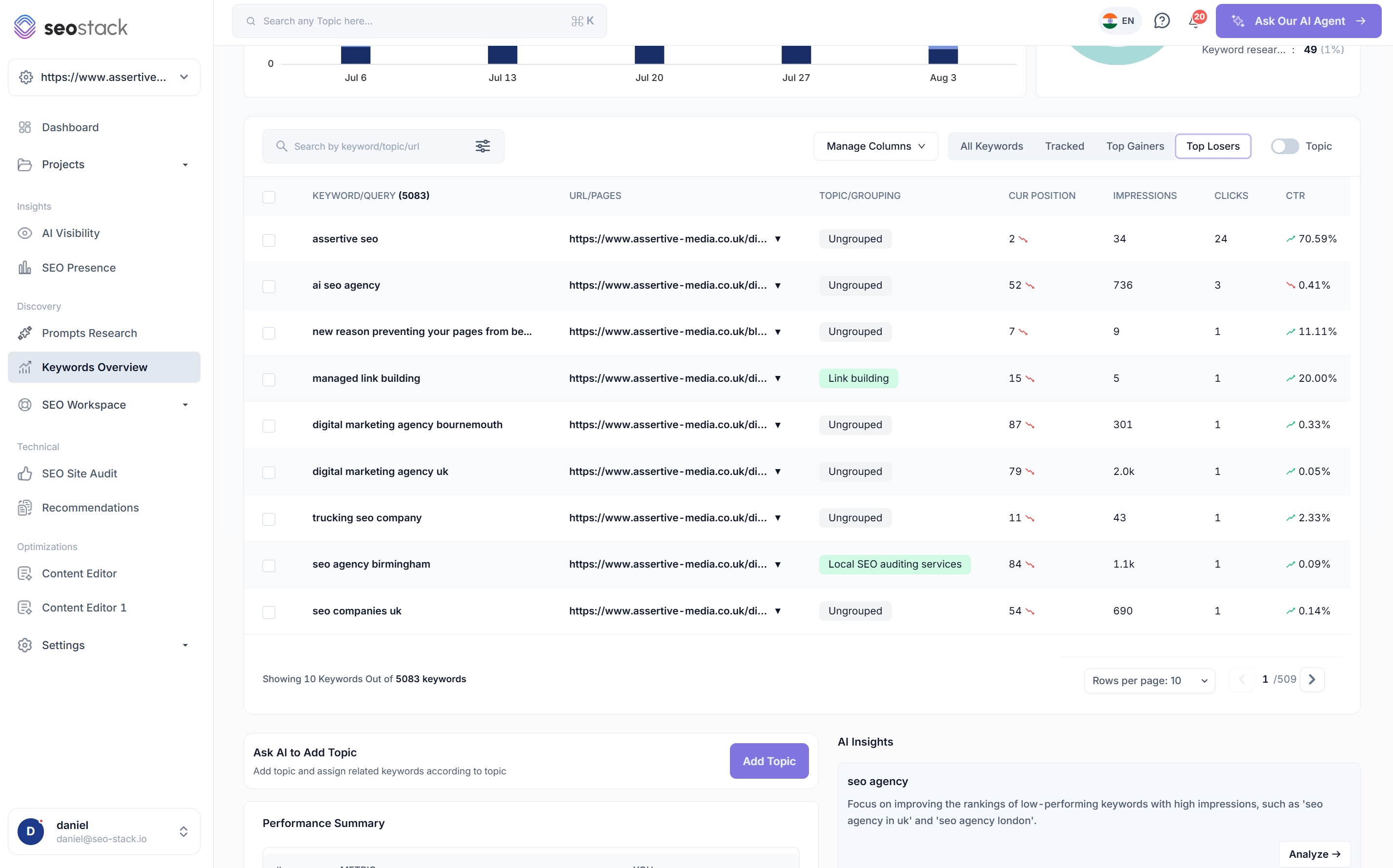
- Top losers ranked by how far they have dropped, so you start with whatever is costing you the most
- Because the ranking URL is shown, you can see when Google has started returning a different page for a keyword
- URL switching is very often the real cause of a ranking drop, and it is almost impossible to spot without this
- Where several of your own pages are being returned for the same term, you are looking at cannibalisation rather than a ranking problem
A drop is not always a ranking problem
If Google has swapped which of your pages it returns for a keyword, the position can fall without anything about your SEO getting worse. Fixing that is a different job to trying to rank the original page harder.
Position over time on any single keyword
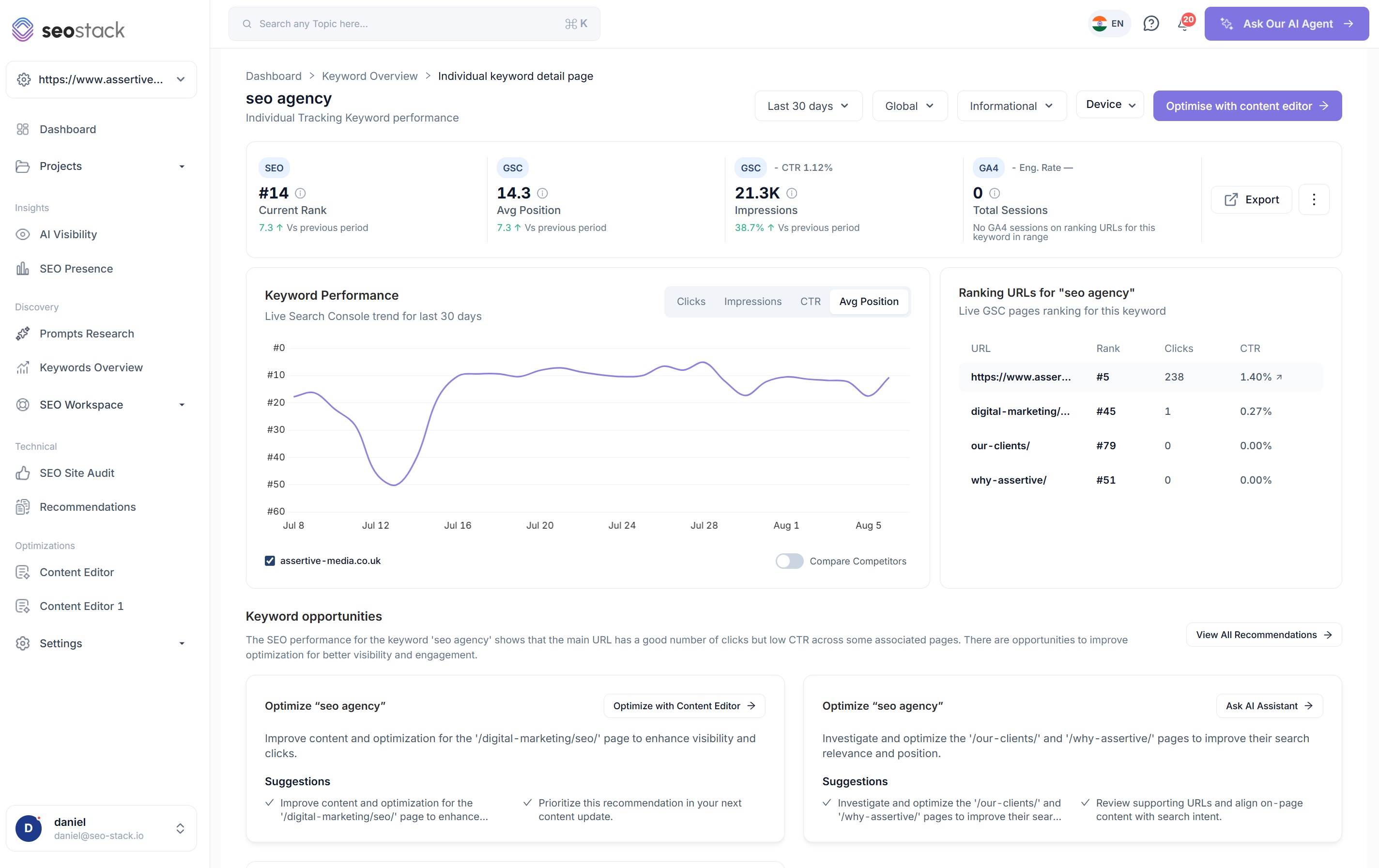
- A performance chart you can switch between clicks, impressions, CTR and average position
- Every URL Google is returning for that keyword, with the rank, clicks and CTR of each
- Current rank and average position against the previous period
- Compare competitors on the same keyword
- Written opportunities on what to change to improve it
Long tail & zero volume
Every keyword you rank for, including the ones nobody tracks
A conventional rank tracker only knows about keywords that exist in its own database and only tracks the ones you have paid for, which means the long tail is almost never measured. That is a problem, because on most websites the long tail is where a very large share of the total clicks actually comes from, and it is usually the part that converts best.
Because SEO Stack reads your Search Console data, every one of those queries is already there. Keywords with no reported search volume, phrases nobody would ever have thought to add, and the very specific questions that turn into customers are all tracked the same way as your head terms, without you having to find them first.
Filtering
Filter rankings down to the segment you are reporting on
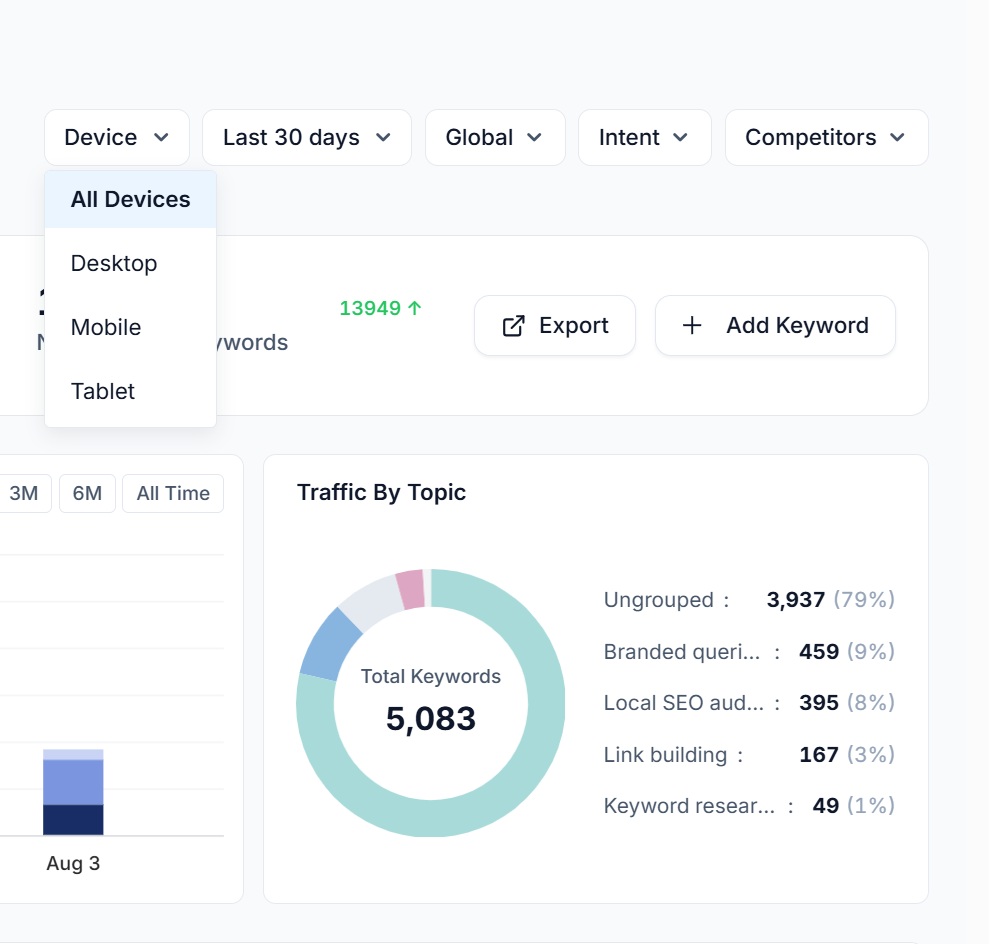
Device
Desktop, mobile and tablet tracked separately, because a keyword sitting at position 6 on desktop and 18 on mobile is really two different problems and a blended figure hides both.
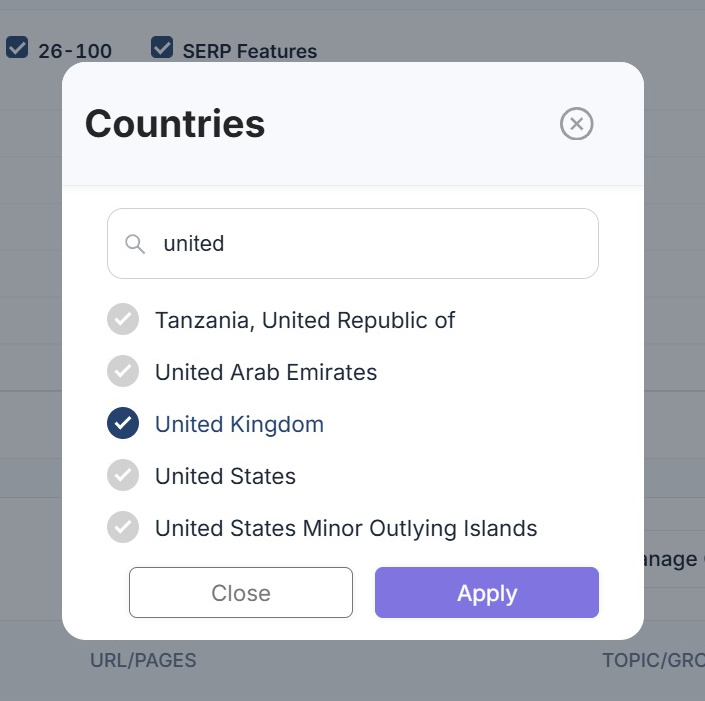
Country
Filter globally or down to a single country, so an international site is assessed market by market rather than as one average that describes nobody in particular.
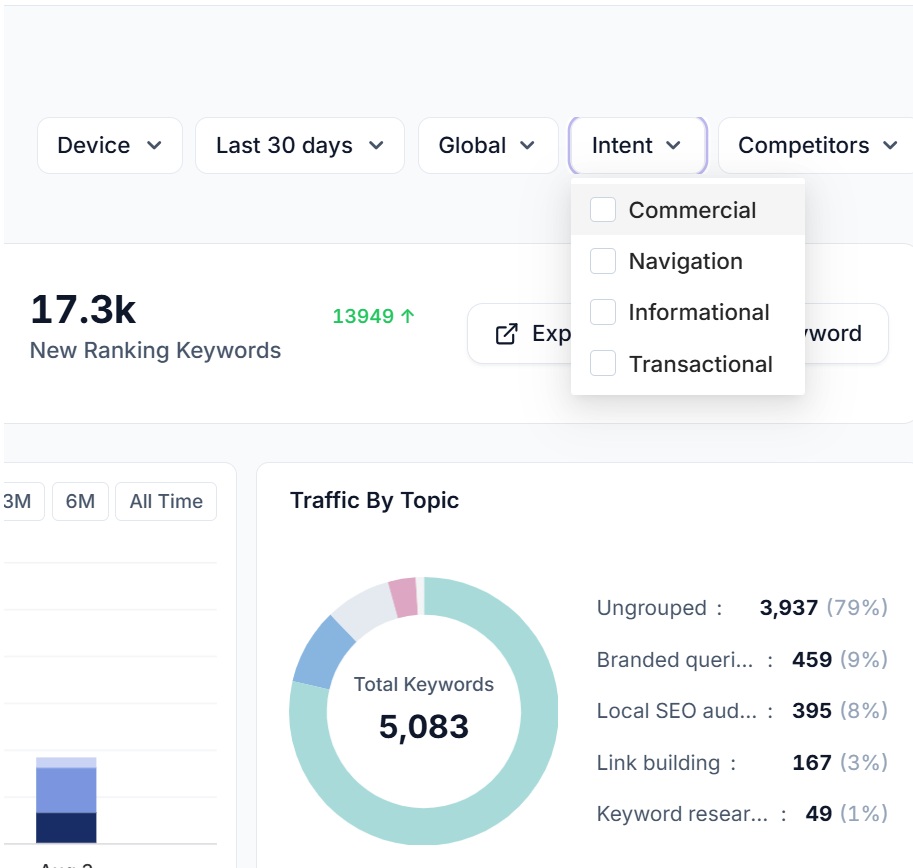
Intent
Separate informational keywords from commercial and transactional ones, so you can report on the rankings that lead to revenue rather than the ones that simply bring in readers.
Client reporting
How SEOs actually use this day to day
Rankings clients cannot argue with
Because the positions come from the client's own Search Console property, nobody can dismiss them as a third party estimate or claim the tool is checking from the wrong location. It removes an entire category of unproductive conversation from a reporting call.
Group keywords the way you report
Build keyword groups and topics that match how you actually talk about the account, whether that is by service line, by location or by campaign, then report movement group by group.
Show trajectory, not a snapshot
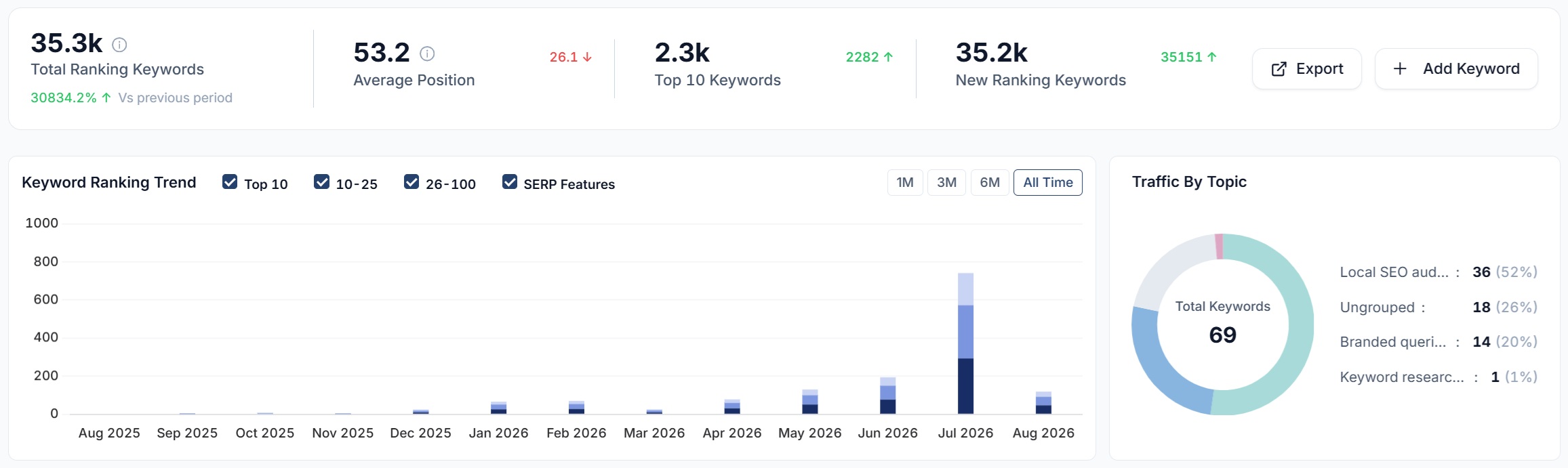
Position distribution over time shows a client that keywords are moving up through the bands even in months where the traffic figure was flat, which is usually the honest story of what is happening.
Explain drops properly
When something falls, being able to show that Google switched which page it returns turns an awkward conversation into a specific, fixable problem.
Why SEO Stack
What you get here that a standalone rank tracker will not give you
First party data
Positions come from Google rather than from a crawler, so there is no sampling, no location guesswork and nothing to explain away.
No per keyword pricing
You are not choosing which keywords deserve a tracking credit, because every keyword you rank for is already included.
Down to position 100
Deep positions are reported reliably rather than being the first thing to degrade, which matters when you are trying to move something from page four to page two.
It sits with everything else
Rankings live in the same platform as your warehoused Search Console data, GA4, AI visibility and content tooling, so you are not reconciling a rank tracker against everything else you use.
What you get out of it
The outcome, not the feature list
Track every keyword you rank for rather than the few hundred you could afford to
Spot cannibalisation and URL switching by seeing which page is being returned
Report rankings from first party data that nobody can dismiss as an estimate
Connect a property. Watch the data start stacking.
Warehousing begins the moment you connect your Search Console property, there is no Google Cloud project to set up, no BigQuery and no schema to design. You simply connect your property and SEO Stack starts storing every row of your data from that day onwards.
- Credit card required
- Cancel within the trial and you won't be billed
- No contracts