Content & Optimisation
New in V3An editor that writes against your own Search Console data
Choose a URL and a target keyword, set the search intent, the tone of voice and the reading level, and the editor drafts and optimises the page using your connected Search Console and GA4 data alongside its own content analysis. You get a live content score, a quality breakdown for structure, readability and discoverability, actionable AI insights, and an estimate of what the optimisation is worth before you publish it.
- 100% data privacy
- 99.99% uptime
- Nothing to configure
- Export anytime, no limits
Trusted by leading companies
The problem
Insight and action normally live in different tools, so a recommendation gets written down in one place, the page gets rewritten in another, and nobody can say afterwards whether the two were related.
The tool
Write and optimise in the same place as the data
The Content Editor sits inside the platform rather than beside it, so the page you are editing arrives with its own performance history attached. You pick the URL and the keyword, set how it should be written, and work on the draft with a live score and a set of specific suggestions down the right hand side.
You set the brief, it writes to it
Target keyword, search intent, tone of voice and reading level are all choices you make before a word is drafted, so the same keyword produces a genuinely different page depending on who is meant to be reading it and what they were after when they searched.
Working from your data, not a blank page
Search Console tells it what the page is already being served for, GA4 tells it what people do when they arrive, and the content analysis tells it what the ranking pages cover, so the draft starts from evidence rather than from a prompt.
Scored while you write
The content score, the structure, readability and discoverability breakdown and the AI insights all update as you work, so you can see whether an edit improved anything instead of publishing and waiting a fortnight to find out.
Optimisation settings
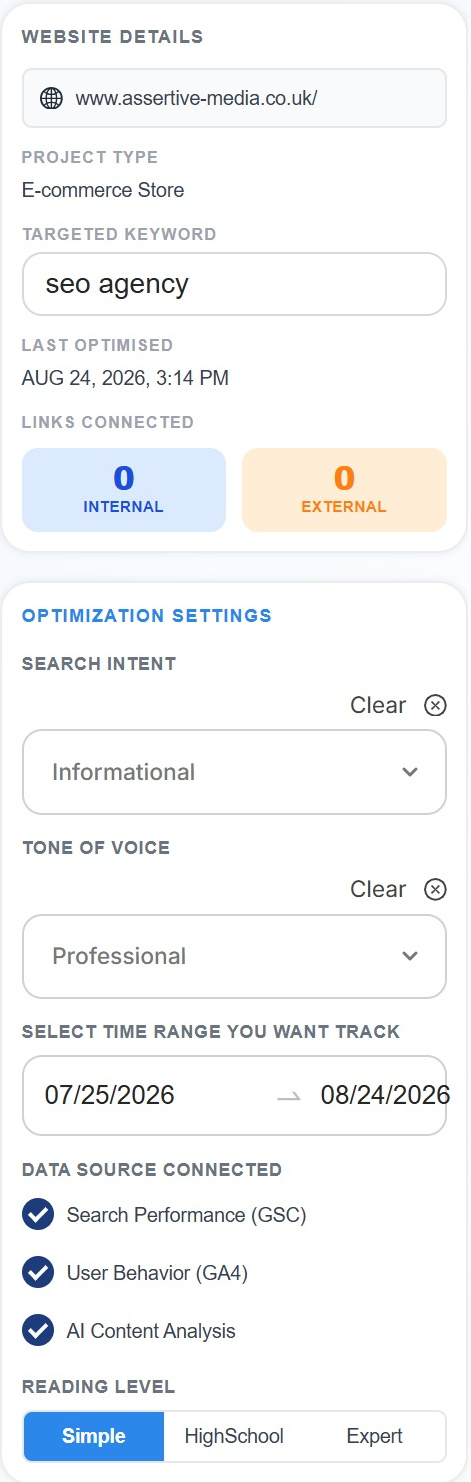
Targeted keyword: seo agency
Search intent
Tone of voice
Reading level
Data sources connected
- Search Performance (GSC)The queries this page already earns
- User Behaviour (GA4)What people do once they land on it
- AI Content AnalysisCoverage against the pages that rank
What does an SEO agency actually do?
SEO agency services for UK businesses
Hire an SEO agency: pricing, process and next steps
An SEO agency helps your website show up in Google when people search for what you sell. We look at what your customers are searching for, fix the things holding your site back, and write the content that answers those searches properly.
Put simply, an SEO agency gets your website in front of people who are already looking for what you do. We find out what they are typing into Google, sort out whatever is getting in the way, and write pages that actually answer them.
An SEO agency is responsible for one thing: making sure your website appears when people search for what you sell. That means understanding the searches, removing the technical barriers, and publishing content that answers those searches better than anyone else does.
An SEO agency improves how visible your website is in organic search results. The work usually covers three areas, technical health so search engines can crawl and index your pages properly, content that matches what people are actually searching for, and the authority signals that make a search engine treat your site as credible.
An SEO agency is there to get you found in Google without paying for the click. In practice that comes down to three things, making sure your site can be crawled and indexed properly, writing content that matches what people search for, and building the kind of credibility that makes Google trust you.
An SEO agency exists to improve organic visibility, and the work divides cleanly into three areas. Technical health determines whether your pages can be crawled and indexed at all, content determines whether they deserve to be served, and authority determines whether they are trusted enough to be ranked above the alternatives.
An SEO agency operates across crawl and index management, entity and topical coverage, and off-site authority acquisition. Engagements typically begin with a technical baseline, log file and Search Console analysis, and a coverage audit against the ranking set, from which a prioritised roadmap of template, content and link interventions is derived.
In practice an SEO agency spends its time on three fronts: making sure Google can crawl and index what you have, closing the entity and topic gaps between your pages and the ones already ranking, and earning the off-site signals that decide who wins when two pages are otherwise equal. Most engagements start with a technical baseline and a coverage audit.
SEO agency work resolves to three interdependent disciplines: crawl and index management, entity and topical coverage against the ranking set, and off-site authority acquisition. Any serious engagement begins with a technical baseline, Search Console and log file analysis, and a coverage audit, because a roadmap built without those is a list of assumptions.
The intent setting is doing the most work here, because somebody typing this wants to understand the subject before they decide anything, so the draft opens by explaining it rather than by selling.
Illustrative draft. Change the intent, the tone or the reading level and the same keyword produces a different page.
The settings
Six choices that decide what gets written
Most AI writing tools give you a prompt box and hope for the best. The settings here exist because the same keyword genuinely needs a different page depending on the intent behind it, the audience reading it and the voice the brand uses.
The URL
Choose from your top-ranking URLs, which is the quickest way to find something worth working on, or paste any page on the site if you already know which one you are here for.
The target keyword
What the page is being optimised toward. Because the editor is reading your Search Console data it already knows what the page earns clicks and impressions for, which is usually a better starting point than the keyword somebody originally intended.
Search intent
Informational, commercial, transactional or navigational. The single most important setting on the panel, because a page written for the wrong intent will not rank however well it is written.
Tone of voice
Professional, conversational, authoritative and so on, so the draft sounds like your brand rather than like everybody else's AI output.
Reading level
Simple, high school or expert. Worth matching to the audience rather than always reaching for the most technical option, because a page pitched over the reader's head performs exactly as badly as one pitched under it.
Data sources and time range
Search Performance from GSC, User Behaviour from GA4 and AI Content Analysis, each switchable, across whatever date range you want the optimisation judged against.
Content analytics
A score, the three things behind it, and what to do next
Down the right hand side of the editor is a live read on the draft: an overall content score, the quality breakdown that produces it, and a set of specific insights drawn from your own performance data rather than from general advice about writing.
Content analytics
Optimised
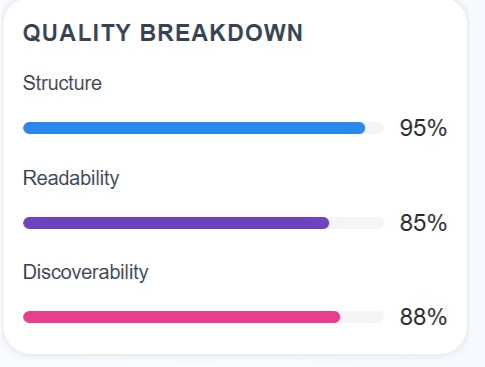
Quality breakdown
- Structure95%
- Readability85%
- Discoverability88%
Estimated impact
- Ranking
- 7.0
- CTR
- 6.0%
- AI visibility
- 88.0%
Traffic +27CTR +150.0%modelled against the current page
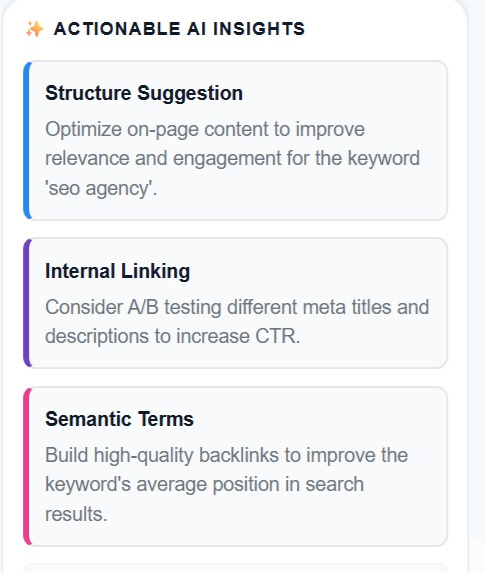
Actionable AI insights
Structure suggestion
Optimise the on-page content to improve relevance and engagement for the keyword 'seo agency'.
Internal linking
Consider A/B testing different meta titles and descriptions to increase click-through rate.
Semantic terms
The click-through rate for 'seo agency' is relatively low at 0.76% against 23,715 impressions, and an average position of 8.51 means you are already on page one.
Illustrative. Switch version to see the difference the optimisation pass makes to the score, the breakdown and the estimates.
The quality breakdown
Three scores, because they fail independently
A single content score is convenient but it hides which part of the page is the problem, so the breakdown separates the three, and it is very common for a page to score well on two of them and badly on the third.
Structure
Whether the page is built in a way a search engine can parse and a reader can scan: a single clear H1, a logical heading hierarchy, sections that each cover one thing, and lists where a list is genuinely the right format. Structure is also what makes a page quotable, because a well built section can be lifted into a featured snippet or an AI answer on its own.
Readability
How much effort the copy takes to get through, judged against the reading level you set rather than against a single target. This is the score people are most tempted to ignore and it is closely tied to whether somebody stays on the page long enough to convert.
Discoverability
How findable the page is for the thing it is meant to be found for: the target keyword and its variants in the places that count, the related entities a search engine expects to see, and enough coverage of the subject that the page is a complete answer rather than a partial one.
Inside the tool
From the flagged keyword to the published page
A real editor, not a text box with a copy button
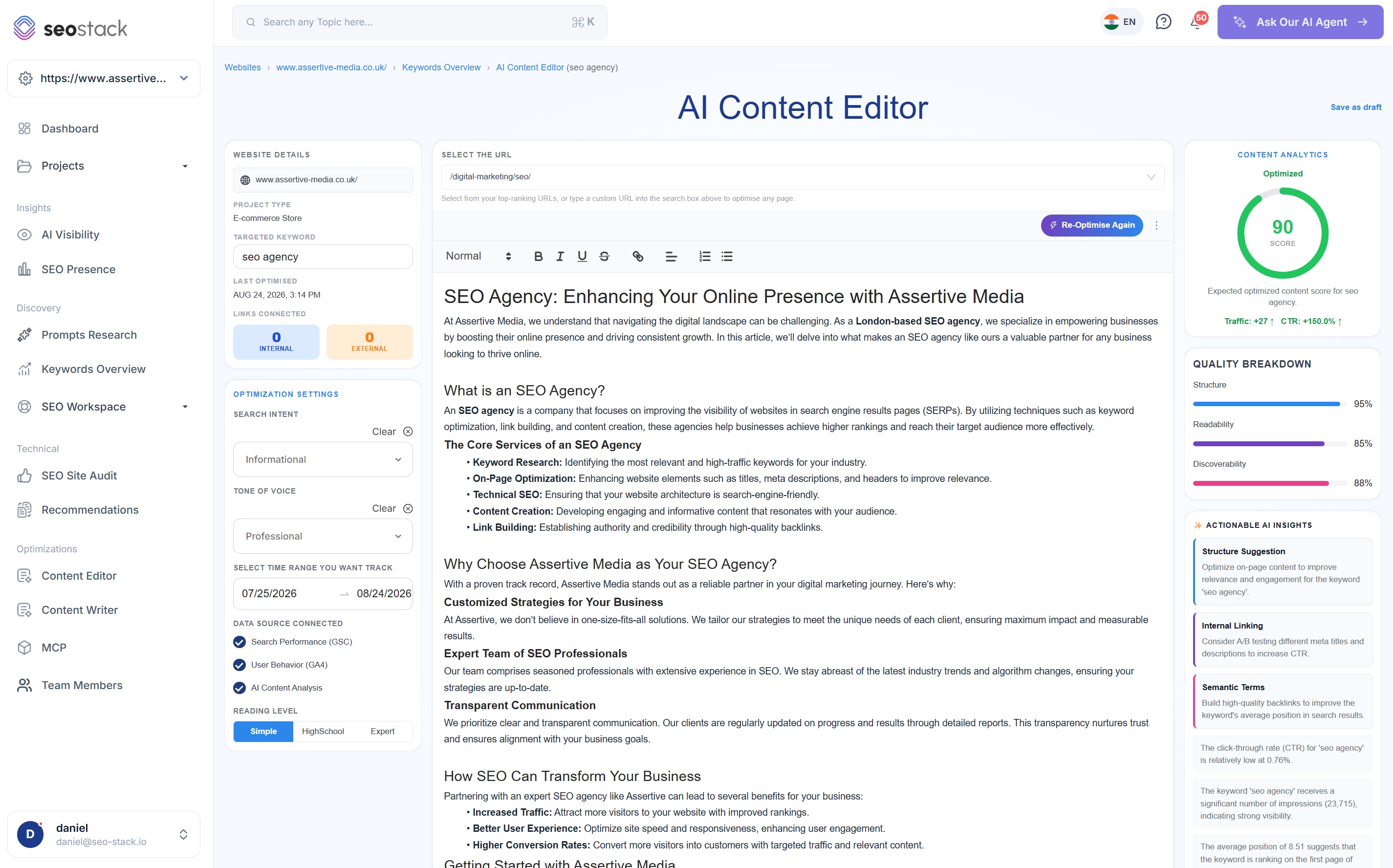
- Full rich text editing with headings, bold, italic, underline, strikethrough, links, alignment and lists
- Select the URL from your top-ranking pages or paste a custom one
- Re-optimise the whole draft at any point without starting again
- Save as draft, so a page can be worked on across more than one sitting
- The website details, the last optimised date and the connected link counts stay visible while you write
The draft is a starting point
It is an editor rather than a generator for a reason. The output is meant to be worked on, and the score updating as you work is what makes that worth doing.
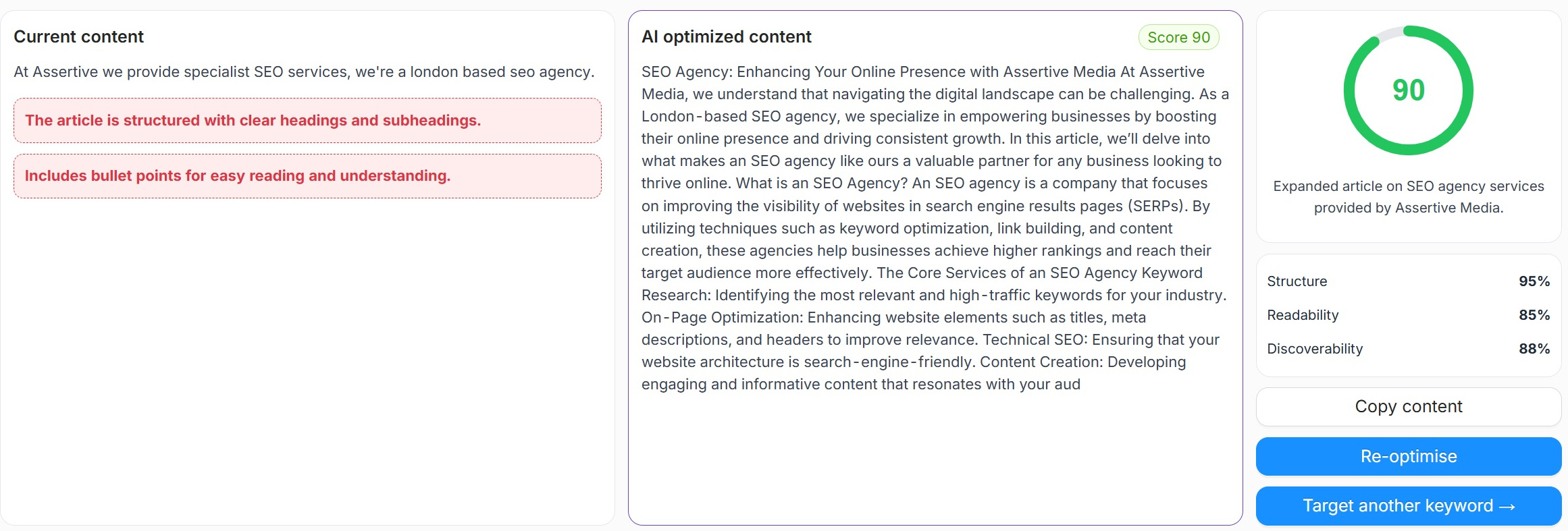
Your current content against the optimised version
- Both versions side by side, with the score against the optimised one
- Problems with the current content flagged inline, i.e. no clear headings, no bullet points
- Estimated ranking, estimated CTR and an AI visibility score for the change
- The data sources the estimate was built from named on the panel
- Copy the content out, re-optimise it again, or target another keyword entirely
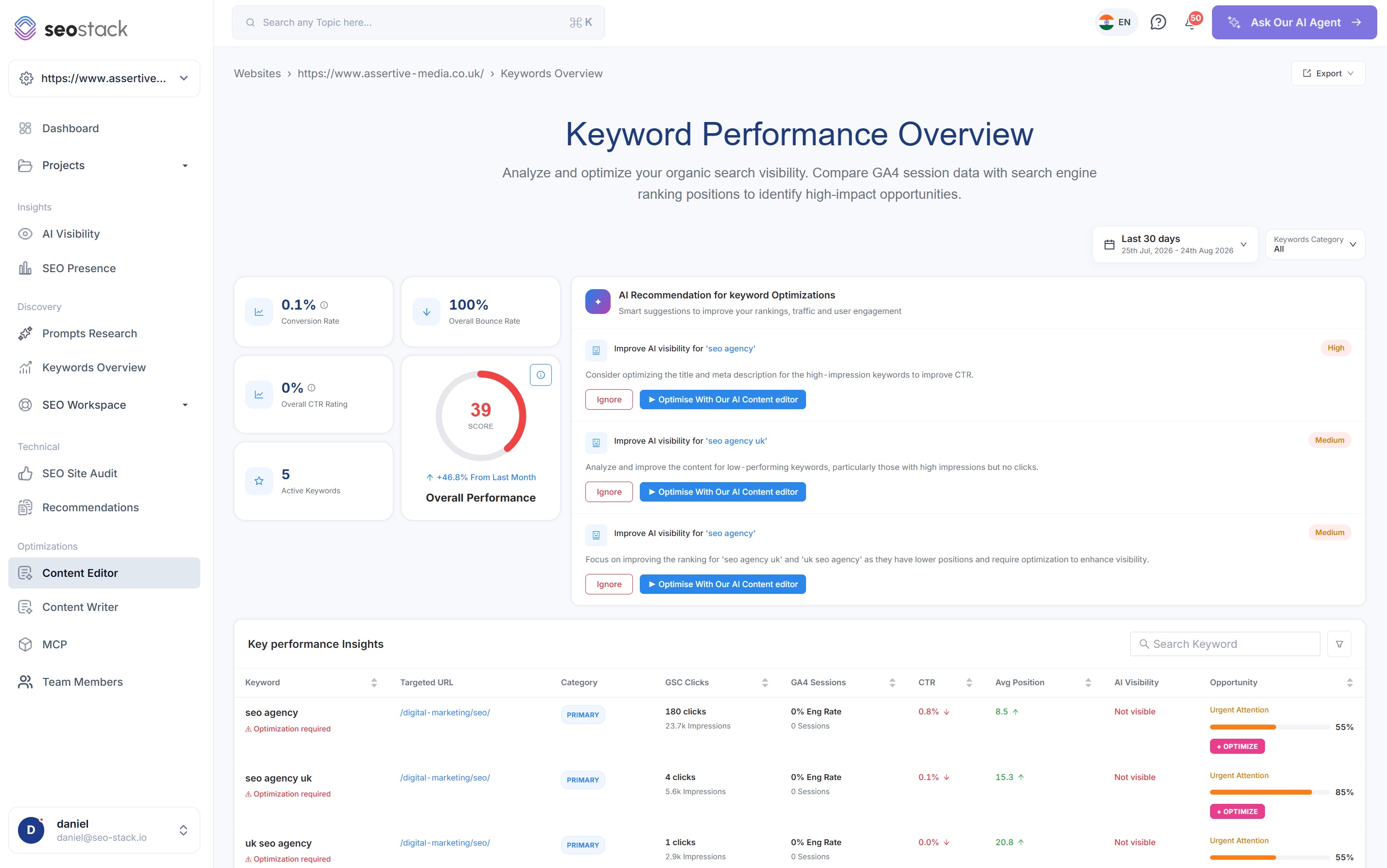
The keyword that needs the work finds you
- A keyword performance overview with conversion rate, bounce rate, CTR rating and an overall performance score
- GSC clicks against GA4 sessions for each keyword, with CTR, average position and AI visibility
- An opportunity score per keyword, flagging the ones needing urgent attention
- AI recommendations with an Optimise With Our AI Content Editor button on each
- Ignore anything that does not apply so the list stays useful
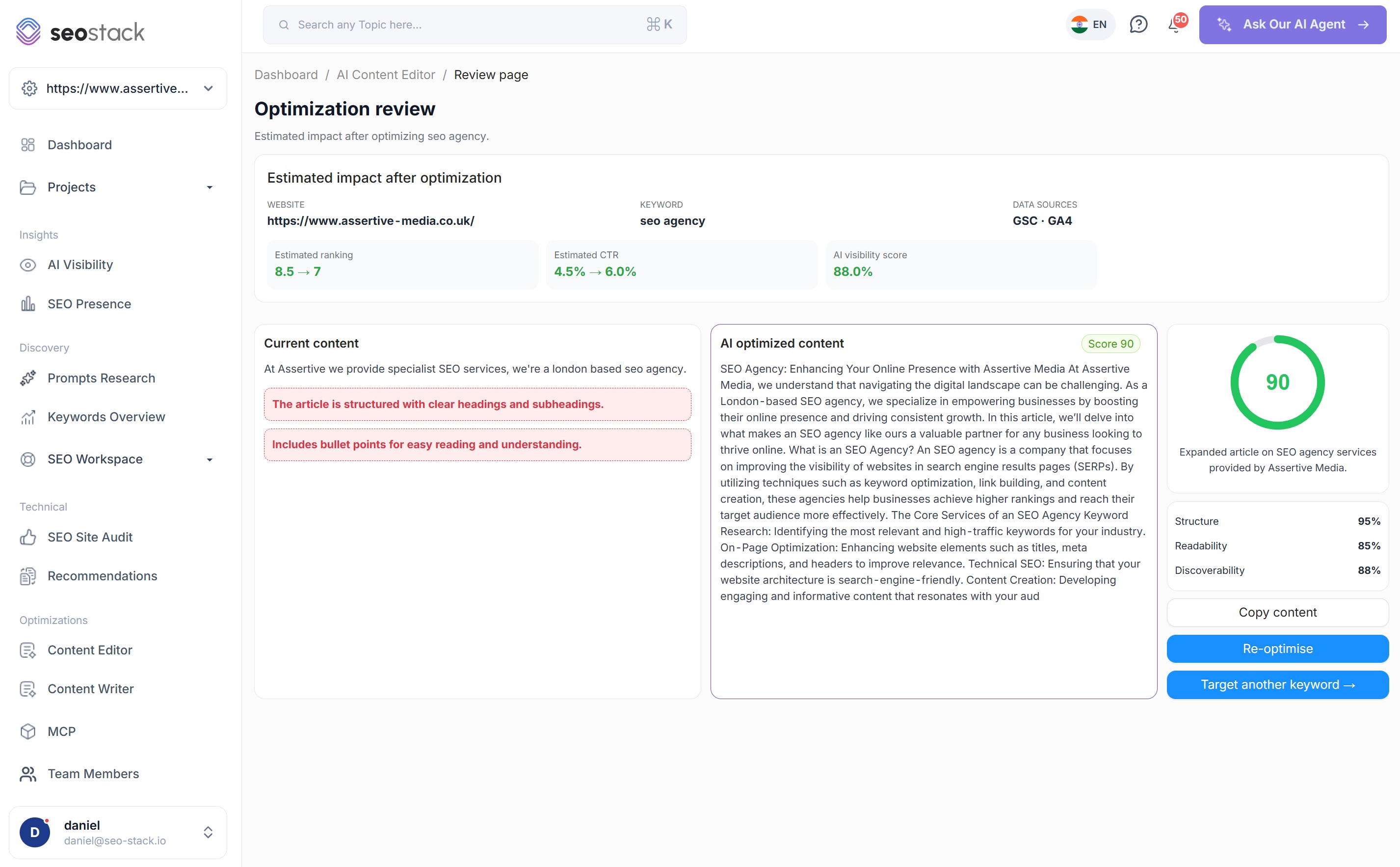
Before you publish
An estimate of what the change is worth
Rewriting a page costs time, and the honest answer to whether it was worth it usually arrives weeks later, so the review page puts a figure against it beforehand using the position and click-through rate the page already has.

Worth being clear about
An estimated ranking of 8.5 moving to 7 is a model, not a promise. It is built from where the page currently sits, the click-through rate its positions should be earning and how much the optimisation improves the coverage, and it is useful for deciding which of five pages to work on rather than for forecasting a number. Naturally the accuracy varies a great deal depending on how competitive the query is and how much history the page has.
Why this helps performance
What the scores are actually proxies for
Structure, readability and discoverability are not arbitrary categories, each one maps onto something that changes whether a page ranks, whether it earns the click and whether anybody does anything once they arrive.
Intent is what decides whether ranking is possible
Google has already established what kind of page each query wants, so a sales page written for an informational query is competing in a format the results have rejected. Setting the intent before the draft exists is the cheapest way there is to avoid writing something that was never going to rank.
Structure is what makes a page quotable
Clear headings and self-contained sections are how a page ends up in a featured snippet or gets summarised into an AI answer, because both of those need a passage that stands on its own. Structure has become one of the highest leverage things on the page, and most people are still treating it as formatting.
Discoverability is coverage, not keyword density
The score is measuring whether the entities and subtopics a search engine expects for this subject are present, which is the same thing the NLP tools measure in more detail. Pages fail this far more often than they fail on keywords, and it is usually why a well written page never moves.
Better copy changes the click-through rate
A page sitting at position eight with a click-through rate of 0.76% is losing most of its opportunity in the results rather than on the page, and rewriting the title, the opening and the value proposition moves that number without moving the ranking at all.
Readability is a conversion lever
Matching the reading level to the audience is not a stylistic preference, it decides whether somebody stays long enough to do anything. That behaviour feeds back into how the page performs rather than sitting harmlessly in your analytics.
The same work improves AI visibility
Models retrieve and summarise, and the pages they can summarise confidently are the ones that are clearly structured, unambiguous about their subject and complete. Optimising for a search engine and optimising to be cited have converged much more than people expect.
The loop
From a problem you can see to a change you can measure
The reason content work so often stalls is that the finding, the fixing and the measuring live in three separate places, and by the time anybody checks whether the rewrite helped, four other things have changed.
Start from a flagged keyword
The keyword overview surfaces the terms needing urgent attention with an opportunity score against each, so the page you work on is chosen by the data rather than by whichever one somebody mentioned in a meeting.
Set the brief, then draft
Intent, tone and reading level first, then let it draft against your Search Console and GA4 data, then edit it into something you would actually publish.
Work the score up
Structure, readability and discoverability move independently, so it is obvious which part of the page still needs attention rather than which part somebody thinks needs attention.
Publish, then measure it properly
Annotate the change, then watch the served query volume and the clicks on that URL. The estimate told you what it might be worth, the data tells you what it was.
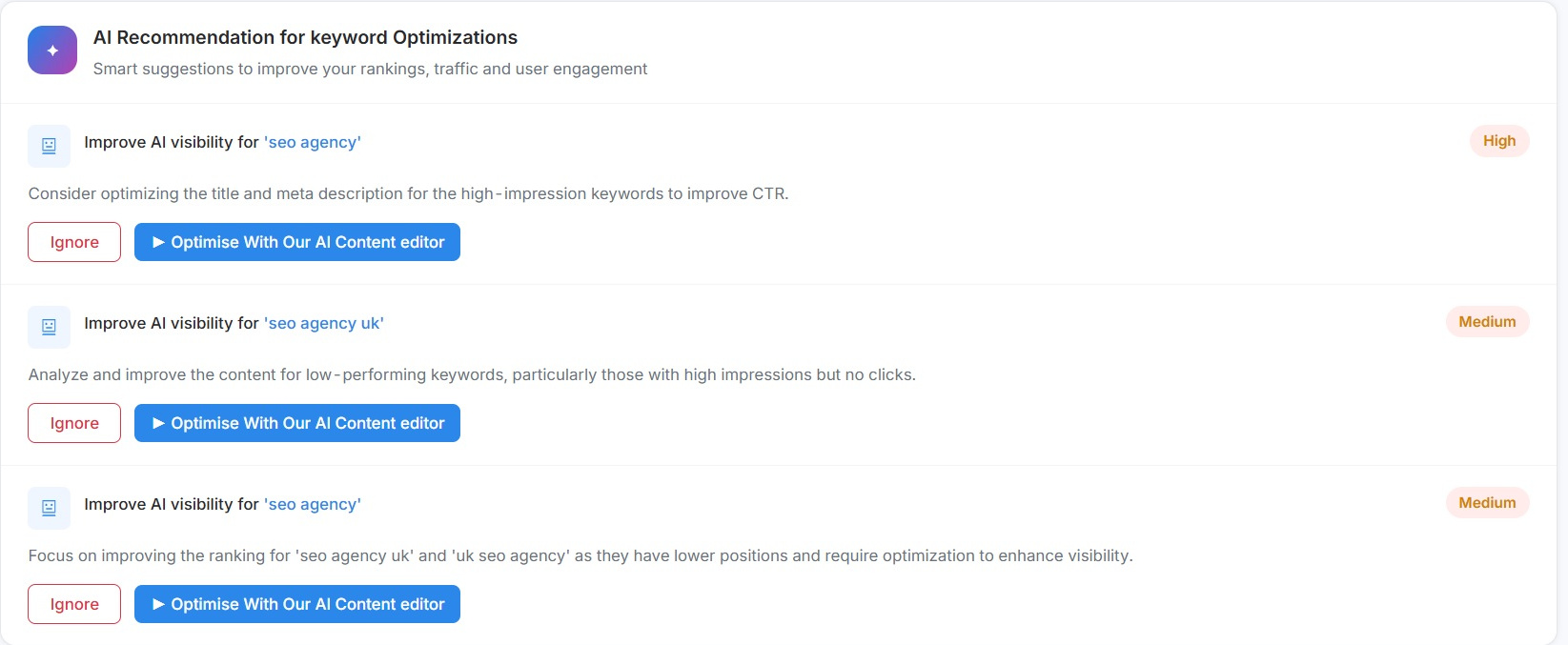
One button between the finding and the fix
Each AI recommendation on the keyword overview carries an Optimise With Our AI Content Editor button, which opens the editor already pointed at the right URL and the right keyword. So the gap that usually swallows content work, the one between somebody noticing a page is underperforming and somebody actually opening it, is a single click rather than a ticket.
More on recommendationsHow SEOs use it
What the Content Editor is actually good for
Rescue a page stuck on page one
A page at position eight with a poor click-through rate does not need more content, it needs a better title, opening and value proposition, and the editor scores exactly those.
Refresh old content at pace
Pull the URL, let it draft against the current ranking set, then edit. Refreshing twenty posts becomes a realistic week rather than a project nobody starts.
Get a first draft that is not generic
Because the intent, tone and reading level are set before anything is written, and the data behind it is your own, the draft does not read like every other AI page on the subject.
Give a client a before and after
The review page puts the current content next to the optimised version with the problems flagged, which makes the case for the work far better than describing it does.
Fix the internal linking while you are there
The insights panel raises internal linking and semantic terms alongside the structural suggestions, so the page gets connected properly rather than just rewritten.
Take it further with the AI assistant
The editor handles the page, and the assistant is reading the same warehoused data underneath, so you can ask it why a page is behaving the way it is before deciding how to rewrite it.
What you get out of it
The outcome, not the feature list
Close the gap between finding a content problem and fixing it
Write for the intent behind the query rather than for the keyword
Know roughly what an optimisation is worth before spending the afternoon on it
Connect a property. Watch the data start stacking.
Warehousing begins the moment you connect your Search Console property, there is no Google Cloud project to set up, no BigQuery and no schema to design. You simply connect your property and SEO Stack starts storing every row of your data from that day onwards.
- Credit card required
- Cancel within the trial and you won't be billed
- No contracts