AI & LLM Visibility
New in V3Know whether AI answers are citing you or your competitors
Tracks your brand's visibility across LLM platforms: visibility score, consistency, brand mentions, citations, share of voice and sentiment, all benchmarked against the competitors you choose.
- 100% data privacy
- 99.99% uptime
- Nothing to configure
- Export anytime, no limits
Trusted by leading companies
Why AI visibility is important now
AI Searches are increasing quickly, is your brand appearing for relevant search queries & prompts across Claude, chatGPT, Google Gemini, Grok, Perplexity?
Research shows that whilst channels such as SEO (organic) and PPC (paid) are still core drivers of traffic & conversions, AI & LLM (large language model) searches are increasing rapidly. SEO Stack allows you to quickly and effectively see how your brand performs across different AI platforms from Claude to chatGPT. It's quick and easy to get started & to see how your brand stacks up against the competition.
900M+
Weekly ChatGPT users
More than 900 million people use ChatGPT each week, according to OpenAI’s February 2026 announcement.
OpenAI · February 2026
1B+
Monthly Gemini users
Google’s Gemini app passed one billion monthly users in August 2026, becoming the fastest-growing product in Google’s history.
Google · August 2026
1B+
Monthly Google AI Mode users
AI Mode surpassed one billion monthly users within a year of launch, with queries more than doubling every quarter.
Google · May 2026
+349%
Claude app audience growth
Claude’s US monthly active app users grew 349% year on year in Similarweb’s 2026 analysis.
Similarweb data, reported by TNW · July 2026
+117%
Grok app audience growth
Grok’s US monthly active app users more than doubled year on year, according to Similarweb’s 2026 analysis.
Similarweb data, reported by TNW · July 2026
+94%
Perplexity app audience growth
Perplexity’s US monthly active app users nearly doubled year on year in Similarweb’s 2026 analysis.
Similarweb data, reported by TNW · July 2026
9.5B
Monthly visits to AI platforms
Generative AI websites averaged 9.5 billion monthly visits worldwide from June 2025 to May 2026, up 70% year on year.
Similarweb · 2026 analysis
4×+
Growth in ChatGPT citation frequency
The share of US ChatGPT prompts whose answers included citations rose from around 1.6% to 6.8% between June 2025 and May 2026.
Similarweb · 2026 analysis
60% higher
Conversion from AI-referred retail visits
Visitors arriving from AI sources converted at a 60% higher rate than non-AI traffic across Adobe’s US retail data in July 2026.
Adobe · August 2026 report, page 8
Track Brand Visibility EffortlesslyAcross AI Search
Find and research prompts, track what your brand gets cited for across core LLMS including chatGPT, Gemini, Grok & more. It’s quick and easy to run an analysis, sign up & get started in minutes.
Tracking AI visibility
Tracking AI Visibility needn’t be complicated, with SEO Stack we combine multiple tracking & analytics solutions under one roof. Rather than navigating across multiple SEO & AI Visibility / Analytics tools, SEO Stack lets you track AI Visibility alongside your Google Search Console and Google Analytics data. We allow digital marketers and brands to know where they appear across organic search, AI search and paid search.
A buying question, asked in plain English, answered with a shortlist. If your brand is not on it, nothing in your analytics will ever tell you the conversation happened.
A few Las Vegas resorts work particularly well for families:
- 1.Circus Circus Indoor theme park and free circus acts, the most openly kid-focused resort on the Strip.
- 2.Excalibur Castle theming and a large arcade, with a walkway straight over to Luxor and Mandalay Bay.
- 3.Mandalay Bay A wave pool with a sand beach, plus the Shark Reef aquarium on site.
All three sit on the south end of the Strip and are connected by covered walkways, which helps with tired legs.
Platform comparison
One brand. Different answers across AI platforms.
Visibility is not one figure. Lead on ChatGPT and you can still be missing from Gemini entirely. Switch platform below and watch the same brand change position, with the number of tracked prompts and runs behind each view shown underneath it.
120 tracked prompts · 960 runs on ChatGPTIllustrative figures
Your strongest platform. You are cited on roughly a third of tracked prompts.
- Your brandYou31% SoV · 44% visibility
- Competitor A28% SoV · 39% visibility
- Competitor B24% SoV · 33% visibility
- Competitor C17% SoV · 22% visibility
You lead on ChatGPT with 31% of all brand mentions. Worth knowing which prompts are carrying it before a competitor works it out.
This matters more each quarter. ChatGPT's share of generative AI web traffic has fallen from roughly 76% to around 53% in a year while Gemini has climbed past a quarter, so a strategy built on one model is a strategy with a shrinking denominator.
Competitor gaps
Find questions where competitors appear without you.
In SEO Stack's AI Visibility tools we find the prompts people are searching for & we look at the gaps where your brand isn't being cited where competitors are. Using a combination of third party & 1st party search console data we're able to extrapolate prompt searches alongside estimated search volumes. Get a much clearer picture of what people are searching for, their objectives and whether your brand is cited/mentioned and ultimately chosen.
Competitor gaps
5 prompts · 104 runs analysed · you are absent from 3 of them
Which SEO agencies are best for enterprise ecommerce?
Agency selection · ChatGPT
Northbeam Digital71%Absent24Who should I hire for a Shopify Plus SEO migration?
Migrations · ChatGPT
Kestrel Search58%Absent24Best agencies for international ecommerce SEO
International · Gemini
Northbeam Digital63%8%24How much should enterprise SEO cost per month?
Pricing · Gemini
Halden & Rowe46%Absent16Agencies that specialise in faceted navigation SEO
Technical · AI Overviews
Northbeam Digital54%4%16
Illustrative data, with invented agency names. In your account these are the prompts and competitors you chose to track.
Send a gap to the Content EditorPick any competitor
Choose one of the brands you track and see only the prompts they win where you are absent, rather than a blended gap number you cannot act on.
With the run count attached
Every gap shows how many runs it is based on and which platform it came from, so a 71% appearance rate over 24 runs is not confused with one lucky answer.
Straight into the work
Send a gap prompt into the Content Editor and the AI Content Auditor in the same session, publish, then re-run the analysis and check the rate actually moved.
Prompt-level drill-down
Open the answer behind the numbers.
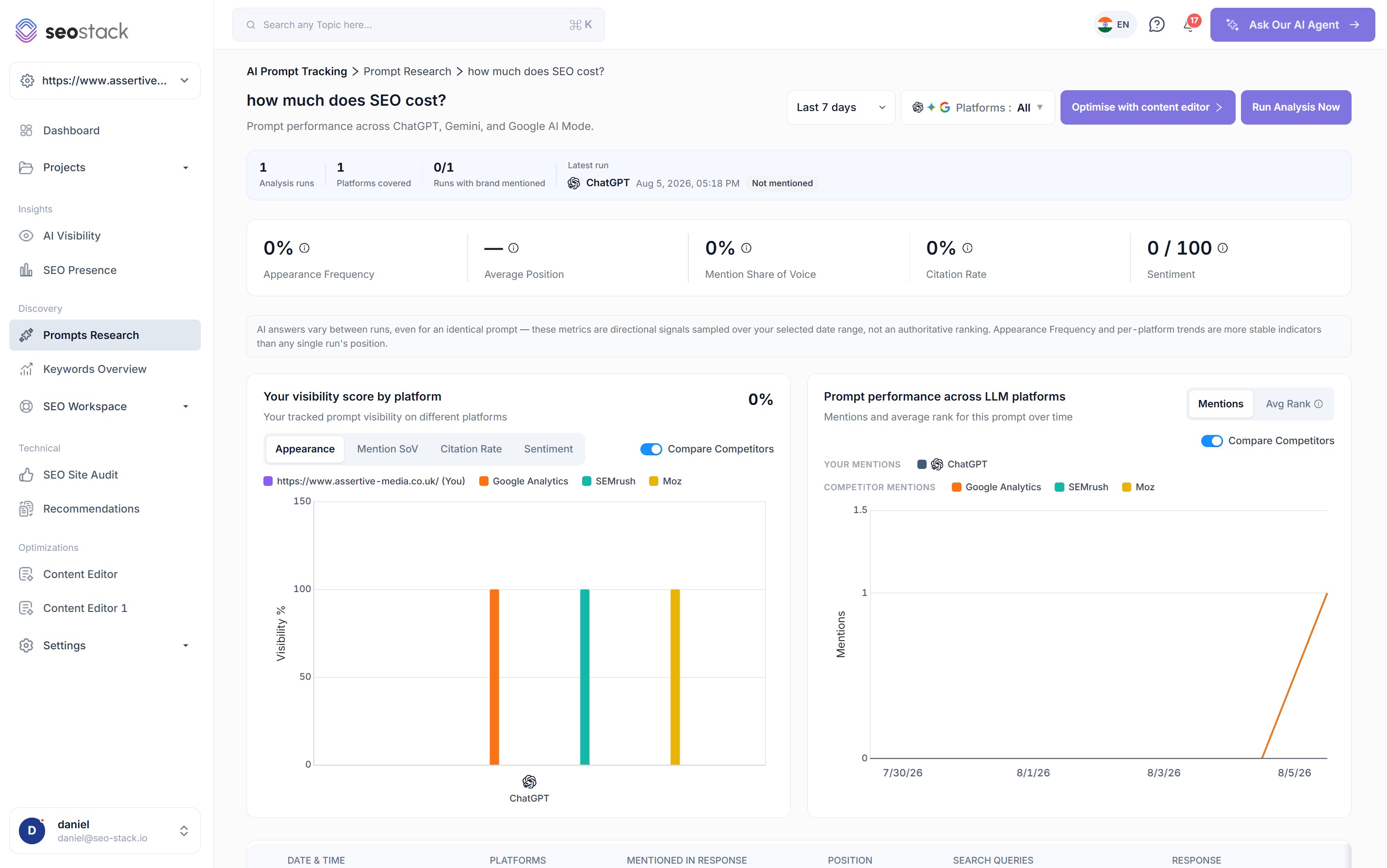
A visibility score is a summary of something specific, and you can open the specific thing. Every tracked prompt gets its own page showing appearance frequency, average position, share of voice, citation rate and sentiment, which platforms it ran on, how you compare against the competitors you are tracking, and the full run history behind all of it.
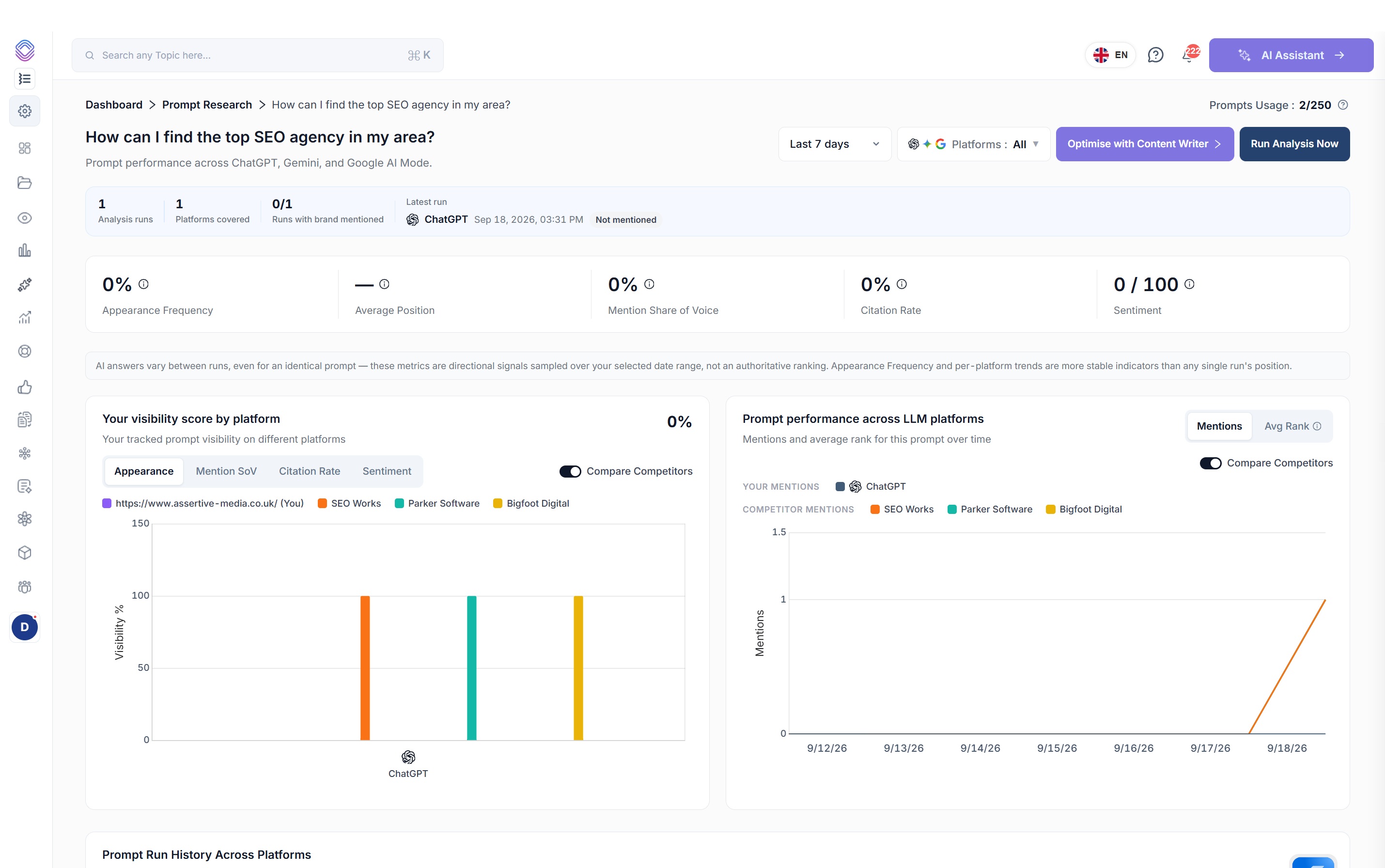
AI answers differ between runs on an identical prompt, and SEO Stack says so in the interface rather than dressing a single run up as a ranking. Appearance frequency across the run set is the number to argue with, and every individual run is kept so you can check it.
Recommendations
Find useful next steps for your content.
Recommendations are attached to the prompt and the run that produced them, so each one can point at the thing in the answer that justifies it. That is the difference between advice you can take to a content meeting and advice you have to defend.
Recommendations for this prompt
“Which SEO agencies are best for enterprise ecommerce?”
ChatGPT · 12 Aug 2026 · 24 runs analysed
- 01High impact
Publish an enterprise ecommerce SEO service page with catalogue size, URL counts and named outcomes
Both agencies cited on this prompt were pulled from their own service pages. The model reached for brand-owned pages first and there is nothing of yours to reach for.
Open in Content Editor - 02High impact
Add a migration case study with before and after query-level data
The second citation is a case study on a 400,000 URL retailer. Case studies with numbers in them are the format this prompt keeps surfacing.
Open in AI Content Auditor - 03Medium impact
Answer the three follow-up questions the model raised, on the same page
Indexation at scale, year-on-year data and organic against paid are the criteria the answer told the buyer to use. Covering them puts you in the retrieval set for the follow-up too.
Open in Content NLP - 04Medium impact
Pursue a listing in the directory the model cited
One of the five sources is a directory round-up. It is the cheapest of these to influence and it feeds more than one prompt in this topic.
Open in Prompt Research
Every recommendation points at something in the run above rather than at general advice, which is what makes it arguable. Illustrative example.
Prompt research
Track the questions your customers ask.
We don't just fabricate or guess what people are searching for, we extrapolate search data from Google Search Console + Google Trends to identify the searches that have a higher probability of being entered into LLMs be it questions on Gemini, Claude, Grok, chatGPT etc. We use real world data to look for the things that your target audience are searching for.
Built from your own Search Console data
Prompt research is pulled from the queries you are already served for rather than from a generic prompt library, so the questions you track are the ones your buyers demonstrably ask.
Branded and unbranded, kept apart
Branded prompts tell you whether the model describes you correctly. Unbranded prompts tell you whether it knows you exist at all. Blending the two produces a number that flatters you and means very little.
Grouped into topics
Prompts are organised by topic, so a gap reads as a subject you are missing rather than as a list of unrelated questions, which is what makes it a content plan.
And by location
The same question answered for a buyer in one market often names a different set of brands, so location sits alongside platform as something you filter by rather than something you average over.
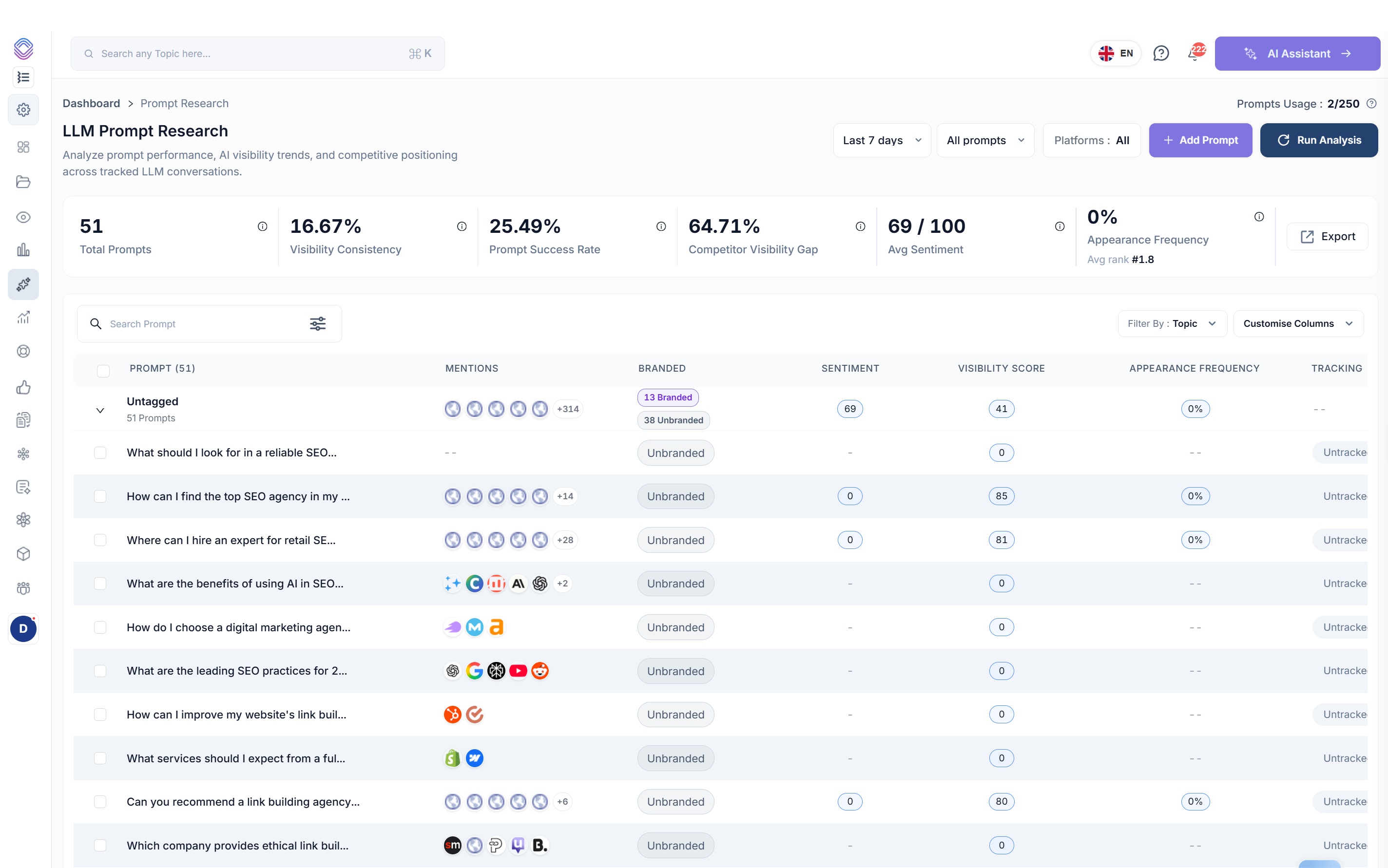
What gets measured
6 key AI Visibility metrics to help with tracking & reach.
SEO Stack provides a handful of AI Visibility metrics to help you understand everything from projected search volume to sentiment. This helps you to better understand how and where your brand appears, the sentiment behind the search, overall visibility and more!
AI Visibility Score
A single score for how present your brand is across every tracked model and prompt, trended day by day so you can tell a real move from noise.
Visibility Consistency
Whether you show up reliably or only occasionally. A brand cited on one run in ten has a very different problem to one cited nine times in ten.
Brand Mentions & Citations
Total mentions and total citations across all AI platforms, so you can separate being talked about from being linked to.
Share of Voice
Your slice of all brand mentions against the competitors you choose, on each platform and across all of them.
Position & Average Rank
Where you land inside the answer, not just whether you appear. Switch the chart between visibility and position, or mentions and average rank.
Sentiment
How the model describes you when it does mention you, scored per prompt, so you catch a bad characterisation before it compounds.
Inside the tool
From a score, down to a single prompt, down to the source
Every level of the tool answers the next obvious question. Where do I stand, who is beating me, on what, and what do I do about it.
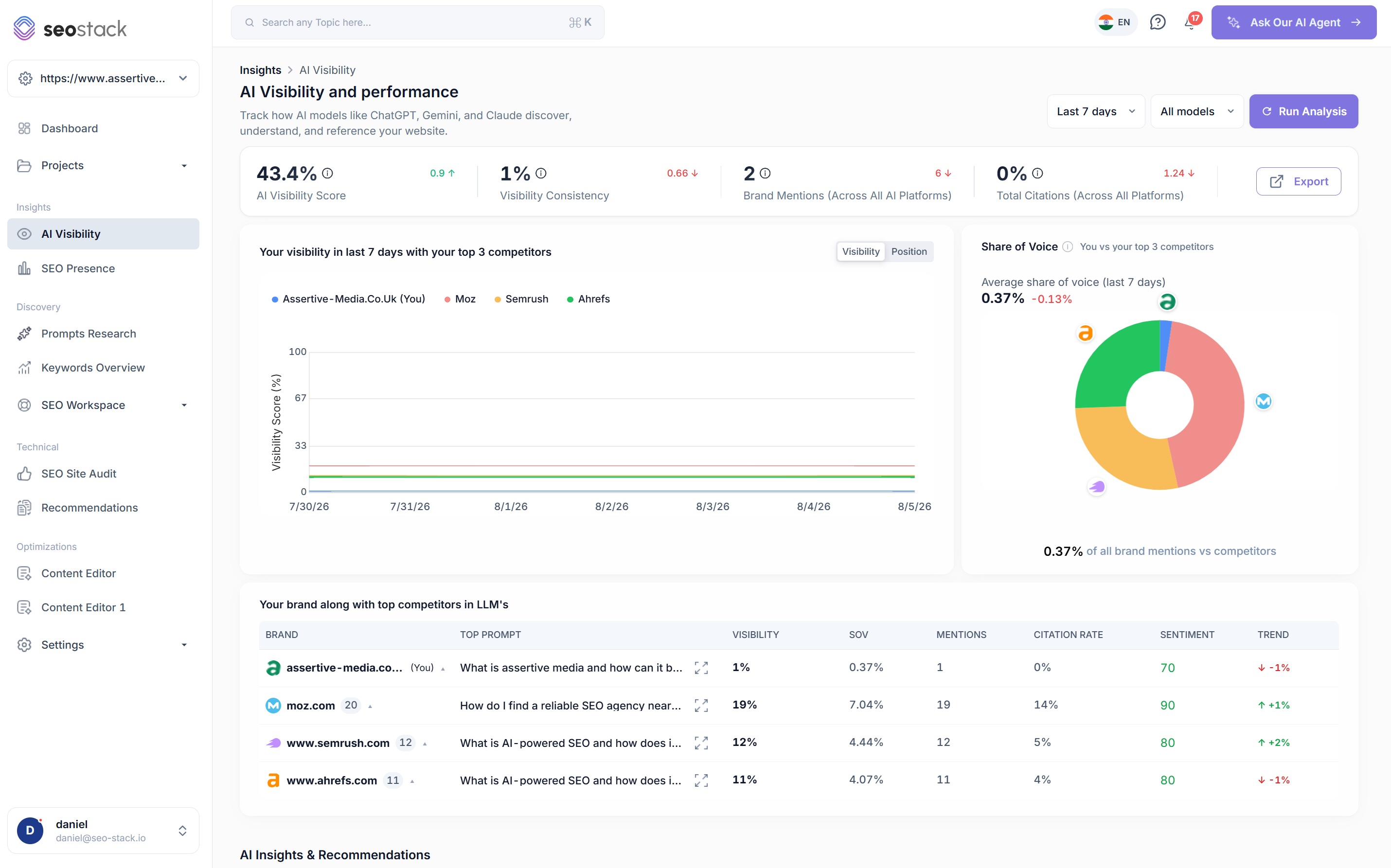
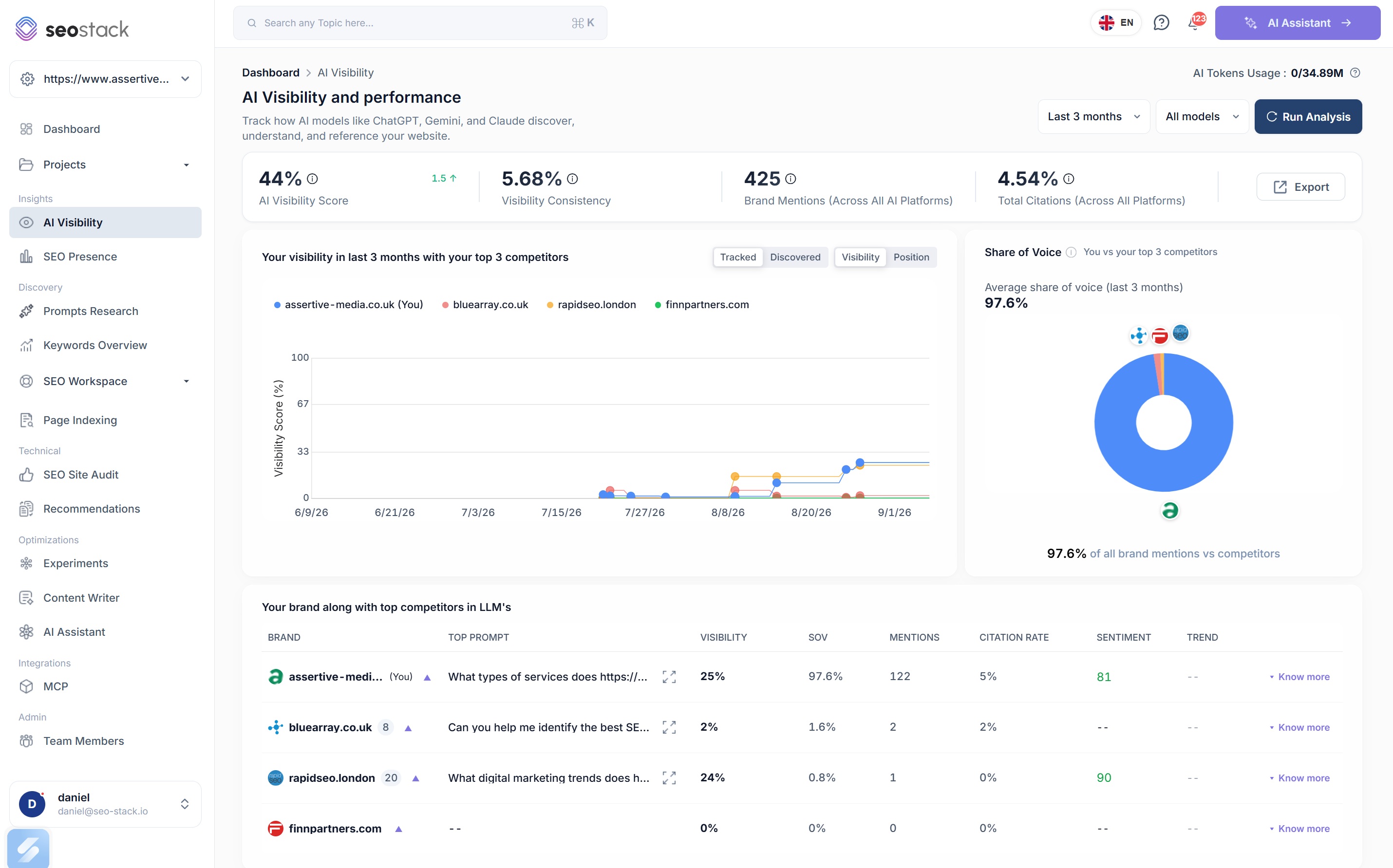
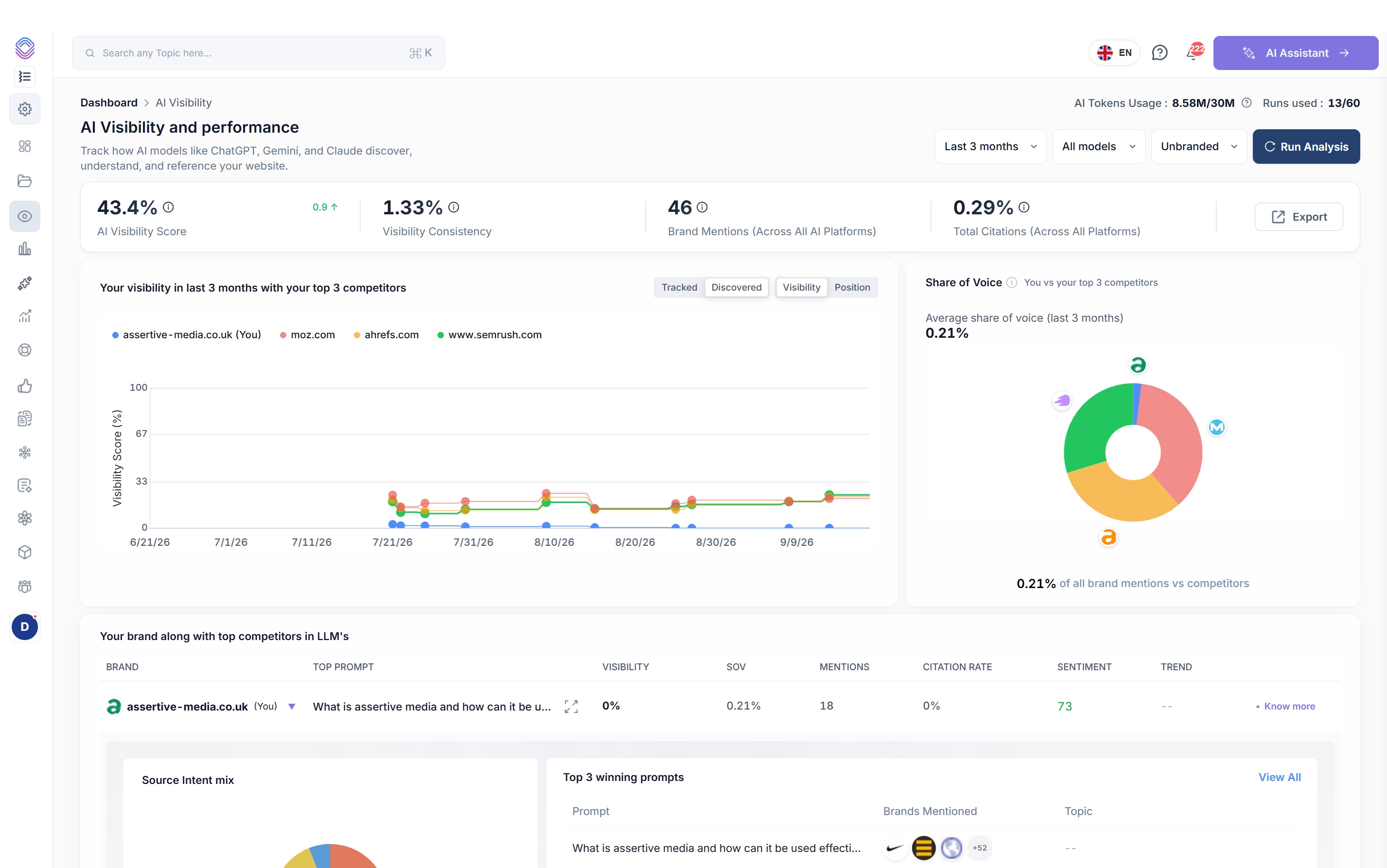
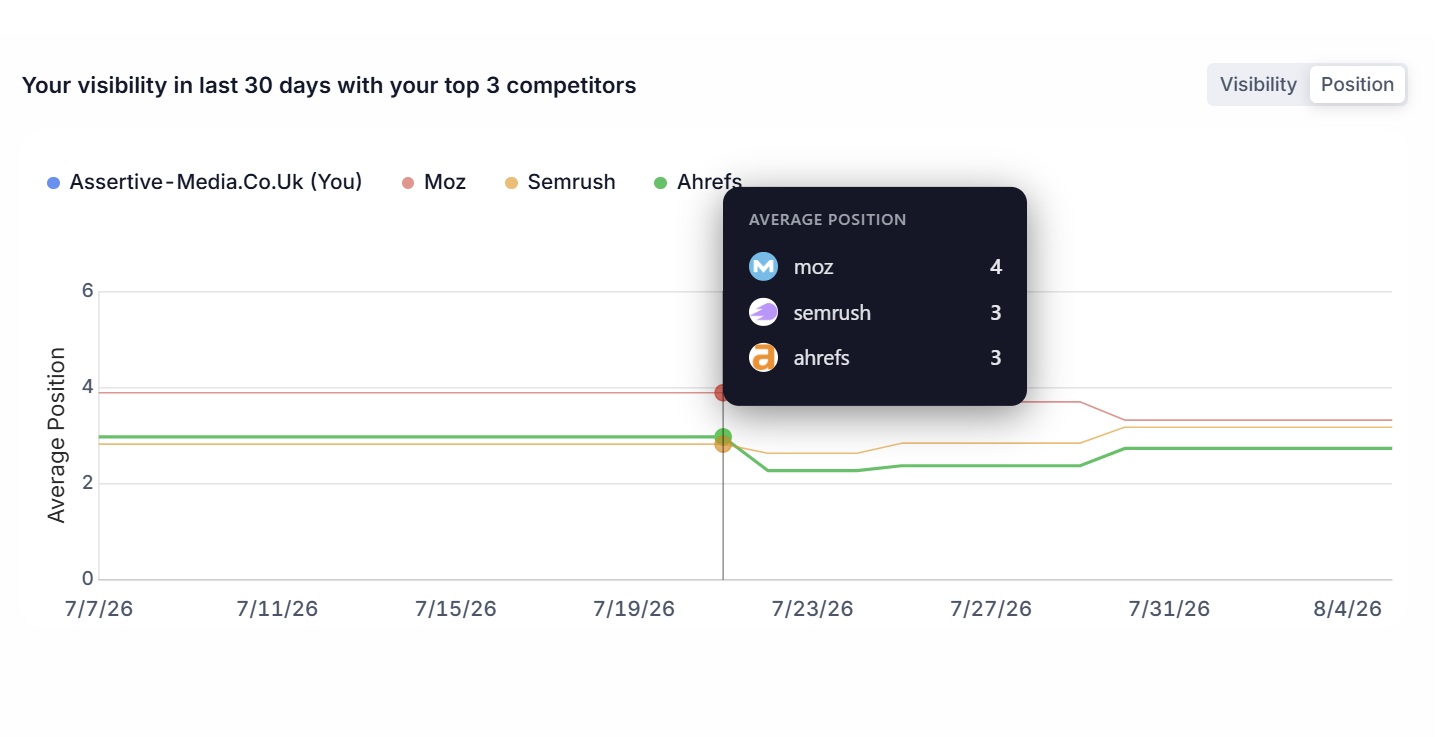
Your visibility against your top competitors, day by day
- Visibility score, consistency, brand mentions and total citations across every tracked platform
- A trend line for you and your top three competitors over the selected range
- Toggle the chart between visibility and position
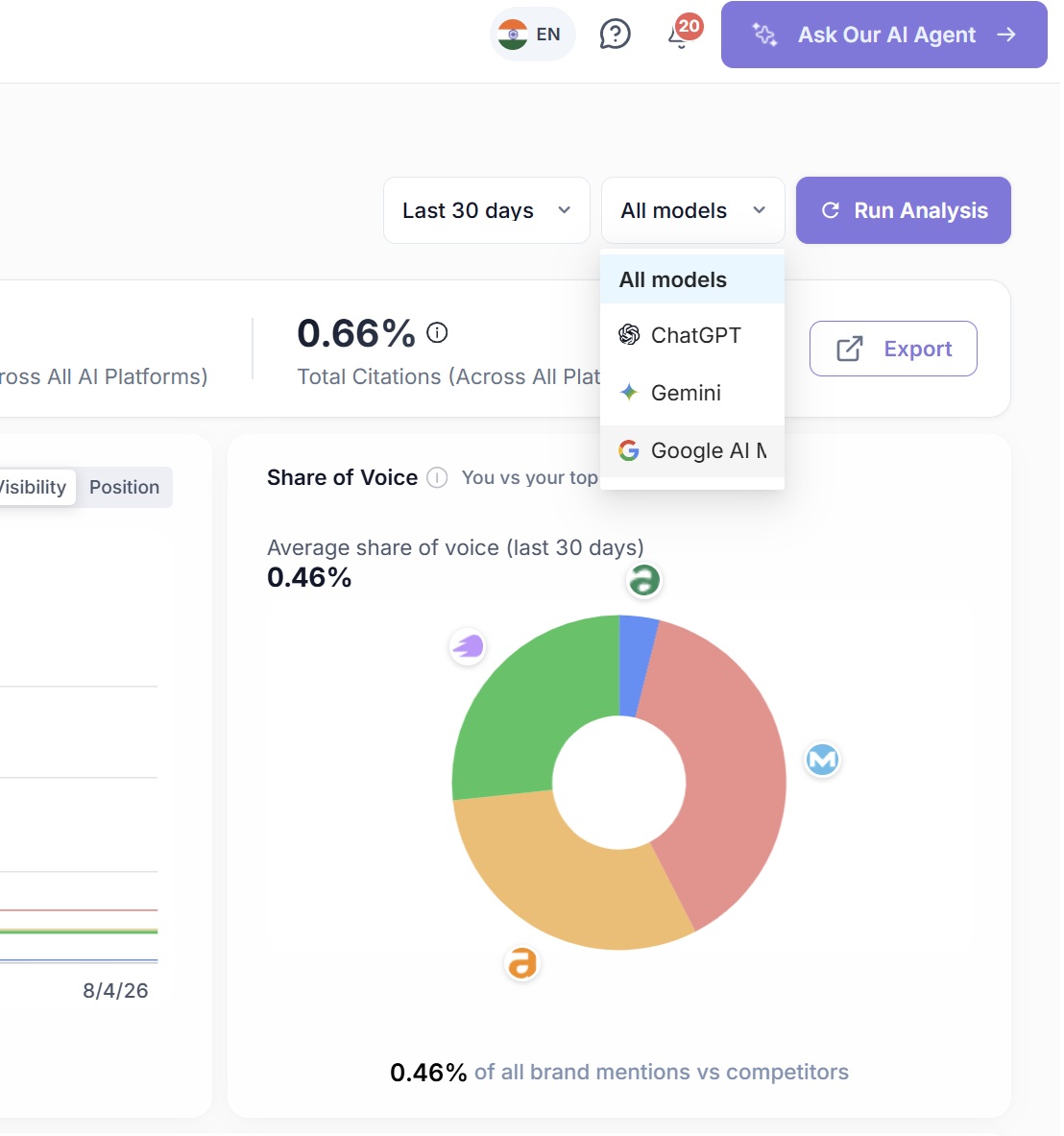
- Filter to a single model, or view all models together
- Share of voice donut showing your slice of all brand mentions
Run analysis on demand
You are not waiting on a weekly crawl. Trigger a fresh run whenever you have shipped something and want to know if it moved.
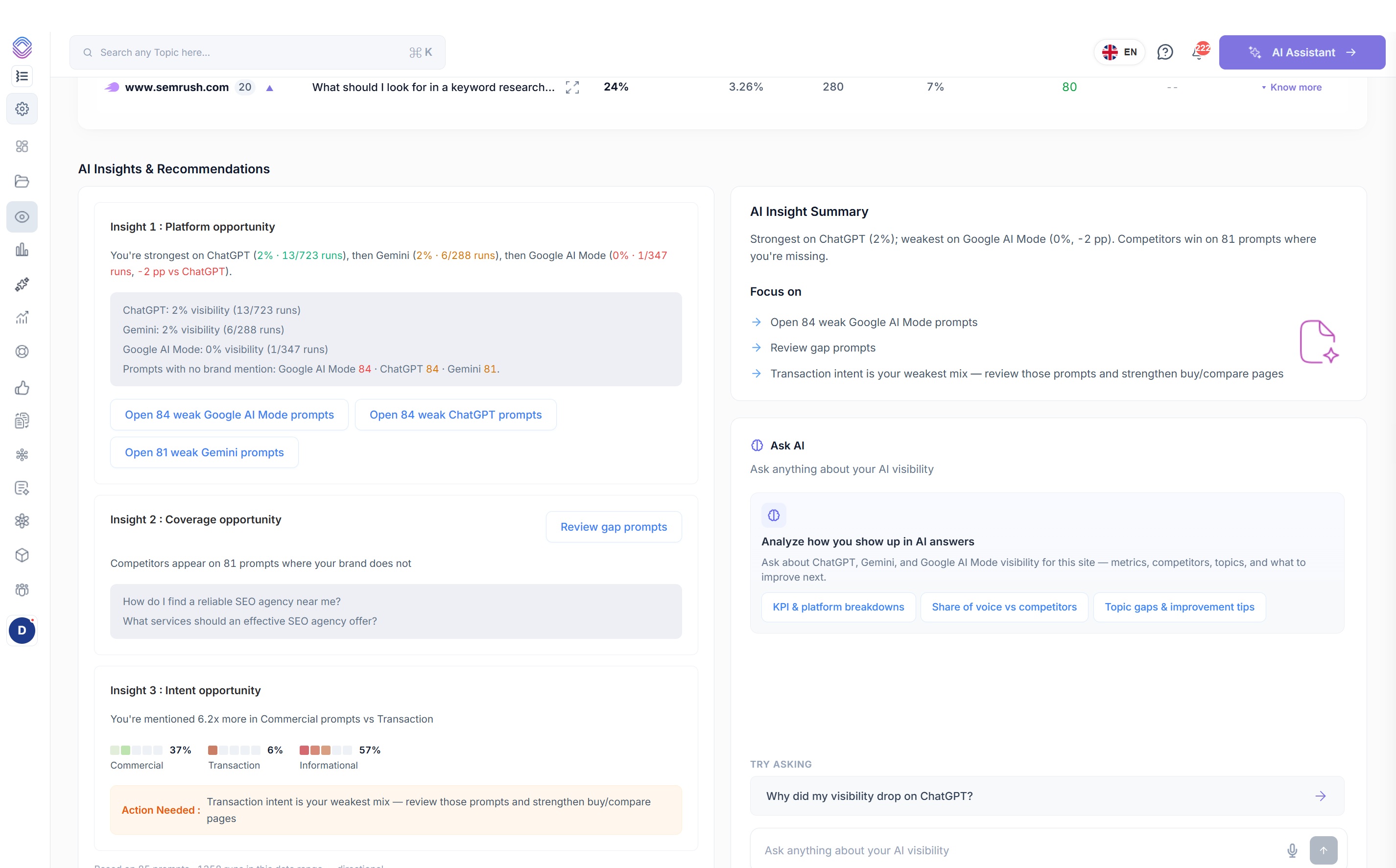
Not just the numbers, but what to do about them
- Platform opportunity: which model you are strongest and weakest on, with the weak prompts one click away
- Coverage opportunity: the prompts competitors win where you do not appear
- Intent opportunity: your commercial, transactional and informational mix, with the weak side flagged
- An AI Insight Summary that reads the whole dashboard and tells you what to focus on
- Ask AI anything about your visibility and get metrics, competitors and topic gaps back
Ask AI
Ask AI anything about your visibility
"Why did our visibility change in the last few days?" is a question you type, not a report you build. You get a short answer in plain English and the KPI snapshot behind it, ready to copy straight into an update.
It reads your visibility data, your Search Console warehouse and your GA4 history at the same time, and it tells you when a sample is too small to lean on rather than dressing it up as a trend.
More on the AI AssistantAsk anything about your AI visibility
Short answer
Visibility shifted mainly because Total Citations dropped sharply (now 0) while mentions are very low and concentrated only on ChatGPT, so small absolute changes move your scores noticeably. Sample size is 100 prompts (directional).
KPI snapshot (2026-07-29 → 2026-08-05) for https://www.assertive-media.co.uk/
| Metric | Value | Change |
|---|---|---|
| AI Visibility Score | 43.4% | +0.9 |
| Visibility Consistency | 1% | 0 |
| Brand Mentions | 2 | |
| Total Citations | 0% | -42.5 |
Visibility vs position
Being mentioned and being first are different problems
The same chart answers two questions depending on which side of the switch you are on, for every competitor you track, over any range you choose.
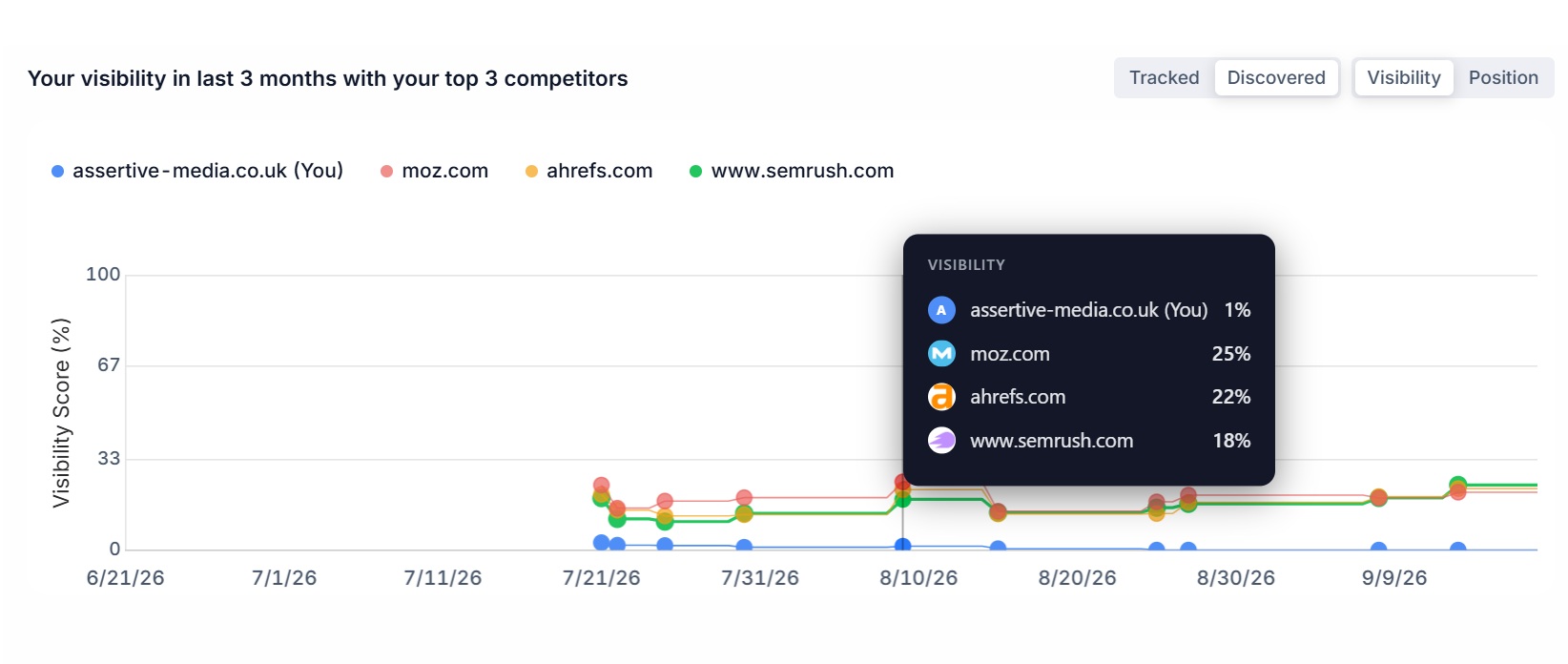
How often do we get mentioned at all?
Visibility score is the share of tracked runs where the model named you. It is the honest headline number: over three months on this prompt set you are on 1% while three competitors sit between 18% and 25%.
Across your whole prompt set
One line for you and one for each of your top competitors, so a move is always relative. If everyone slid at once the model changed; if only you slid, something you did changed. Benchmark over 7 days, 30 days or any window you pick.
Down to a single prompt
The same two views on one question, with mentions and average rank per platform, plus every individual run and the response it produced. That is how you tell a genuine slip from the variance you get running the same prompt twice.
Tracked across
- ChatGPT
- Google Gemini
- Claude
- Grok
- Perplexity
- More being added
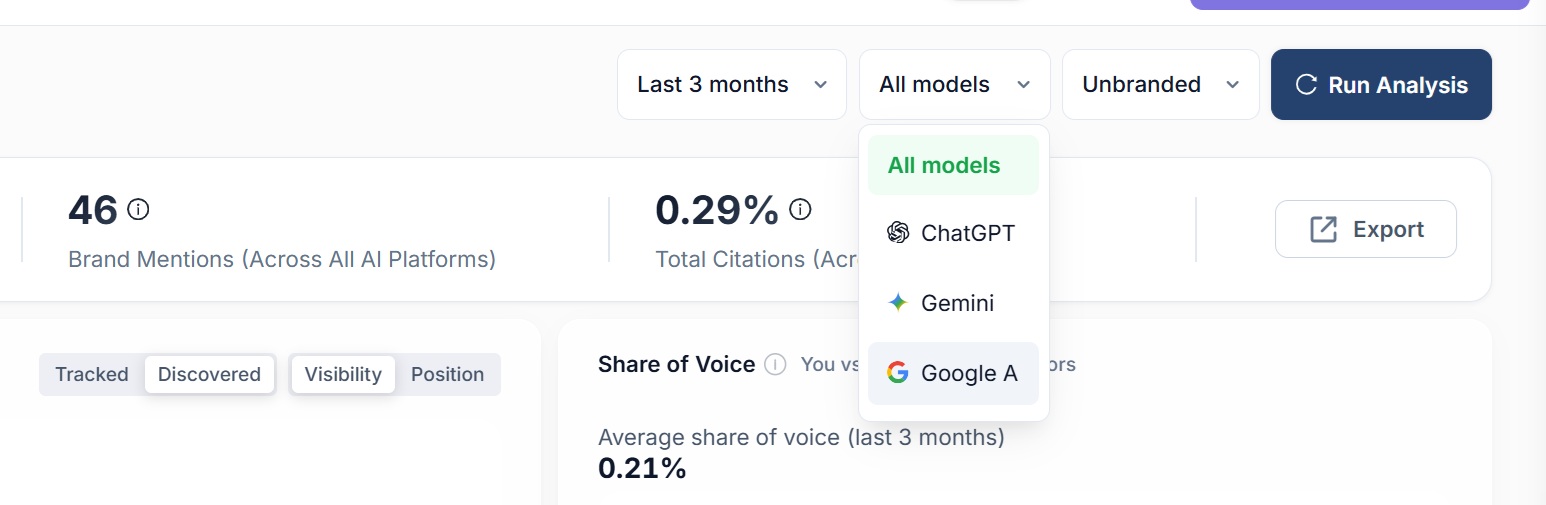
Filter every chart and table to one model or view them together. Because each platform is scored separately, you can see the thing a single blended number hides: leading on one model while being absent from another.
What you get
Know what’s included.
Five platforms at launch, a monthly prompt pool shared across the sites you enable, analysis on a set cadence plus on-demand runs whenever you want one, and no separate AI visibility subscription to buy.
Five platforms at launch
Every metric can be filtered to a single platform or viewed across all of them, because the models disagree. Each has its own training data, its own retrieval behaviour and its own preferred sources, so the brand that wins on one is regularly not the brand that wins on another.
ChatGPT
The largest single source of AI referral traffic, and where most brands see their first citations appear.
Google Gemini
The fastest climbing share of generative AI traffic, and increasingly the model where a category leader is decided.
Claude
Heavily used in professional and technical research, where the buyer is often further down the funnel.
Grok
Wired into a live social feed, so it reflects what is being said about a brand now rather than only what was written about it.
Perplexity
Answer-first and citation-heavy, which makes it the clearest read on whether your pages are considered a source at all.
More on the way
Platform coverage is expanding. New ones are added to the same dashboard, with no change to how you track.
Analysis frequency
Prompts are checked around eight times a month by default, roughly twice a week, on every plan. That cadence is what makes appearance frequency meaningful rather than anecdotal.
Plus runs on demand
You are not waiting on a scheduled crawl. Trigger a fresh run whenever you have published something and want to know whether it changed the answer.
Trial terms
A 14 day free trial, cancel anytime, no contracts. AI visibility is part of the plan rather than a separate subscription, so there is no add-on to price up on the side.
Full allowances across every tool are on the pricing page.
Against the specialist tools
You shouldn't need a second subscription to see this
Products like Profound and Peec AI proved the category matters. Our argument is not that prompt tracking is unimportant, it is that it belongs next to your search data rather than in a separate bill.
Your search & analytics data
Warehoused from day one, every row kept, no 16-month cliff.
AI & LLM visibility


Visibility, share of voice, citations and sentiment on every tracked model.
One subscription. One project. One bill.
Everything above sits in the same platform, against the same property, so AI visibility is a column next to organic clicks rather than a second tool you reconcile by hand.
| Consideration | Standalone LLM trackers | SEO Stack |
|---|---|---|
| What you are buying | A dedicated LLM tracking product. It does prompt tracking well and nothing else, so it sits alongside whatever you already pay for. | AI visibility as one of 30 tools, next to your Search Console warehouse, GA4, rank tracking, content auditing and site audit. |
| Cost | A separate subscription on top of your existing stack, priced as a specialist tool. | Included from the Basic plan at $129.99/mo, alongside your Search Console warehouse rather than as a separate subscription. There is no AI visibility tier and no add-on. |
| Trackable prompts | Prompt allowances are the main pricing lever, so the useful volume usually sits well up the plan ladder. | A substantially higher prompt allowance for the money, because prompts are not how we price the product. |
| Joined to your search data | AI visibility in isolation. Correlating it with organic performance means exporting from two products and joining it yourself. | The same project already holds every Search Console row and your GA4 data, so AI visibility sits beside the organic performance it is affecting. |
| Acting on what you find | Reporting tells you a competitor wins a prompt. What you do about it happens somewhere else. | A gap prompt goes straight into the Content Editor and the AI Content Auditor, in the same session. |
| Asking follow up questions | Whatever the dashboard exposes is what you get. | Ask AI is wired to your visibility data, and the wider AI Assistant is wired to your full warehouse, so a follow up is a sentence. |
How teams use it
All your AI Visibility needs in one place, from visibility to recommendations
Build the prompt set
Research and add the questions your buyers actually ask, one at a time or in bulk. Prompt Research shows tracked count, success rate, competitor gap, sentiment and appearance frequency.
Prompt ResearchWatch where you land
Run analysis across every tracked platform, then follow visibility, share of voice, citations and sentiment against your competitors as they move.
Close the gaps
Take the prompts a competitor owns straight into the Content Editor and the AI Content Auditor, publish, then re-run and check the citation rate actually moved.
AI Content AuditorReport it as a channel
Export the whole picture, no row caps, and put AI visibility in the deck next to organic clicks rather than as an anecdote about ChatGPT.
What you get out of it
Grow your AI Visibility with SEO Stack Today!
See exactly where competitors out-cite you and on which prompts
Track whether content changes moved your citation rate
Report on AI visibility as a first-class channel
Connect a property. Watch the data start stacking.
Warehousing begins the moment you connect your Search Console property, there is no Google Cloud project to set up, no BigQuery and no schema to design. You simply connect your property and SEO Stack starts storing every row of your data from that day onwards.
- Credit card required
- Cancel within the trial and you won't be billed
- No contracts