For in-house SEO teams
Paid media can prove what it bought. Now SEO can too.
In-house SEO with the reporting problem solved. Search Console and GA4 warehoused together with no row limits and no 16-month cliff, every change your team makes logged against the data, and an AI analyst that can explain what moved before anybody asks you to.
14 day trial · Credit card required · Cancel within the trial and you won't be billed · No contracts · No BigQuery, nothing to configure
Trusted by leading companies
The reality
The part of the job nobody hired you for
You were hired to grow the channel, and a surprising amount of the week goes on proving that it grew. None of these are skill problems, they are all consequences of organic being the only channel where the data is rented, incomplete and stored somewhere else.
Every drop becomes your fault by default
Traffic falls and the meeting starts before you know the cause, so you end up defending a position you have not diagnosed yet, which is a very difficult room to be in.
Query CountingYou inherited a site with no memory
Your predecessor left and took every record of what was changed and when with them, and Search Console only reaches back sixteen months anyway, so the migration everyone still blames is already invisible.
AnnotationsPaid proves its return, you get asked for patience
The channel with clean numbers wins the budget conversation. Organic contribution lives in one tool and organic revenue lives in another, and joining them by hand is not credible in a board pack.
SEO PresenceGetting dev resource means queueing
Engineering wants a business case with a number on it, and it is important for SEO is not one, so your fixes sit in a backlog behind everything that arrived with a forecast attached.
Click forecastingYou cannot prove the content budget worked
Six figures of content spend and no view of what proportion of the index actually earns anything, so when renewal season arrives the honest answer is anecdotal.
Index PerformanceSomeone asked whether ChatGPT mentions us
It is a board-level question now, most in-house teams have no data on it, and I will look into it is the answer that gets an agency called in to answer it for you.
AI VisibilitySee it
One screen, before anyone asks
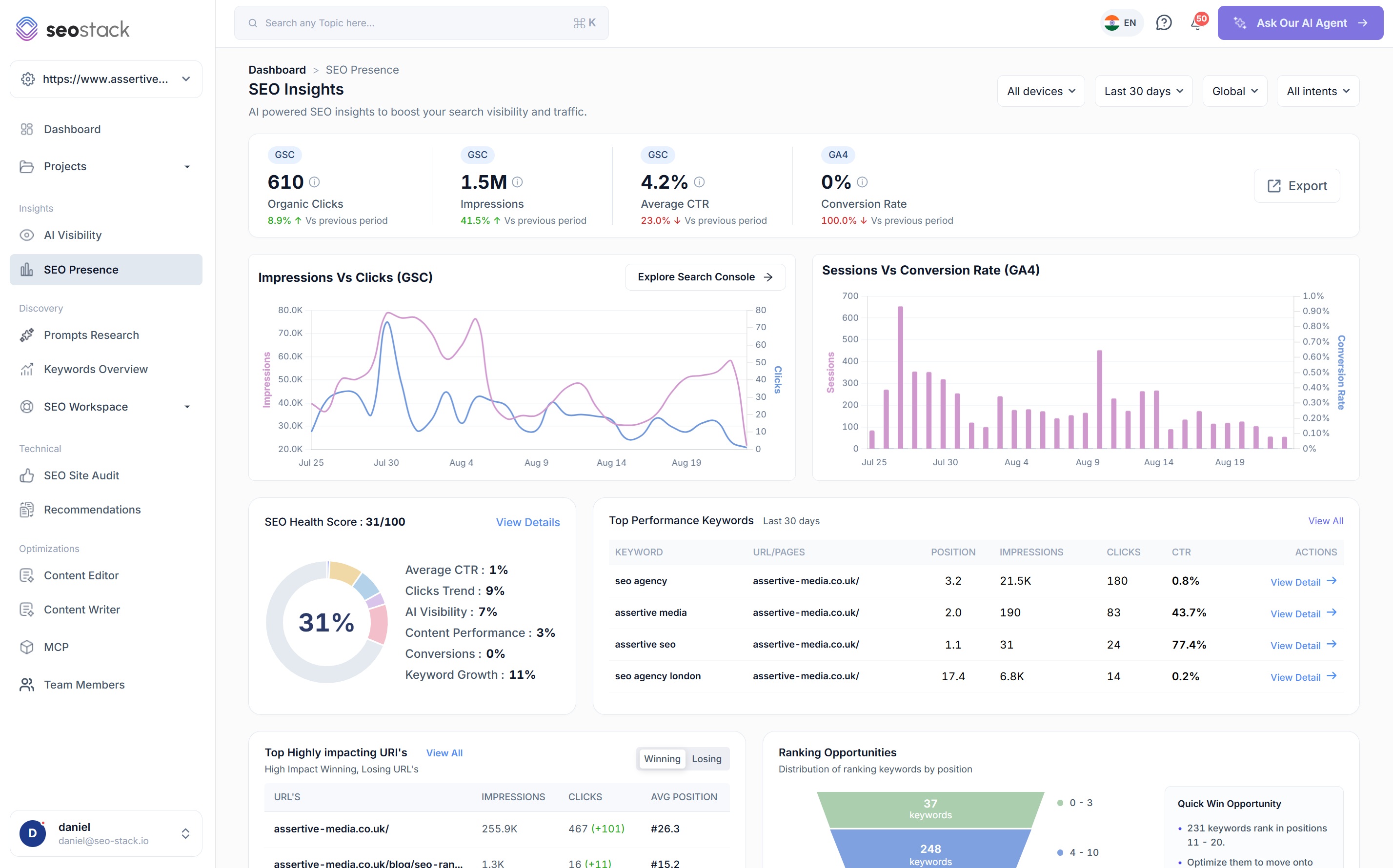
SEO Presence puts Search Console and GA4 on the same dashboard, so the monthly stakeholder update stops being an assembly job across four tools and becomes a screen you can share.
Four headline numbers, each badged with its source
Clicks, impressions, CTR and conversion rate, every one of them shown against the previous period and labelled GSC or GA4 so nobody has to ask which tool a figure came from.
The pattern separate reports hide
Impressions plotted against clicks on a dual axis, which is how you catch impressions climbing while the click-through rate falls. Sessions against conversion rate then tells you whether the traffic was worth having.
A health score you can break down
Six factors, i.e. clicks trend, CTR, keyword growth, content performance, conversions and AI visibility, each shown with the points it contributes, so a low score tells you which part of the operation is dragging rather than just that something is wrong.
Filtered to the question being asked
Device, country, date range and query intent, with every panel on the dashboard responding, and because the data is warehoused the long comparisons keep working after Google's own window has moved on.
Prove it
Connect organic performance to money
Paid media can show what every pound bought. Organic has historically been unable to, not because the value was not there, but because the performance data and the revenue data lived in different tools and nobody trusts a join done by hand in a spreadsheet.
The change log is the institutional memory fix
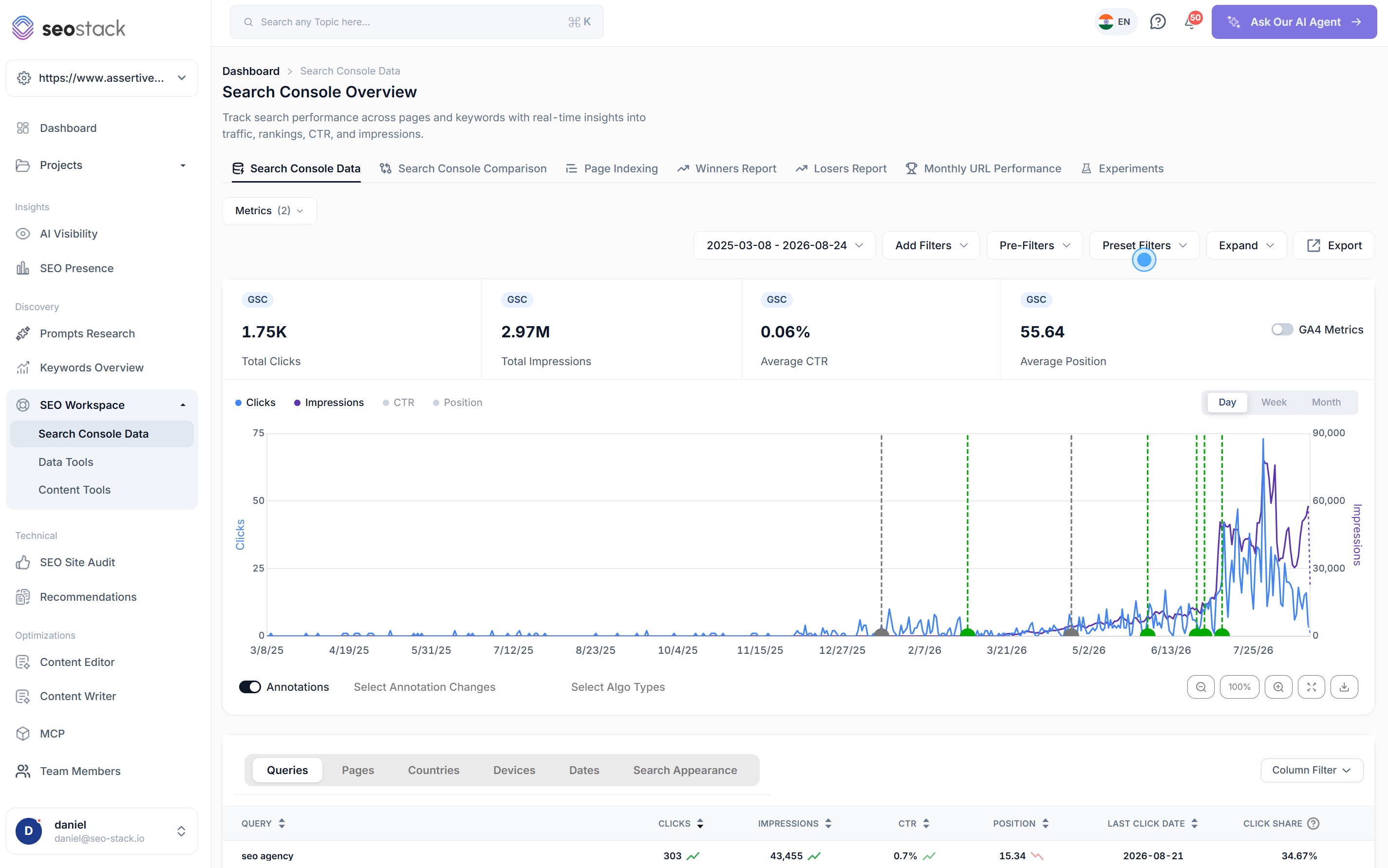
Every change your team makes is logged with a date, an author, a URL scope and a change type, then plotted on every chart alongside Google's own algorithm update markers, and the AI reads the whole log and tells you which changes helped and which did nothing.
- The record survives staff turnover, so the next person inherits a history rather than a mystery
- Tasks convert into annotations, so the work log and the performance data are one record rather than two nobody reconciles
- AI Experiments set a pivot date, a hypothesis and the GSC and GA4 metrics that matter, then give a verdict on whether it worked
- The AI Assistant answers the hybrid questions neither tool answers alone, i.e. which pages rank well and convert badly
Defend it
Know what caused it before the meeting starts
Walking into the room with the cause already identified changes how the channel is perceived for the rest of the year, and it is the single most useful thing on this page for anybody who has ever had to explain a drop they did not yet understand.
Clicks down 31 to 38%. Which one is it?
- Clicks1,8401,140
- Impressions94,20055,600
- Queries served3,4101,910
- Average position6.26.1
- CTR1.95%2.05%
Diagnosis
Google is serving the page for fewer things
Clicks and impressions fall together, the number of distinct queries the page is served for falls with them, and the average position barely moves. Nothing has been outranked, the page has simply narrowed.
What you actually do
A coverage problem rather than a ranking one. The page has lost topical breadth, usually after a rewrite, a consolidation or a core update reassessing what it is about, and the work is content rather than links.
Query Counting- Clicks1,8401,190
- Impressions94,20086,900
- Queries served3,4103,270
- Average position4.19.6
- CTR1.95%1.37%
Diagnosis
You have been pushed down the page
Impressions and query count hold roughly steady, so Google still considers the page relevant for the same things, but the average position has fallen and the click-through rate has collapsed with it. Somebody has outranked you.
What you actually do
A competitive problem. Look at who moved above you and on what, then decide whether the answer is coverage, internal links, authority or all three. The one thing it is not is a content cull.
Winners & Losers- Clicks1,8401,270
- Impressions94,20099,800
- Queries served3,4103,720
- Average position2.82.6
- CTR1.95%1.27%
Diagnosis
Ranking better, being clicked less
The hardest of the three to spot and the one most stacks get wrong. Impressions are up, the query count is up and the average position has improved, and clicks have still fallen, because the answer is now being given above the result.
What you actually do
Nothing is broken, the click is being taken further up the page. The response is AI visibility work rather than ranking work, and telling a client this correctly on a panic call is the difference between a renewal and a review.
AI VisibilityIllustrative figures. On a clicks chart alone these three are indistinguishable, which is why so many panic calls end in the wrong piece of work.
Google algorithm update overlays sit on every chart alongside your own annotations, so this coincided with the March update and here is the evidence becomes a statement rather than a hunch. Date comparison then lets you run the same query set against the same period last year, which Search Console cannot do once its sixteen months have rolled.
Fund it
Turn the backlog into a business case
Nothing gets prioritised internally without a number attached to it, so the most useful thing a tool can do for an in-house team is convert professional judgement into a figure somebody outside the channel will accept.
Striking distance, quantified
Ranking opportunities bucket every keyword by position band, and the quick win panel totals the monthly impressions sitting in positions 11 to 20. That turns there is opportunity here into a number you can weigh against effort and put in front of engineering.
SEO PresenceA forecast built from your own data
Click forecasting models what clicks would be at a realistic click-through rate using your own historic impression data rather than a third party estimate, which is the artefact that actually gets dev resource allocated.
Click forecastingContent investment, evidenced
Index performance groups your whole index into bands and tracks the composition over time, so forty percent of our index earned nothing last year, and here it is improving since the refresh programme started is a defensible renewal case.
Index PerformanceA roadmap you did not have to write
Recommendations and the site audit produce a ranked, explained list of fixes with impact ratings, affected pages and estimated time against each, which doubles as the prioritised backlog you were going to spend a week assembling.
RecommendationsManaging an agency
Your own numbers, independent of your agency's
A large share of in-house SEOs manage an external agency rather than doing all the work themselves, and that arrangement has a structural problem in it: the agency supplies the data and the interpretation of its own performance at the same time.
Warehoused under your account you get an independent read. Annotations log what the agency changed and when, AI Experiments verify whether those changes moved anything, and Winners and Losers gives you the headline before their deck arrives. Team access lets you give them per-property read or write access without touching your origin Search Console account, and revoke it cleanly when the relationship ends.
You stop grading the agency on a report the agency wrote.
Team & delegationThe AI question
Answer the AI question before it is asked
AI visibility tracks your visibility score, citations, share of voice and sentiment across ChatGPT, Gemini and Claude, benchmarked against competitors you name, and prompt research shows what actually triggers a mention.
The internal argument is straightforward. This is a board-level question now, and the team that already has the data looks like it is running the channel, whereas the team that does not gets an agency brought in to answer it. It is also one of the six health score factors, so it gets reviewed every month rather than remembered once a quarter.
The toolset
What you would actually open, and when
Organised by the job rather than by product category, because that is how the week actually runs. Every row links through to the tool if you want the detail behind it.
A handful of things start higher up, i.e. keyword clouds and project management on Pro, and white-label reporting on Agency. Everything else on this list is on every plan, so you are choosing how many websites you connect and how large each allowance is rather than being sold the useful modules separately.
Why it works in-house
What actually changes for an in-house team
Agencies buy SEO Stack to run more accounts. In-house teams buy it for a different reason, which is that organic is judged against channels with far better reporting and the gap has very little to do with how good the SEO is.
The reporting burden collapses
One screen replaces the monthly assembly job across Search Console, GA4, a rank tracker and a spreadsheet, which is usually a day a month back for whoever draws the short straw.
The channel becomes defensible
A dated change log next to algorithm update markers means a bad month has an explanation rather than an atmosphere, which is what stops budget conversations turning into confidence conversations.
Requests come with numbers attached
Forecasts and striking-distance totals travel much better through a business than professional judgement does, because they can be compared against everything else competing for the same resource.
The knowledge stays with the company
History, annotations, experiments and tasks all live in the account rather than in one person's memory, so turnover stops resetting the channel every couple of years.
You are ahead of the AI question
AI visibility sits in the same monthly review as everything else, so when it comes up at board level you answer it from data rather than commissioning somebody to find out.
Nobody has to learn a platform
The assistant answers in plain English and every export goes to Sheets, CSV or PDF, so the people who need the output do not need a login or a training session to use it.
Getting sign-off
What to send your Head of Marketing
Being convinced is rarely the blocker. Getting it approved is. So here is the version that survives being forwarded to somebody who does not know what a query count diagnostic is.
- What it costsBasic is $129.99 a month for 10 websites and five years of history. Pro is $349.99 for 30 websites at the same depth. Extra properties are $10 each per month.
- What it replacesRank tracking, client and stakeholder reporting, site auditing, content scoring, AI visibility tracking and SEO project management, all of which are commonly bought separately and none of which talk to each other when they are.
- The alternative routes to the same outcomeA BigQuery pipeline plus the engineering time to build and maintain it, or an enterprise SEO platform at a materially higher annual commitment with a procurement cycle attached to it.
- Why it is approvableMonthly, no contract, cancel anytime, which means it does not need to go through procurement and it does not commit the business to anything beyond next month.
- What it does not doIt is not a backlink index. If the team does competitor link analysis, that stays with Ahrefs or Semrush. This owns the first-party data layer, which is the half nobody currently has.
Objections
Before you start
Do we need BigQuery, a Cloud project or engineering time?
None of the three. There is no Cloud project to create, no billing account, no dataset schema and no export job to maintain. You authorise a property with Google once and warehousing starts immediately, which is normally the difference between this happening this month and it sitting in a backlog until next year.
How does this differ from an enterprise SEO platform?
Mostly in how you buy it and what it is built on. There is no annual commitment, no procurement cycle and no sales call, it is monthly and you can cancel. And it is built on your own first-party Search Console and GA4 data rather than on a third party estimate of it, which is what makes the numbers defensible when somebody senior questions them.
Does it replace Ahrefs or Semrush?
No. There is no backlink index and no third party keyword volume database here. Teams doing competitor link analysis keep Ahrefs or Semrush alongside, and SEO Stack owns everything built on your own data. Saying that plainly is more useful to you than a claim that would fall apart in week two.
Can our agency have access without access to our Search Console account?
Yes, and this is one of the better reasons to run it in-house. You grant per-property read or write access inside SEO Stack, which makes no change at all to the users on your origin Search Console property, and you revoke it cleanly when the relationship ends.
What happens to the warehoused data if we cancel?
The warehouse stops accumulating when the subscription ends, and while you are subscribed everything you have connected keeps building rather than rolling off at 16 months the way Google's own window does. If you are evaluating, the practical point is that the history starts the day you connect, so connecting early costs nothing and delaying is the expensive option.
Can we connect multiple brands, regions or domains?
Yes. Basic covers 10 websites and Pro covers 30 websites, and extra properties are $10 each per month if you go slightly over, so a multi-region or multi-brand setup does not force you into a different conversation.
How is our data isolated and secured?
Access is granted per workspace, and a property somebody has not been granted is not listed anywhere in their account. It is not greyed out and it is not visible, it simply is not there, which matters when an agency or a contractor has access to one brand and not the others.
Can we get the data into our own BI or reporting stack?
Yes, through the MCP server and unlimited exports. The MCP exposes 23 tools over the warehouse with no row limits, so Claude, ChatGPT, n8n, Make or your own scripts can query it directly, and everything on screen exports to Sheets, CSV or PDF without a row cap.
How long before a newly connected property is useful?
The backfill imports whatever Google still holds, normally its own 16-month window, and that is available shortly after you connect. Everything from that day onward accumulates permanently, so the property gets more useful every month rather than less.
What happens when the person who set this up leaves?
This is rather the point of the annotation log. The record of what was changed, when, on which URLs and by whom stays with the account rather than leaving with the person, so whoever picks the channel up next inherits a history instead of a mystery.
Start warehousing before the next core update.
Warehousing begins the moment you connect your property, so the next time traffic moves you will have the history and the change log to explain it, rather than reconstructing the story out of whatever Google has not deleted yet.
14 day trial · Credit card required · Cancel within the trial and you won't be billed · No contracts · Nothing to configure