Content & Optimisation
New in V3Rewrite your title tags in bulk, with the intent worked out for you
Pulls the current title for every page, works out the search intent behind it, and writes a better one. Run a single URL when you are fixing one page, or select the lot and rewrite hundreds at once, then export the results ready for your CMS.
- 100% data privacy
- 99.99% uptime
- Nothing to configure
- Export anytime, no limits
Trusted by leading companies
The problem
Title rewrites are one of the highest leverage things in SEO and almost everyone postpones them, because doing it properly means opening several hundred pages, checking what each one ranks for and writing something better for every single one.
The tool
The job everybody postpones, done in an afternoon
Title rewriting is high leverage and universally put off, because doing it properly across a few hundred pages means opening every one of them, working out what it ranks for and writing something better. This does the fetching, the intent detection and the drafting, and leaves you with the judgement.
It fetches the titles for you
Every page and its current title arrives in the table already, so the tedious half of the job, working out what each page currently says, is done before you start.
The intent is detected per URL
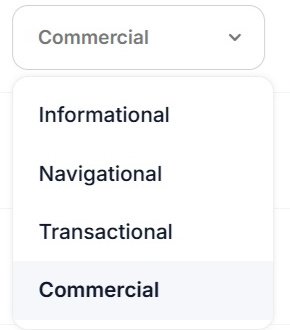
Informational, navigational, transactional or commercial, worked out from the page and what it is being served for, and set as a dropdown so you can override it when you disagree.
One page or several hundred
Run a single URL when you are fixing one page, or select the whole list and rewrite the lot in one go, then export the results for whoever is putting them live.
Title tag rewriting
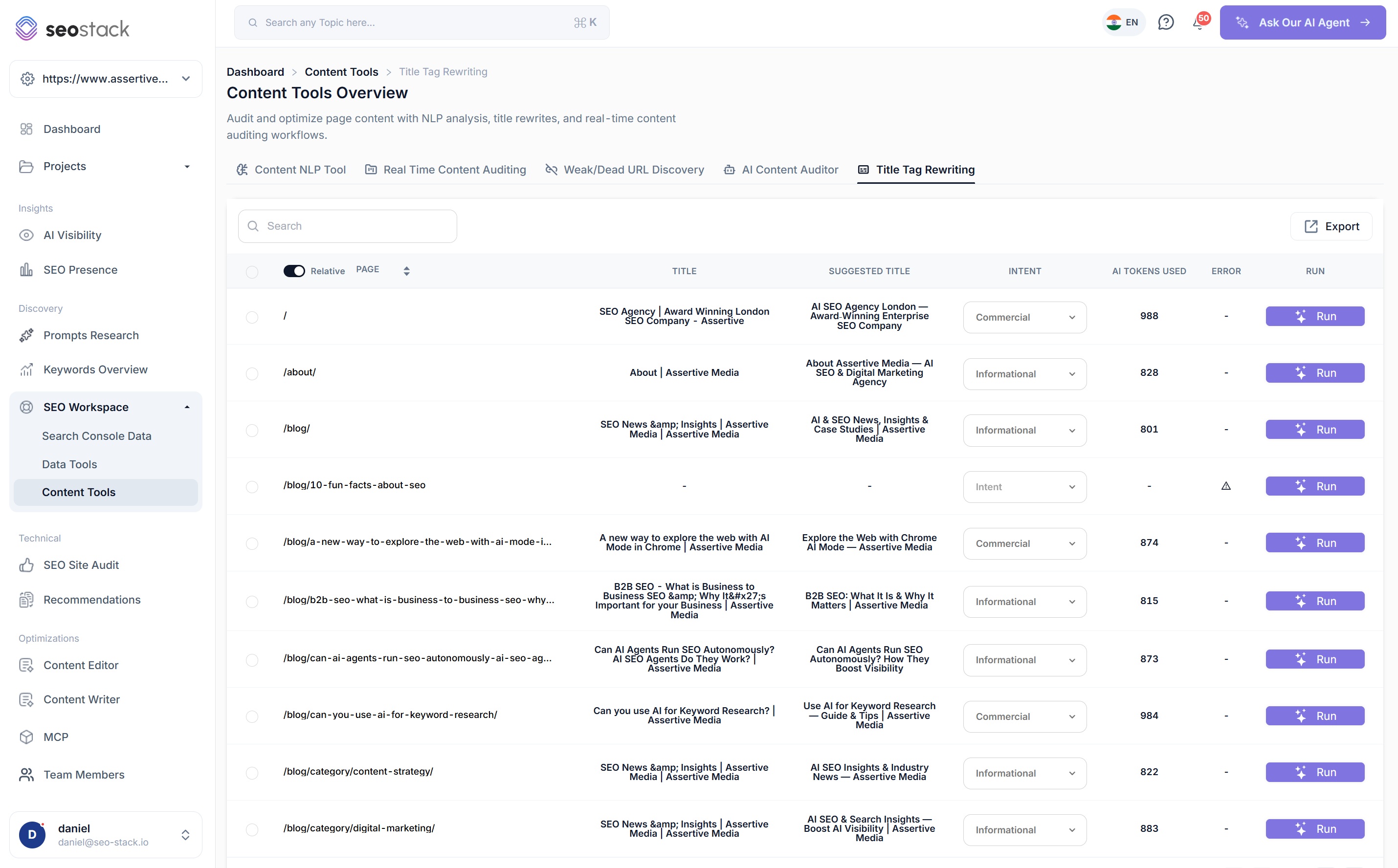
| Page | Current title | Suggested title | Intent |
|---|---|---|---|
| / | SEO Agency | Award Winning London SEO Company - Assertive57 chars | AI SEO Agency London, Award-Winning Enterprise SEO Company58 chars | |
| /blog/ | SEO News & Insights | Assertive Media | Assertive Media55 chars | AI & SEO News, Insights & Case Studies | Assertive Media56 chars | |
| /blog/b2b-seo-what-is-business-to-business-seo/ | B2B SEO - What is Business to Business SEO & Why It's Important for your Business | Assertive Media99 chars, will be cut off | B2B SEO: What It Is & Why It Matters | Assertive Media54 chars | |
| /about/ | About | Assertive Media23 chars | About Assertive Media, AI SEO & Digital Marketing Agency56 chars | |
| /blog/can-you-use-ai-for-keyword-research/ | Can you use AI for Keyword Research? | Assertive Media54 chars | Use AI for Keyword Research, Guide & Tips | Assertive Media59 chars |
How the result renders
Before
www.example.co.uk/
SEO Agency | Award Winning London SEO Company - Assertive
After
www.example.co.uk/
AI SEO Agency London, Award-Winning Enterprise SEO Company
What the rewrite fixed: Brand truncated to a single word, and no mention of the service people are actually searching for now.
Before
www.example.co.uk/blog/
SEO News & Insights | Assertive Media | Assertive Media
After
www.example.co.uk/blog/
AI & SEO News, Insights & Case Studies | Assertive Media
What the rewrite fixed: Brand name repeated twice, wasting characters that could describe the page.
Before
www.example.co.uk/blog/b2b-seo-what-is-business-to-business-seo/
B2B SEO - What is Business to Business SEO & Why It's Impor…
After
www.example.co.uk/blog/b2b-seo-what-is-business-to-business-seo/
B2B SEO: What It Is & Why It Matters | Assertive Media
What the rewrite fixed: Far beyond the length Google will display, so the brand never appears in the result at all.
Before
www.example.co.uk/about/
About | Assertive Media
After
www.example.co.uk/about/
About Assertive Media, AI SEO & Digital Marketing Agency
What the rewrite fixed: Too short to say anything, and gives a search engine almost nothing to match against.
Before
www.example.co.uk/blog/can-you-use-ai-for-keyword-research/
Can you use AI for Keyword Research? | Assertive Media
After
www.example.co.uk/blog/can-you-use-ai-for-keyword-research/
Use AI for Keyword Research, Guide & Tips | Assertive Media
What the rewrite fixed: A question where the query is a task, so the title does not match what people are typing.
Real rewrites from one run. Select a row to see how it renders, or change the intent if you disagree with what the tool worked out.
Inside the tool
Six columns, and the comparison sits in the middle
The table is laid out so the current title and the suggested one are side by side, because the decision you are making is a comparison and everything else on the row is there to inform it.
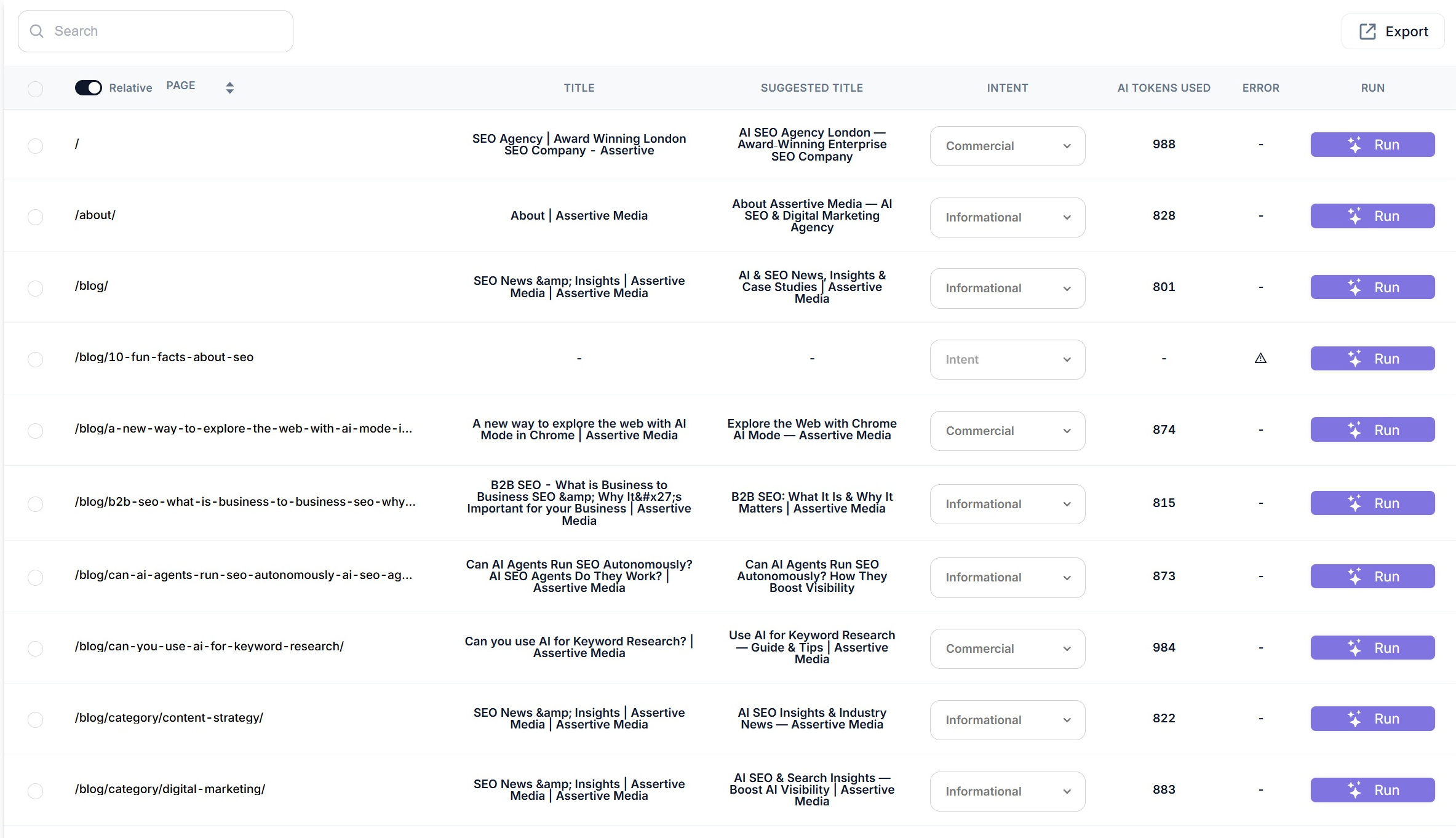
Page and current title
Pulled from the live page, so what you are looking at is what is actually deployed rather than what the CMS thinks is deployed. Relative or absolute URLs, whichever you work in.
Suggested title
Written against the detected intent and the subject of the page, and sitting directly next to the original so the comparison takes a second rather than a mental note.
Intent
A dropdown per row. Change it and the rewrite changes with it, which matters because a commercial page and an informational page on the same subject want completely different titles.
Error
Flagged where a page has no title at all. Finding those is worth the run on its own, because a page with no title is a page Google is inventing one for.
AI tokens used
Shown per row, so a bulk run across several hundred pages has no surprises attached to it.
Export
The whole set of rewrites out in one file, ready for a CMS import or for whoever is going to put them live.
The intent step
The same page needs a different title depending on why people arrive
This is the step that separates a useful rewrite from a reworded one. A page about keyword research written for somebody trying to understand the subject wants a title that explains, and the same page written for somebody trying to do the job wants a title that promises the outcome. Getting that wrong is why plenty of well written titles never improve anything.
So the tool works the intent out per URL and shows it as a dropdown rather than hiding it. If you know the page better than the model does, change it, and the rewrite follows.
Informational
Explain what the page covers. Questions work here, and so does naming the format, i.e. guide, checklist or comparison.
Commercial
Somebody is comparing options, so the title needs to say what you offer and what makes it worth their click over the other nine.
Transactional
They are ready to act. Lead with the offer and the outcome, not with a definition of the category.
Navigational
They already know who you are, so the brand belongs at the front and the page needs to be identifiable at a glance.
Why title tags matter
One line of text, doing three jobs at once
Titles get treated as an afterthought because they are small, and they are the highest ratio of impact to effort on the entire page. Here is what that one line is actually doing.
The title is what earns the click
Ranking and being chosen are two different achievements. Your position decides whether you appear, the title decides whether anybody picks you over the nine other results on the screen, and only one of those two shows up in a rank tracker.
It is one of the clearest relevance signals you control
A search engine uses the title to work out what a page is about and which queries it is a sensible answer for. There are very few on-page elements where a single line of text carries that much weight, and fewer still that take five minutes to change.
Length decides whether the message survives
Beyond roughly sixty characters the title gets cut off in the result, which usually means the brand name disappears and the second half of your sentence goes with it. Plenty of sites have their best differentiator sitting in the part nobody ever sees.
Google will rewrite a bad one for you
If your title does not match the query well, Google will generate its own from the page, and what it produces is rarely what you would have chosen. Writing a good one is how you keep control of what appears.
It matters for AI answers as well
Models retrieving and summarising pages lean on the same signals, so a clear title that states plainly what the page is about makes you easier to summarise correctly and easier to cite.
It is the fastest change in SEO
No new content, no developer time, no waiting for a crawl of a new page. Change the line, wait for a recrawl, and the click-through rate moves or it does not, which makes it one of the few genuinely quick tests available.
Worth being clear about
Rewriting a title is not guaranteed to improve anything, and a rewrite that moves further away from the query can make the click-through rate worse. So treat it as a change to be measured rather than an improvement to be assumed: note the date, watch the CTR on that URL over the following weeks, and put the old one back if it was better. It really does vary by page, which is exactly why being able to do it at volume matters.
How SEOs use it
What the Title Rewriter is actually good for
Fix the duplicated brand names
Templates that append the site name to a title that already ends in the site name are astonishingly common, and a bulk run finds every instance of it in one pass.
Find the pages with no title at all
The error column flags them, and those are the pages where Google is writing your title for you without ever asking.
Work the high impression, low CTR pages
Take the pages that are already being served plenty and clicked rarely, run those first, and you are changing titles where there is genuinely something to win.
Clean up after a migration
Migrations leave behind truncated titles, missing brand names and templates applied to the wrong page types. This is the fastest way to sort a few hundred of them out.
Give a client something visible
A before and after list of two hundred titles is a tangible deliverable in a discipline where most of the work is invisible, and it is genuinely useful rather than busywork.
Hand it straight to a developer
Export the set and the change becomes a data job rather than two hundred separate CMS edits somebody has to be talked through.
What you get out of it
The outcome, not the feature list
Get through a job everybody postpones in an afternoon rather than a fortnight
Stop losing your brand name to truncation on every long title
Match the title to what people are actually searching for
Connect a property. Watch the data start stacking.
Warehousing begins the moment you connect your Search Console property, there is no Google Cloud project to set up, no BigQuery and no schema to design. You simply connect your property and SEO Stack starts storing every row of your data from that day onwards.
- Credit card required
- Cancel within the trial and you won't be billed
- No contracts