Content & Optimisation
New in V3Audit a page the way a quality rater would, in about a minute
Runs eleven checks across keyword alignment, clarity of offering, calls to action, value proposition, content length, trust signals, NLP quality, overall quality, depth and coverage, and grammar and tone. Each one is colour coded from good to bad, scored out of ten against search intent, and comes with a written list of exactly what would move it.
- 100% data privacy
- 99.99% uptime
- Nothing to configure
- Export anytime, no limits
Trusted by leading companies
The problem
Content audits are slow, subjective and rarely produce a list anyone follows, because two people looking at the same page will disagree about whether it is any good and neither of them can prove it.
The tool
A quality review of any page, run against the query it is serving
The AI Content Auditor reads a page the way somebody assessing quality would, then reports back on eleven separate things, colour codes each one and tells you what would improve it. Because it is scored against the search intent behind your own lead query, the judgement is about whether this page answers that query well rather than whether the copy is nicely written.
Eleven checks, all in one pass
Keyword alignment, clarity of offering, calls to action, value proposition, content length, trust signals, NLP quality, overall quality, depth and coverage, and grammar and tone, each judged separately so a page that is strong in one place and weak in another shows up as exactly that.
Colour coded, so the verdict is instant
Green is good, the muddier green is fair, grey is neutral or missing, orange is poor and red is bad. Scanning the list takes seconds, which is what makes auditing forty pages a realistic afternoon rather than a project.
Every check comes with the fix
Opening a check gives you what the auditor found and what to do about it, written against your page rather than as general best practice, so it can be handed to a writer or a developer without translation.
Content checks
11 checks on this page
- Good6
- Fair3
- Neutral or missing2
- Poor
- Bad
Whether the query this page is being served for is genuinely the query this page is built to answer. Grey here means the auditor could not establish a clear alignment either way, which usually happens on pages that cover several services at once and never commit to one of them.
The page contains many relevant elements, an H1, services, case studies and testimonials, and it demonstrates authority, but it is diffuse. To align tightly with the target keyword, prioritise conversion focused content, tighten the proof near the top, add intent-mapped sections, implement structured data and provide explicit deliverables and timelines.
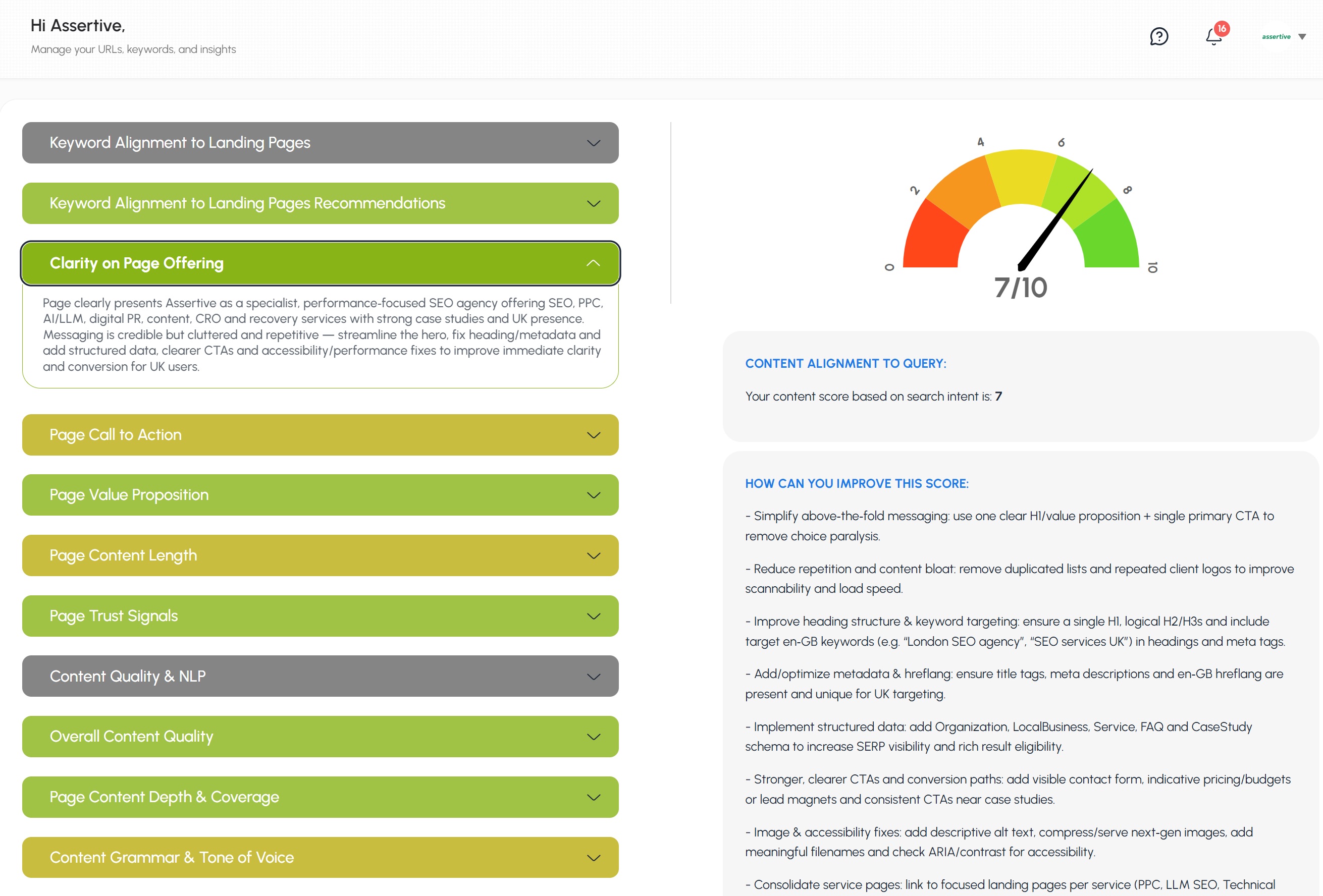
The page clearly presents the business as a specialist, performance focused agency offering SEO, PPC, AI and LLM, digital PR, content, CRO and recovery services, with strong case studies and a UK presence. Messaging is credible but cluttered and repetitive, so streamline the hero, fix the heading structure and metadata, and add structured data and clearer CTAs to improve immediate clarity and conversion.
Too many equal-weight CTAs with no single primary action in the hero, an overuse of generic learn more links, and no clear value tied to any of them. Inconsistent labels and placement reduce both conversion clarity and your ability to track what is working, and the mobile experience needs a sticky CTA with tappable phone and email buttons.
Whether somebody landing on this page understands within a few seconds what you do, who you do it for and why you rather than anybody else. A page can rank perfectly well and still fail this one, which is usually visible in the bounce rate long before it is visible in the rankings.
Length is judged against the pages currently ranking for the query rather than against a target word count, because 800 words is generous for one query and thin for another. Fair here means the page is inside the range but toward the shallow end of it.
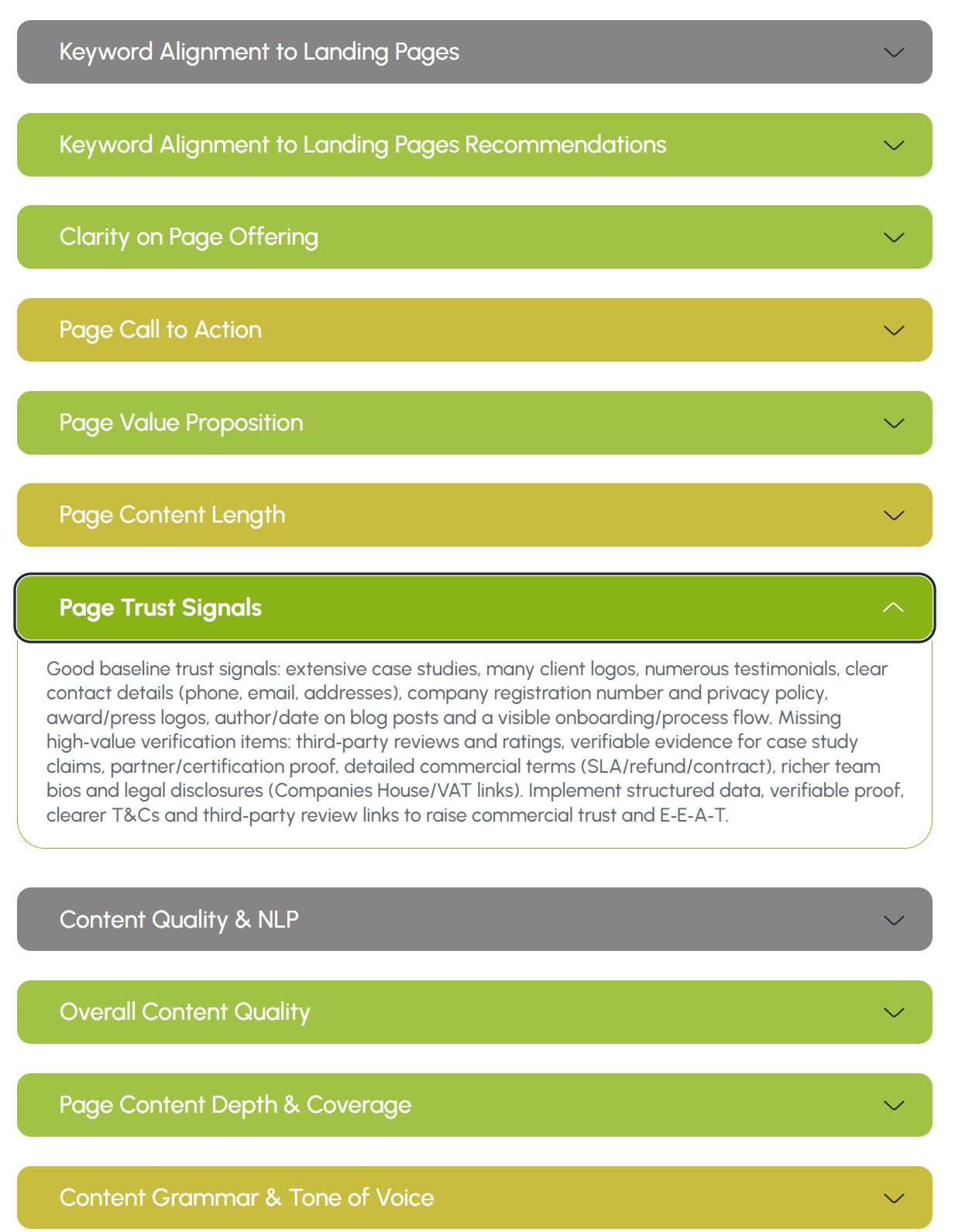
Good baseline trust signals: extensive case studies, client logos, testimonials, clear contact details, a company registration number, a privacy policy, award and press logos, and an author and date on blog posts. Missing the higher value verification items though, i.e. third party reviews and ratings, verifiable evidence for case study claims, certification proof and detailed commercial terms.
How well a machine can work out what the page is about from the entities on it, which is the same question the Content NLP tool answers in far more detail. Grey means there was not enough signal to call it either way, which on its own tells you something.
The summary judgement across everything else: is this a page a search engine would be comfortable putting in front of somebody, and is it a page a person would be satisfied with when they arrive.
Whether the page covers the subject to the depth the query implies, including the subtopics and objections the ranking pages handle. Depth and length are different things, and pages routinely pass one and fail the other.
Readability, grammar and whether the register matches the audience and the intent. A commercial page written in the tone of an academic paper, or a technical subject written as marketing copy, both cost you conversions that the rankings never show.
Illustrative wording. Open any check to read the finding, the colour is the verdict and the text is what to do about it.
Reading the results
Five colours, and you know where the work is before you read a word
The point of colour coding an audit is that the shape of a page is visible at a glance, so a run of grey and orange down the middle of the list tells you more in two seconds than a scored report tells you in ten minutes.
The page handles this properly. Worth reading the note anyway, because good rarely means finished.
Present but underdone. Usually the cheapest work on the whole audit, because the foundation is already there.
Not enough signal to call it either way, or the thing being checked for is simply absent from the page.
Actively holding the page back. These are the ones to take to whoever owns the template.
A serious problem for both the ranking and the person who lands on the page. Deal with these first.
The score
Out of ten, against the intent behind the query
Alongside the checks the auditor gives a content alignment score, which answers a narrower question than whether the page is good: does this page satisfy what somebody typing that particular query was actually after.
Score and guidance
Content alignment to query
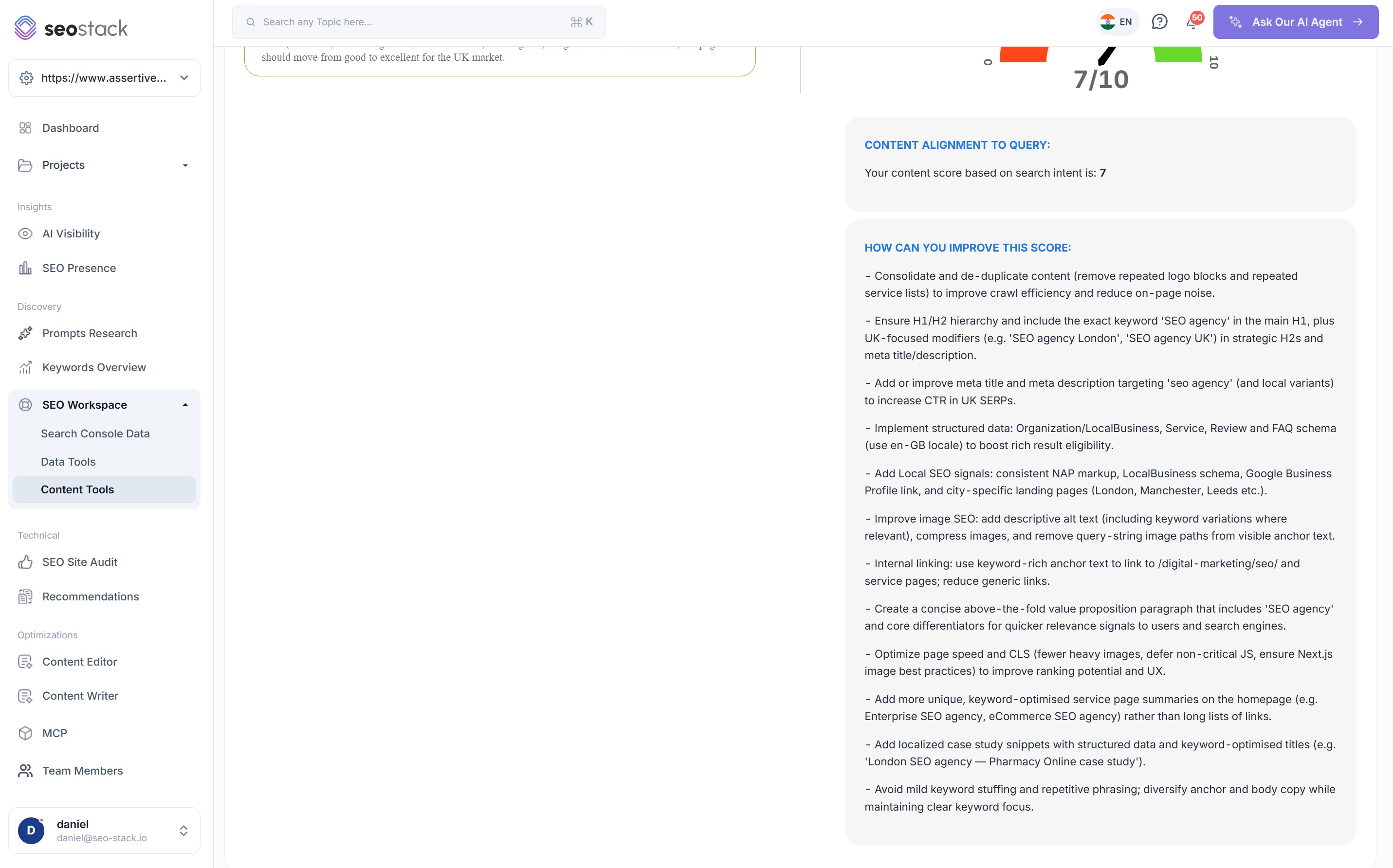
Content has strong topical relevance for the target keyword, with multiple occurrences, a clear service focus and solid case studies. On-page gaps reduce the potential: duplicate content, an inconsistent heading structure, missing title focus, image alt issues and no LocalBusiness or Service structured data.
How can you improve this score
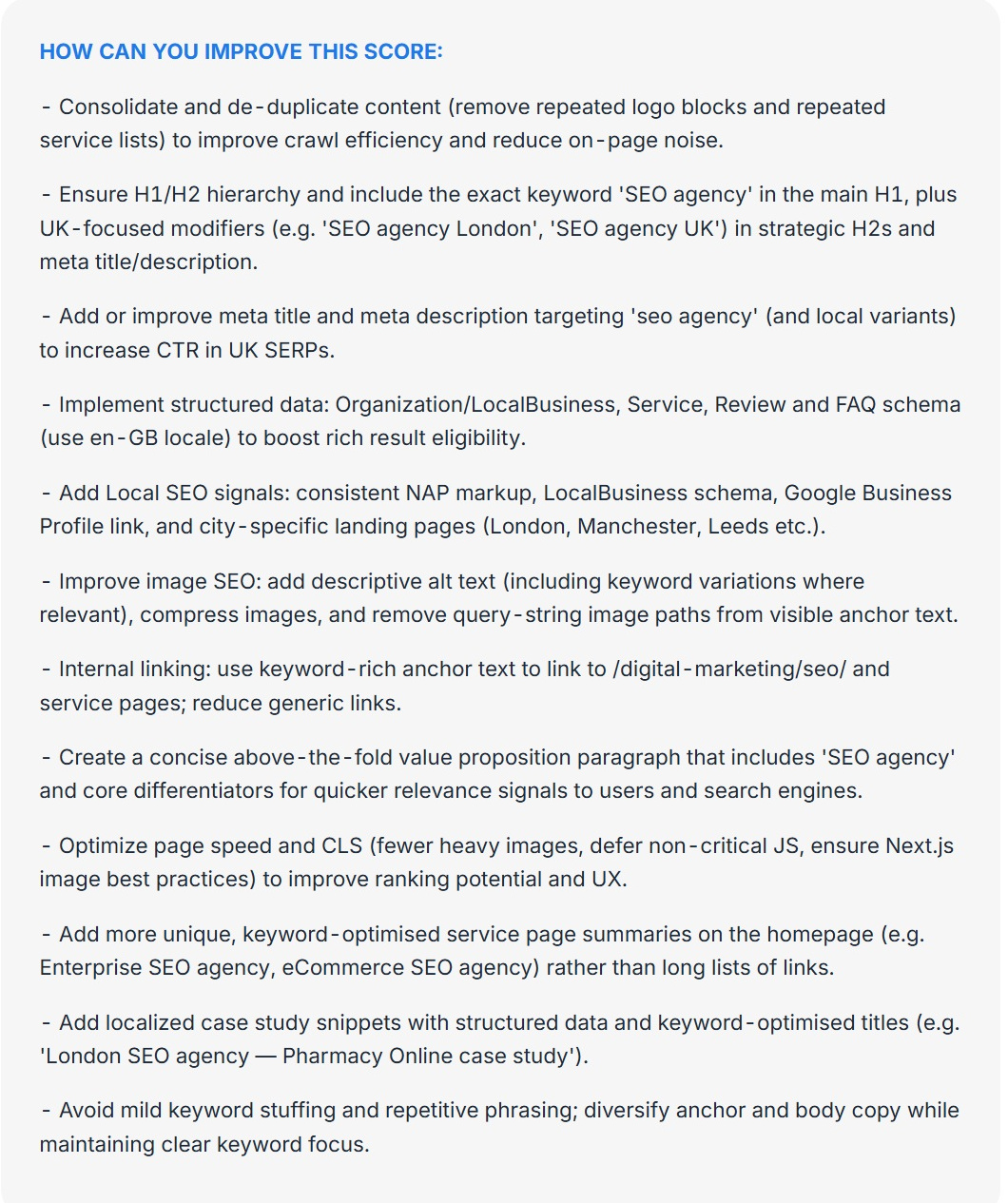
- Consolidate and de-duplicate content to improve crawl efficiency and reduce on-page noise
- Fix the H1 and H2 hierarchy and include the exact target keyword in the main H1
- Rewrite the meta title and description around the target keyword and its local variants
- Implement Organization, LocalBusiness, Service, Review and FAQ schema
- Add a concise above the fold value proposition paragraph that names the service
- Use keyword-rich internal anchors into the relevant service pages
- Choose one primary CTA for the hero and demote everything else
- Replace generic learn more links with action language that says what happens next
- Tie a clear benefit to each CTA, i.e. what the user gets and how quickly
- Make CTA labels and placement consistent so conversion can actually be tracked
- Give CTAs a distinct colour and size hierarchy rather than embedding them in body copy
- Add a sticky mobile CTA with tappable phone and email buttons
- Link out to third party reviews and ratings rather than hosting testimonials alone
- Provide verifiable evidence for the claims made in case studies
- Show certification and partner proof where you hold it
- Publish commercial terms, i.e. contracts, SLAs and refund policy
- Expand team bios so the people behind the work are identifiable
Illustrative. Switch check to see the dial move and the guidance change with it.
The improvement list is the deliverable
Underneath every score is a list of specific changes, i.e. consolidate duplicated content, put the exact keyword in the H1, add Organization and LocalBusiness schema, write a value proposition paragraph above the fold, fix the image alt text. Ten or twelve of them per check is normal, and they are written about your page rather than assembled from a checklist, which is the difference between an audit somebody implements and one that gets filed.
Naturally you will not do all of them, and you should not try. The list is there so the decision about what to do is an informed one rather than a guess.
Running an audit
Five settings, then it does the reading
The settings exist because the same page deserves a different verdict depending on who is meant to be landing on it, and getting the intent and the market right is what stops the audit being generic.
The URL
Any page on the property. The auditor fetches it, reads it and reports on what is actually live rather than on what the CMS says should be there.
The query
Your lead query by clicks, your lead query by impressions, or a custom query. The first two come straight out of Search Console, so the page gets judged against what Google is genuinely serving it for.
The intent
Commercial, informational, transactional or navigational. This is the setting that changes the verdict most, because a page that is excellent for an informational query can be a poor commercial page and the other way round.
The niche
Sets the standard the page is being held to, since what counts as adequate trust signalling on a recipe blog and on a financial services page are not remotely the same thing.
The market
Language and country, so the tone, spelling and local signals are judged against the right audience rather than a generic one.
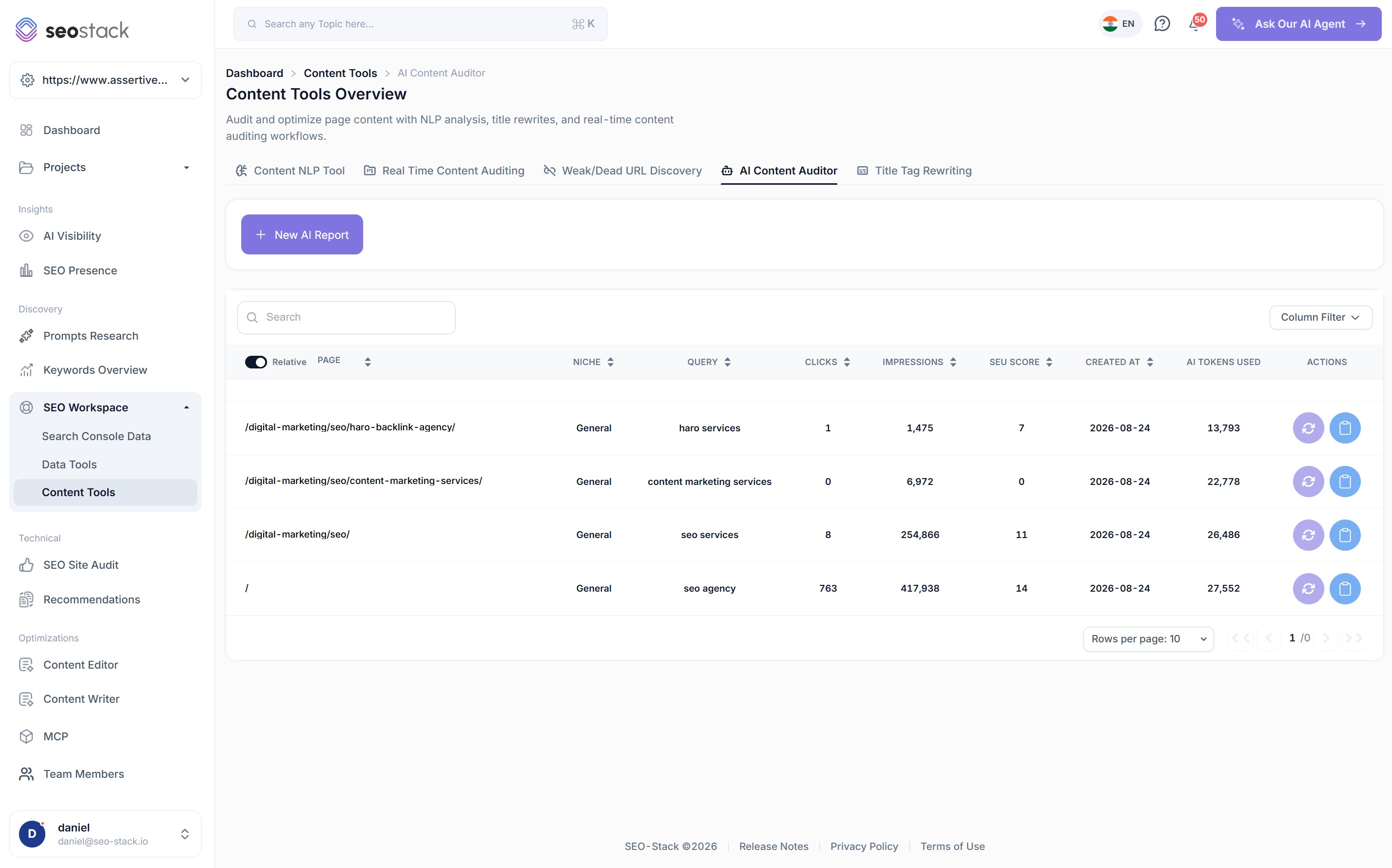
Every report is kept with the page, the query, the clicks, the impressions and the SEU score against it, so a page can be re-audited after the work and the two compared.
Pairs with the Content NLP tool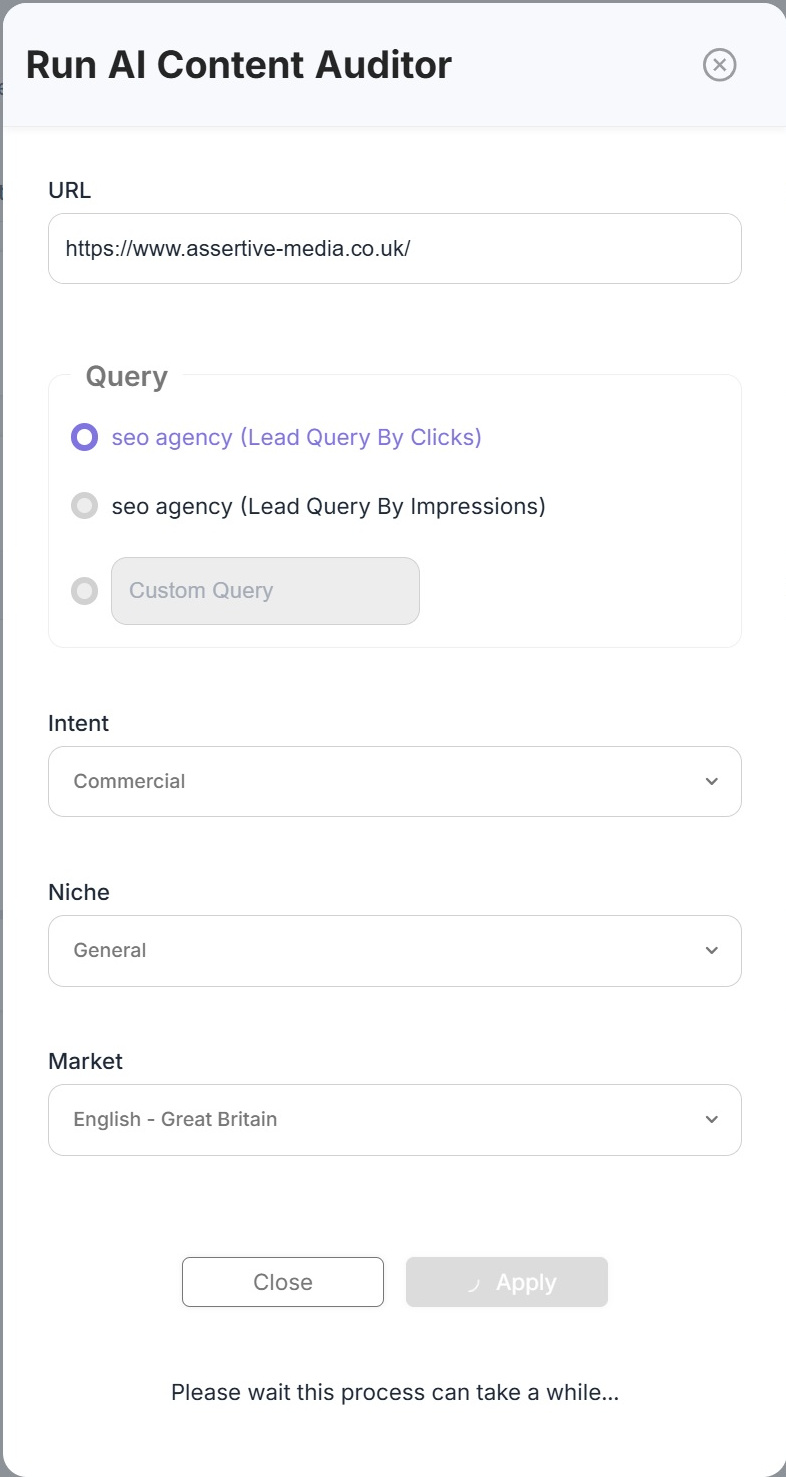
Inside the report
From the context down to the individual change
The numbers the audit was made against
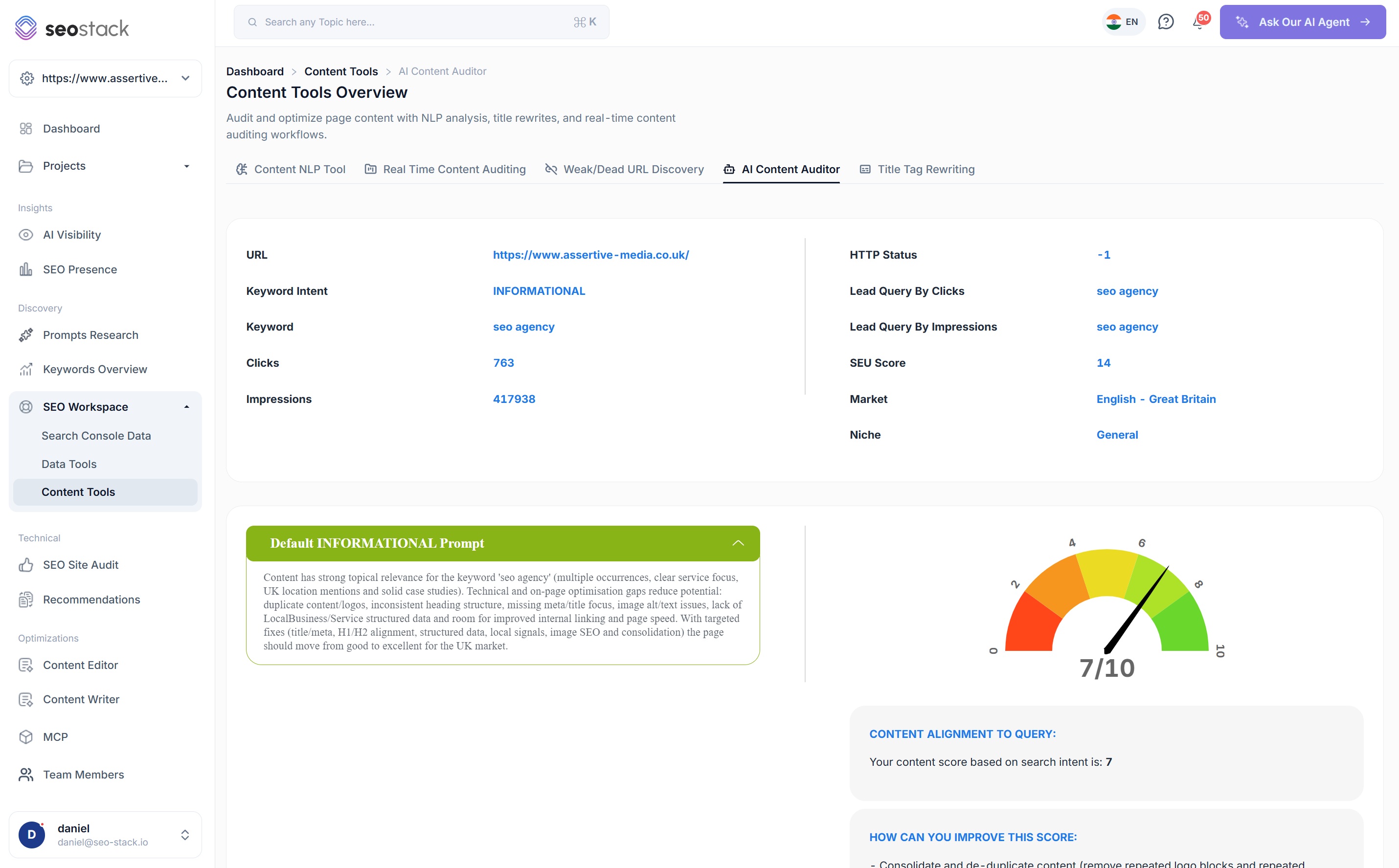
- The URL, the keyword and the keyword intent the audit was run for
- Clicks and impressions for that page, so the audit sits next to its actual performance
- Lead query by clicks and lead query by impressions, which are often two different queries
- The SEU score, the market and the niche the page was judged against
- HTTP status, so a page returning something unexpected is obvious before you read further
Two lead queries, one page
When the query bringing you clicks and the query bringing you impressions are different, the page is being served for something it is not converting on, which is worth auditing against both.
Eleven verdicts, colour coded, each expandable
- Every check collapses to a single colour coded bar, so the whole page reads in seconds
- Open any one for the written finding, covering what is there and what is missing
- Keyword alignment gets its own recommendations block, separate from the verdict
- The findings are specific, i.e. which trust signals you have and which verification items you do not
A dial, a summary and a list of changes
- A 0 to 10 dial with the same colour scale running across it
- A one paragraph summary of what is working and what is holding the page back
- The full improvement list underneath, usually ten or more specific changes
- Written for the query and the market you selected rather than in the abstract
Every audit kept, with the performance beside it
- One row per report with the page, the niche and the query it was run against
- Clicks, impressions and SEU score, so the audits can be sorted by what matters commercially
- The date and the AI tokens the report used
- Re-run any audit in place after making the changes
Why the checks matter
What each of these actually does for the ranking
None of these checks are stylistic. Each one maps onto something a search engine either measures directly or infers from behaviour, which is why the same list keeps appearing in guidance about content quality, and why bringing a page up on all eleven is usually what moves it.
Intent alignment decides whether ranking is even possible
If the ten pages ranking for a query are all comparison guides and yours is a sales page, no amount of on-page work will get you there, because Google has already established what kind of answer that query wants. The keyword alignment check is the one that catches this, and it is by far the most expensive mistake on the list to leave in place.
Clarity and value proposition change what happens after the click
A page can rank and still fail, because somebody arrives, cannot tell within a few seconds what you do or why you, and goes back to the results. That behaviour is visible to Google well before it is visible to you, and it tends to feed back into the ranking rather than sitting harmlessly in your analytics.
Trust signals are what quality assessment is built on
Verifiable evidence, third party reviews, real authors, commercial terms and identifiable people are the things a rater looks for and the things a model looks for when deciding whether to cite you. Testimonials you host yourself are the weakest form of this, which is exactly what the trust check keeps flagging.
Depth and coverage are how relevance gets judged
Length is not the point, coverage is. A page that handles the subtopics and the objections the ranking set handles gives an engine far more reason to consider it a complete answer, and a page that covers a third of them gives it a straightforward reason not to.
Calls to action turn rankings into revenue
This one is not an SEO check in the traditional sense and it is usually the one with the most money attached to it. A page ranking second with no clear primary action is losing more than a page ranking fifth with a good one, and neither of those facts appears in a rank tracker.
The same signals decide whether an AI answer cites you
Language models retrieve and summarise, and the pages they can summarise confidently are the ones where the offering is stated plainly, the entities are unambiguous and the claims are verifiable. Nearly every check here improves that at the same time as it improves the ranking.
Raising the standard
How a page gets from fair to genuinely competitive
The reason most content never improves is not that people do not know it needs work, it is that nobody can say specifically what work, so the page gets rewritten once, feels a bit better and performs identically. Working from a scored audit removes the argument from the process.
Audit and record where the page is
Run the audit against the query the page is actually being served for and keep the report, so the starting position is written down rather than remembered.
Take the reds, then the oranges, then the greys
Work in colour order rather than in list order. The reds are costing you now, the oranges are holding you back, and the greys are usually the cheapest to fix because something is simply absent.
Make the changes the guidance names
The improvement list is specific enough to hand over, which means the work can be split between a writer, a developer and whoever owns the template without three separate briefings.
Re-audit and compare
The colours moving and the score moving is the evidence. It is a far better answer to did that work than looking at rankings a fortnight later and hoping the timing lines up.
Worth being clear about
Bringing every check to green does not guarantee a ranking, and anybody telling you otherwise is selling something. What it does is remove the reasons a page would not rank, which matters a great deal when the pages you are competing against are strong. It really does vary by query how much of the gap is content and how much of it is links or brand, so the sensible way to read a good audit score is that the content is no longer the thing holding you back.
How SEOs use it
What the AI Content Auditor is actually good for
Work out why a page will not move
When a page is technically fine, well linked and still stuck, the auditor usually names the reason in the first three checks, and intent misalignment is the most common answer.
Audit a whole section in an afternoon
Because the verdict is colour coded, twenty reports can be scanned in the time it takes to read one traditional audit, which makes reviewing a template or a section realistic.
Give a client something they can act on
A colour coded list with written recommendations is a far easier document to present than a spreadsheet, and it makes the case for the work without you having to argue it.
Fix the conversion side while you are there
The CTA, clarity and value proposition checks are commercial rather than technical, so an SEO audit ends up improving what happens after the click as well as the ranking.
Build a trust checklist for the whole site
The trust signal findings repeat across pages, so what starts as one page audit usually turns into a list of things to add to every template, i.e. review links, verifiable claims and clearer terms.
Take it further with the AI assistant
The audit tells you what to change, and the assistant is reading the same warehoused data underneath, so you can ask it to draft the value proposition or the headings rather than starting from a blank page.
What you get out of it
The outcome, not the feature list
Turn a vague this page underperforms into a specific list of fixes
Audit at a pace that makes reviewing a whole site realistic
Give a writer or a developer the change rather than the criticism
Connect a property. Watch the data start stacking.
Warehousing begins the moment you connect your Search Console property, there is no Google Cloud project to set up, no BigQuery and no schema to design. You simply connect your property and SEO Stack starts storing every row of your data from that day onwards.
- Credit card required
- Cancel within the trial and you won't be billed
- No contracts