Content & Optimisation
New in V3Find dead content without killing pages that never had a chance
One list of every weak and dead URL on the site, with the age of index against each one, so a page published three weeks ago is never mistaken for a failure while a two year old page earning four clicks gets flagged for exactly what it is.
- 100% data privacy
- 99.99% uptime
- Nothing to configure
- Export anytime, no limits
Trusted by leading companies
The problem
Every find your dead content method flags brand new pages that simply have not had time to perform yet, which is how content pruning ends up killing things that were only a month from working.
The tool
Every underperformer, with the context to judge it
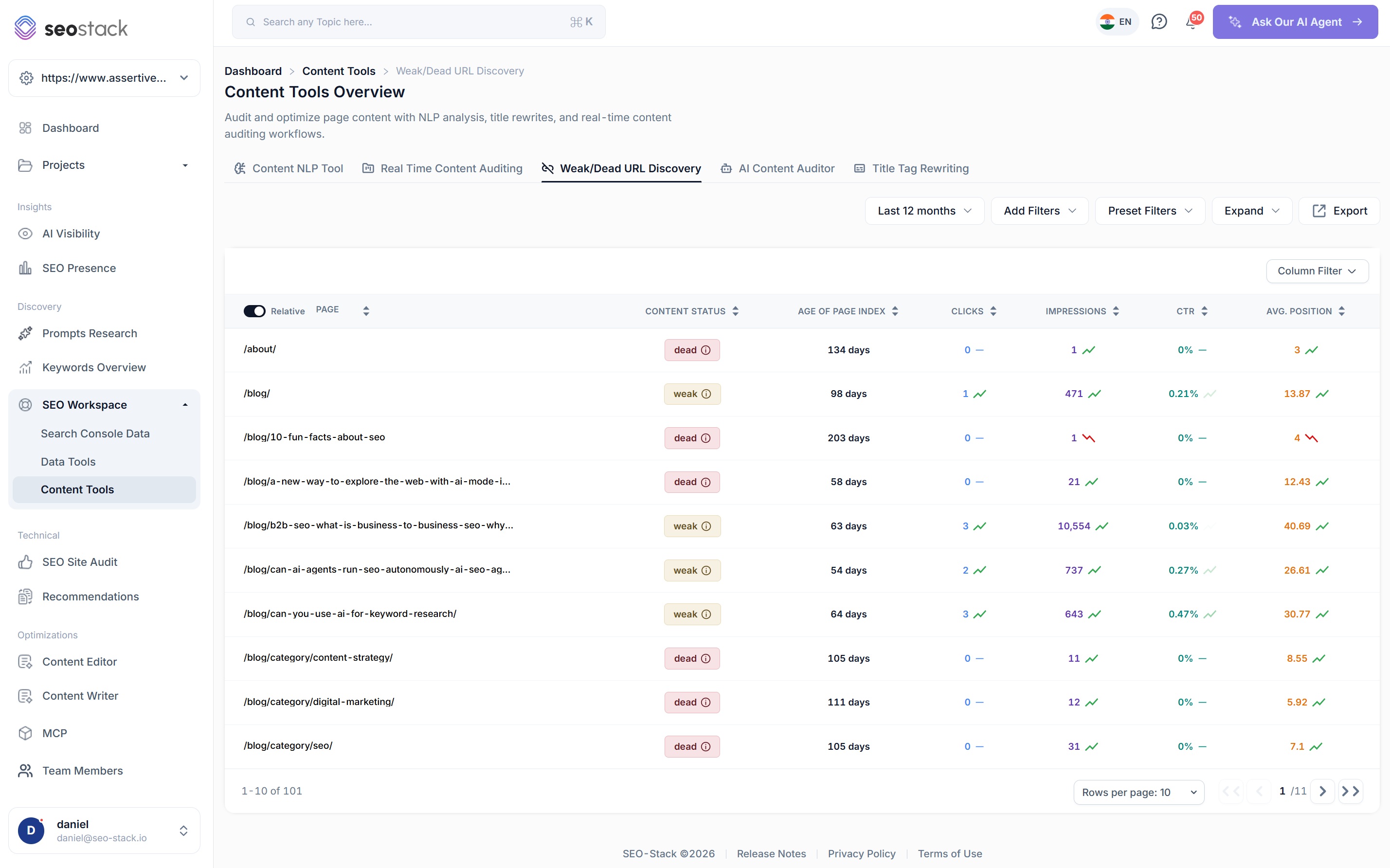
Weak and Dead URL Discovery pulls the two lowest performing bands out of your index into a single table you can sort and filter. It is a deliberately simple tool, and the whole reason it exists is that the obvious version of it, a list of pages with no clicks, is actively dangerous without the age column next to it.
One list, both problems
Weak and dead URLs together rather than in two separate reports, because the decision you are making about them is the same decision: improve it, consolidate it, redirect it or remove it.
Age of index on every row
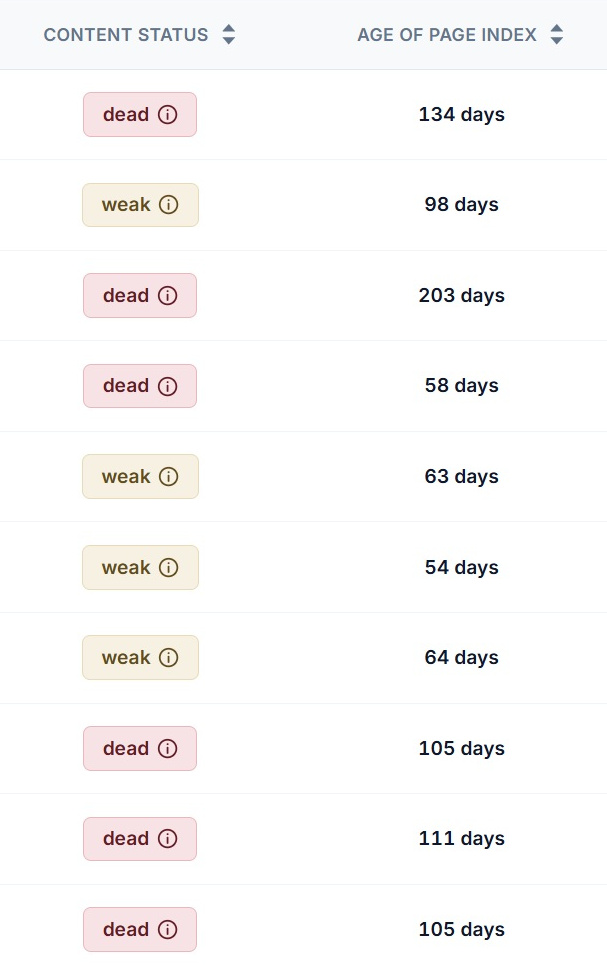
The column that makes the list usable. A page indexed six weeks ago with no clicks is a page that has not had time yet, and a page indexed two years ago with no clicks is a page that has had every chance, and no other underperformer report tells you which is which.
The numbers that put it there
Clicks, impressions, CTR and average position sit on the same row with trend arrows, so you can tell a page that is recovering from one that is still falling before you decide anything about it.
Weak & dead URL discovery
Last 12 months
Indexed at least
7 of 15 URLs shown, 8 too young to judge
| Page | Status | Age of index | Clicks | Impressions | CTR | Avg. position |
|---|---|---|---|---|---|---|
| /blog/10-fun-facts-about-seo | dead | 203 days | 0 | 1 | 0% | 4 |
| /case-studies/sci-mx-nutrition-ltd/ | dead | 156 days | 0 | 61 | 0% | 11.66 |
| /about/ | dead | 134 days | 0 | 1 | 0% | 3 |
| /digital-marketing/seo/industries/ | dead | 129 days | 0 | 74 | 0% | 8.69 |
| /blog/category/digital-marketing/ | dead | 111 days | 0 | 12 | 0% | 5.92 |
| /blog/category/content-strategy/ | dead | 105 days | 0 | 11 | 0% | 8.55 |
| /blog/ | weak | 98 days | 1 | 471 | 0.21% | 13.87 |
| /blog/can-you-use-ai-for-keyword-research/ | weak | 64 days | 3 | 643 | 0.47% | 30.77 |
| /blog/b2b-seo-what-is-business-to-business-seo/ | weak | 63 days | 3 | 10,554 | 0.03% | 40.69 |
| /blog/traditional-seo-vs-llm-optimisation/ | dead | 62 days | 0 | 1 | 0% | 12 |
| /blog/a-new-way-to-explore-the-web-with-ai-mode/ | dead | 58 days | 0 | 21 | 0% | 12.43 |
| /case-studies/casinofy | dead | 55 days | 0 | 4 | 0% | 3 |
| /blog/can-ai-agents-run-seo-autonomously/ | weak | 54 days | 2 | 737 | 0.27% | 26.61 |
| /get-proposal/ | dead | 48 days | 0 | 12 | 0% | 2.58 |
| /blog/how-seo-helps-private-clinics/ | dead | 38 days | 0 | 36 | 0% | 20.69 |
- Old enough to judge
- 7
- Dead among them
- 6
- Too young
- 8
Illustrative. Raise the age threshold and the pages that have not had time to perform drop out, which is the difference between a prune list and a list of everything you published this quarter.
The age column
A page with no clicks is not automatically a bad page
New content takes months to settle. It gets indexed, gets served for a handful of odd queries, drifts around while Google works out what it is for, and only then starts earning anything, so judging it at four weeks tells you almost nothing.
Under 90 days, no clicks
Leave it alone, or give it internal links and see what happens. Deleting a page at this age tells you nothing about whether it would have worked, and you can never run the experiment again.
Over a year, no clicks
Google has had twelve months to find a reason to serve this page and has not found one. That is a relevance verdict rather than a timing problem, and it is safe to act on.
Old, weak, but impressions climbing
The trend arrows matter here. A page earning three clicks with impressions rising is on its way somewhere, and pruning it would be throwing away the one thing that was working.
Old, weak, and still falling
Consolidation or removal, depending on whether anything else covers the subject. A page that has been declining for a year very rarely turns around on its own.
What is in the table
Seven columns, and nothing you have to interpret
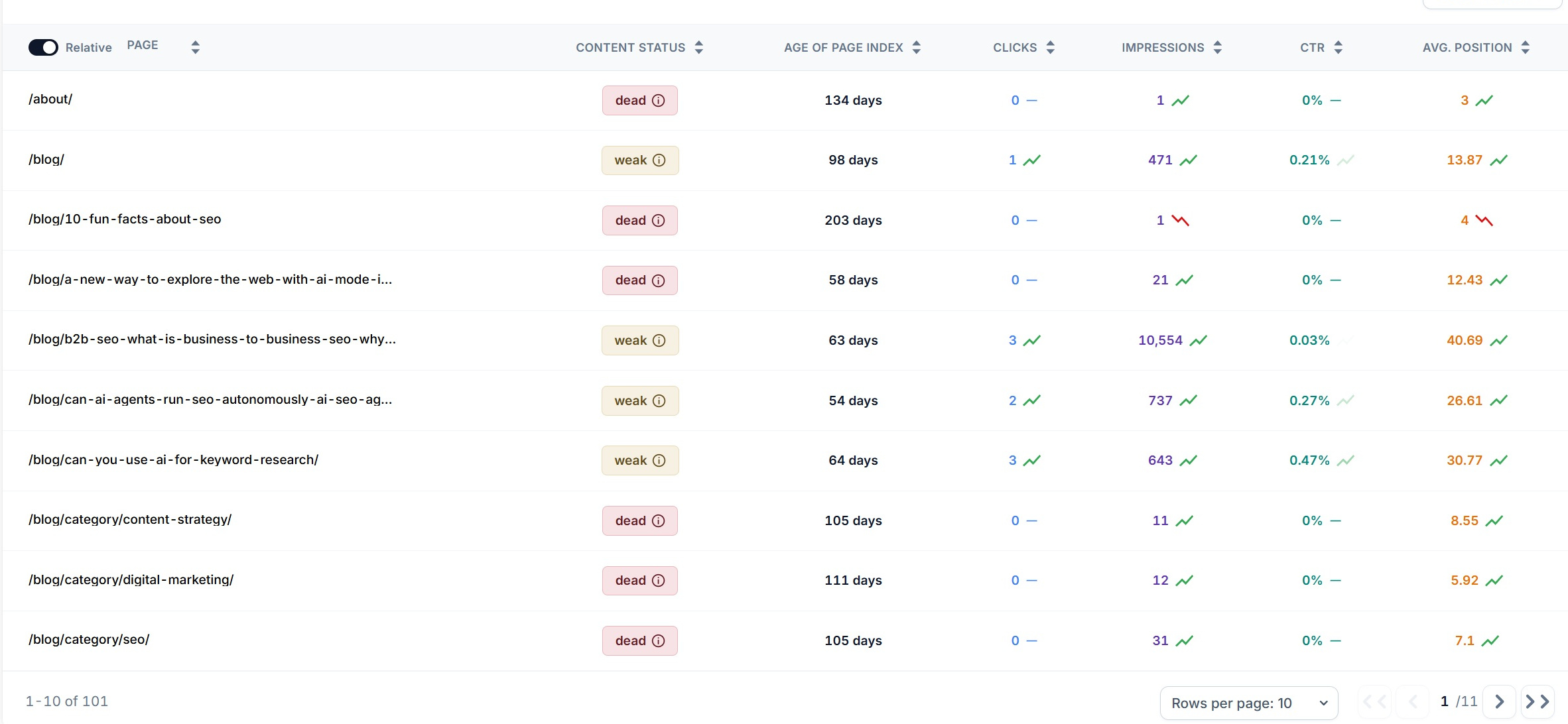
There is no score here and no black box. Every column is a fact about the URL, which is deliberate, because the output of this tool is usually going to be handed to somebody who will want to know exactly why a page is on the list.
Page
The URL, relative or absolute, whichever you prefer to work with. Sortable, so a folder's worth of pages can be brought together in one click.
Content status
Weak or dead, using the same published thresholds as the index performance bands, so the two tools always agree with each other.
Age of page index
How long the URL has been indexed, in days. Sort by it and the pages with no excuse left rise to the top of the list.
Clicks and impressions
The numbers that classified it, with a trend arrow on each, so you can see whether the page is going nowhere or on its way somewhere.
CTR and average position
A page ranking in the twenties with no clicks is a ranking problem, and a page ranking in the top five with no clicks is a title problem. Very different jobs.
Export
The whole list, with no row limits, for when the prune list has to be reviewed by somebody who does not have a login.
What to do with the list
Four options, and deleting is only one of them
Content pruning has a bad reputation because it is usually treated as a delete list, and plenty of sites have made things measurably worse by removing pages that were carrying links or covering a subject nothing else did.
Improve
For pages ranking well with no clicks, or ranking badly on a subject you genuinely want. Usually a title, a value proposition and better coverage rather than a rewrite from scratch.
Consolidate
For the three thin posts covering the same subject. Merge them into one proper page and redirect the others, which almost always outperforms leaving all three in place.
Redirect
For pages with nothing left to say but with external links or a sensible destination. Redirecting keeps whatever equity they carry rather than throwing it away.
Remove
For pages with no links, no traffic, no purpose and no destination. The smallest group of the four, and the one people reach for first far too often.
Then watch the dead band actually shrink
This tool gives you the list, and Index Performance gives you the picture, so once the work is done you can annotate the clean-up and watch the dead band fall over the following months. That is the part that makes pruning defensible, because the traffic barely moves at first and the composition moves immediately.
How SEOs use it
What Weak & Dead URL Discovery is actually good for
Build a defensible prune list
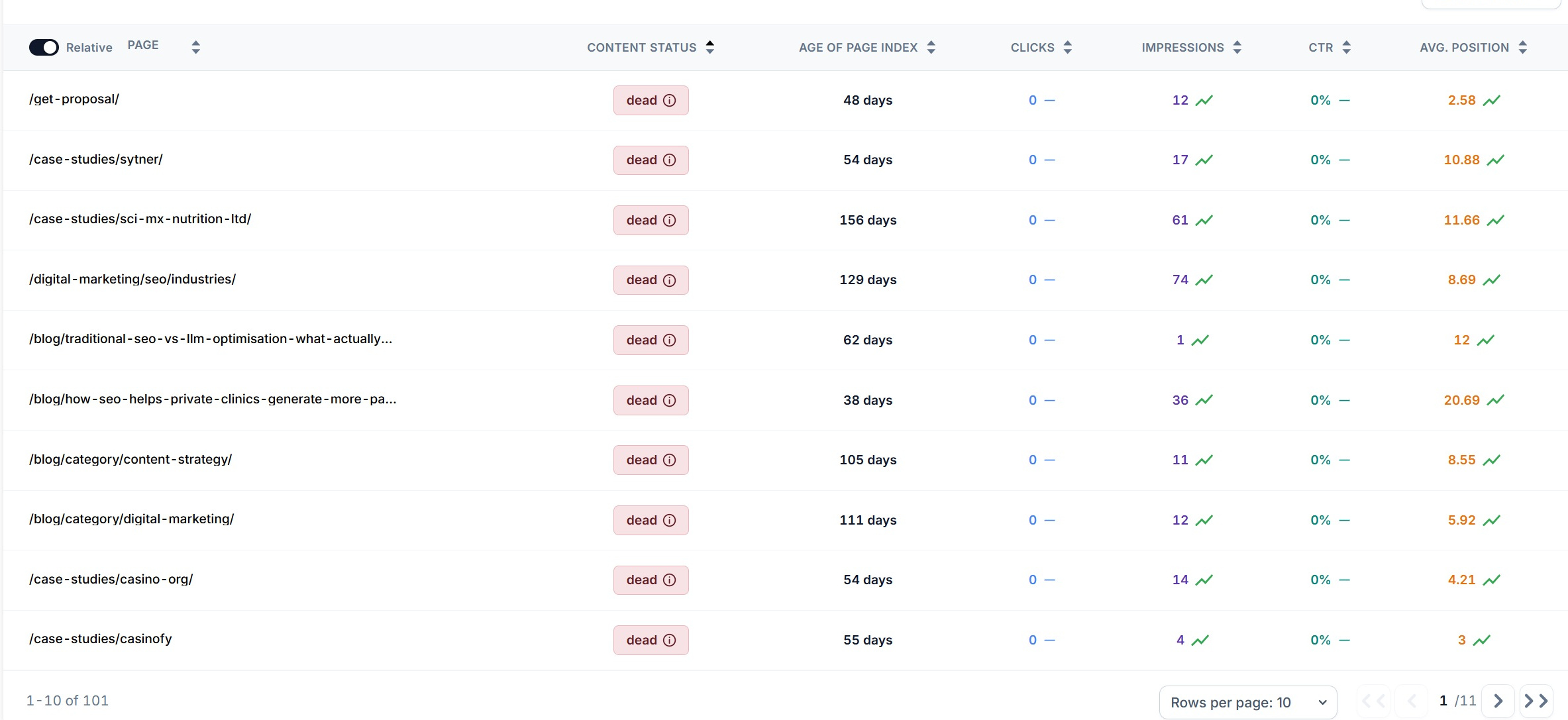
Sort by age, take everything over a year old with no clicks and rising nothing, and you have a list where every row can be justified on its own without anybody having to trust your judgement.
Audit a content programme honestly
Filter to the blog and sort by age. If everything published eighteen months ago is still sitting in the dead band, that is a finding about the programme rather than about the pages.
Separate title problems from content problems
A dead page ranking at position three is not a dead page, it is a page with a title nobody clicks. Those get fixed in an afternoon and never get found in a report that only looks at clicks.
Have the conversation about publishing volume
A hundred and one weak or dead URLs out of a hundred and thirty eight is a very direct way of asking whether publishing more is the right plan, and it is much easier to have that conversation with a table than with an opinion.
What you get out of it
The outcome, not the feature list
Build a prune list you can defend line by line
Stop deleting pages that were three weeks from performing
Separate the pages worth improving from the pages worth removing
Connect a property. Watch the data start stacking.
Warehousing begins the moment you connect your Search Console property, there is no Google Cloud project to set up, no BigQuery and no schema to design. You simply connect your property and SEO Stack starts storing every row of your data from that day onwards.
- Credit card required
- Cancel within the trial and you won't be billed
- No contracts