Content & Optimisation
New in V3Run an NLP audit on any page and find out what it is missing
Generate a detailed NLP brief for any URL against any target query. You get a content score and a search engine understanding score, every topic the ranking pages cover with how often they use it against how often you do, full SERP analysis, related keyword groups, the questions people are actually asking, a recommended content structure and a topic chart of the whole subject.
- 100% data privacy
- 99.99% uptime
- Nothing to configure
- Export anytime, no limits
Trusted by leading companies
The problem
You can feel that a page is thin, but proving what is actually missing, how much of it to add and whether the edit made any difference is guesswork, so most content briefs end up being somebody's opinion written down.
The tool
An NLP audit for any URL, against any query
Point the Content NLP tool at a page, choose the query to audit it against, and it reads your copy alongside every page currently ranking for that term, then writes a brief covering what is there, what is not, and how much of it the pages beating you are using.
Two scores, measuring two different things
The content score tells you how well the page covers the subject against everything already ranking for it, and the search engine understanding score tells you how clearly a machine can work out what the page is actually about, which are not the same problem and rarely have the same fix.
The missing topics, named
Rather than telling you the page is thin, the brief lists every topic the ranking pages cover, how often each one appears in their copy and how often it appears in yours, so a zero in that column is a specific instruction rather than a feeling.
Built from your own query data
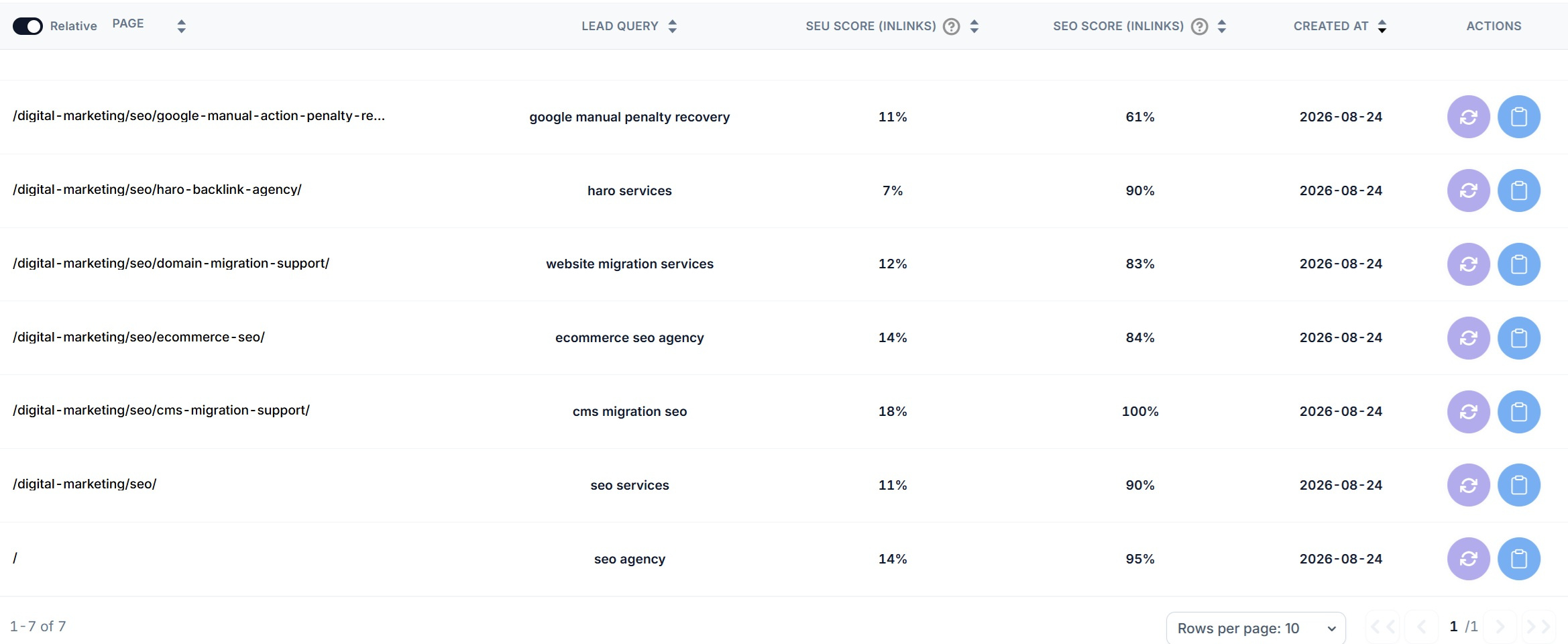
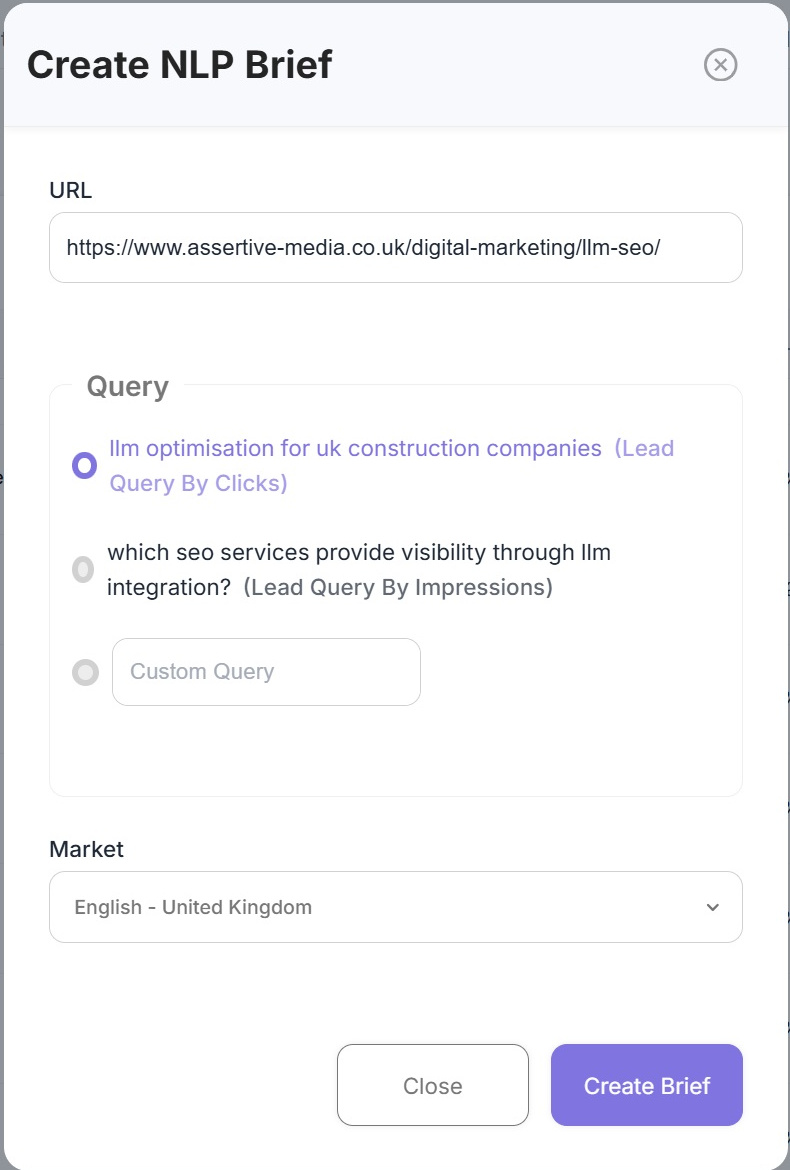
When you create a brief the tool offers your lead query by clicks and your lead query by impressions straight from Search Console, so the page is audited against what it is genuinely being served for rather than the keyword somebody once decided it should target.
Topics analysis
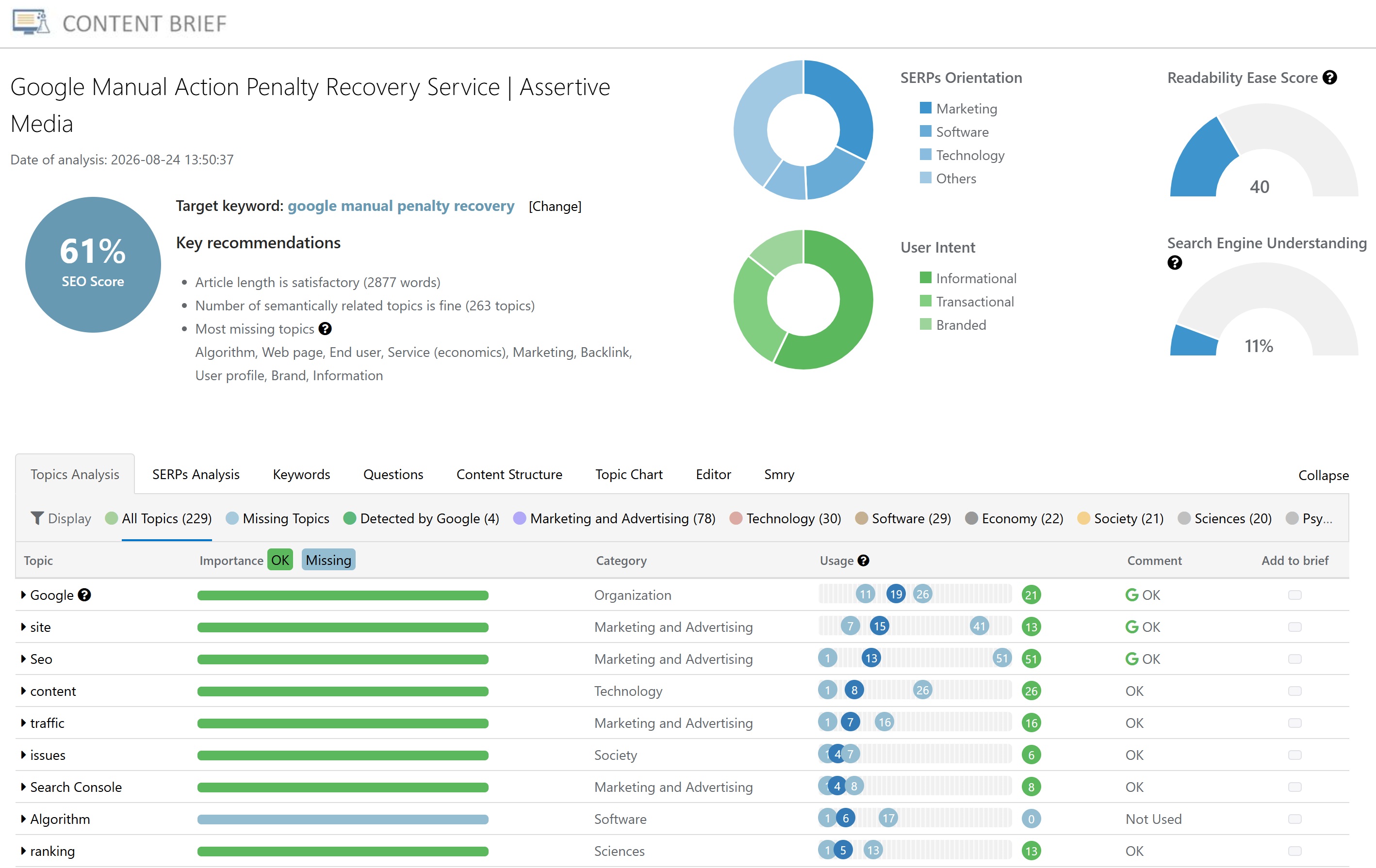
google manual penalty recovery
- 61%
- SEO score
- 11%
- Search engine understanding
- 40
- Readability ease
- 2,877
- Words on page
| Topic | Importance | Top pages | You | Comment |
|---|---|---|---|---|
| GoogleOrganization | 19 | 21 | OKDetected by Google | |
| siteMarketing and Advertising | 15 | 13 | OKDetected by Google | |
| SeoMarketing and Advertising | 13 | 51 | OKDetected by Google | |
| contentTechnology | 8 | 26 | OK | |
| trafficMarketing and Advertising | 7 | 16 | OK | |
| Search ConsoleMarketing and Advertising | 4 | 8 | OK | |
| AlgorithmSoftware | 6 | 0 | Not used | |
| rankingSciences | 5 | 13 | OK | |
| Google PenaltyMarketing and Advertising | 8 | 2 | OK | |
| pageMarketing and Advertising | 5 | 0 | Not used | |
| recovery serviceEconomy | 8 | 4 | OK | |
| backlinkMarketing and Advertising | 4 | 0 | Not used | |
| User profileTechnology | 3 | 0 | Not used | |
| End userEconomy | 3 | 0 | Not used |
Illustrative. 14 of 14 topics showing, and the column worth looking at is the gap between what the ranking pages use and what you do.
Running a brief
Pick a URL, pick a query, then work the brief
The setup is deliberately short, because the useful part is the analysis rather than the configuration, and the two query options that matter most are already sitting in your Search Console data.
- 01
Choose the URL
Any page on the property, including one you have not published yet if you point it at a staging URL.
- 02
Choose the query
Your lead query by clicks, your lead query by impressions, or a custom query when you are writing for something the page does not rank for yet. The first two come straight out of your Search Console data.
- 03
Choose the market
Language and country, because the ranking set for the same phrase in the UK and the US is often a completely different group of pages with a completely different idea of the subject.
- 04
Read, edit, regenerate
Work through the brief, make the changes, then run it again. The score moving is the only reliable evidence that the edit did anything.
Inside the brief
Six views of the same subject
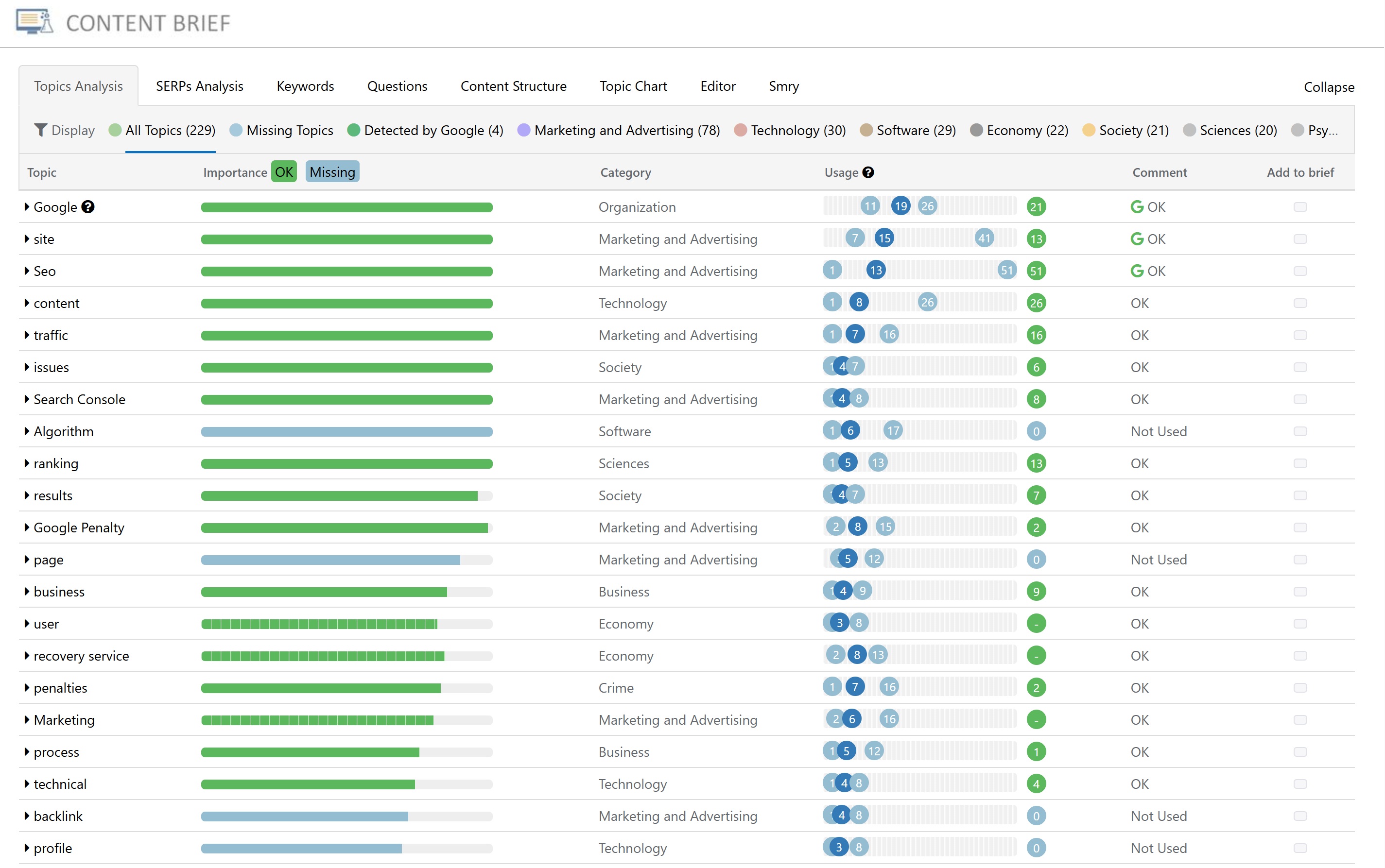
Every topic, and how much of it you use
- One row per topic with an importance bar, a category and a comment of OK or Not Used
- The usage column shows the range across the ranking pages next to your own count
- Filter to missing topics, to a single category, or to the topics Google has actually detected on your page
- Add any topic straight to the brief, so the writer gets a list rather than a report
- Hundreds of topics in a typical analysis, ranked so the top of the table is the work
The zero column is the whole point
A topic the ranking pages mention six times and your page mentions zero times is not an opinion about your writing, it is a gap you can close in an afternoon.
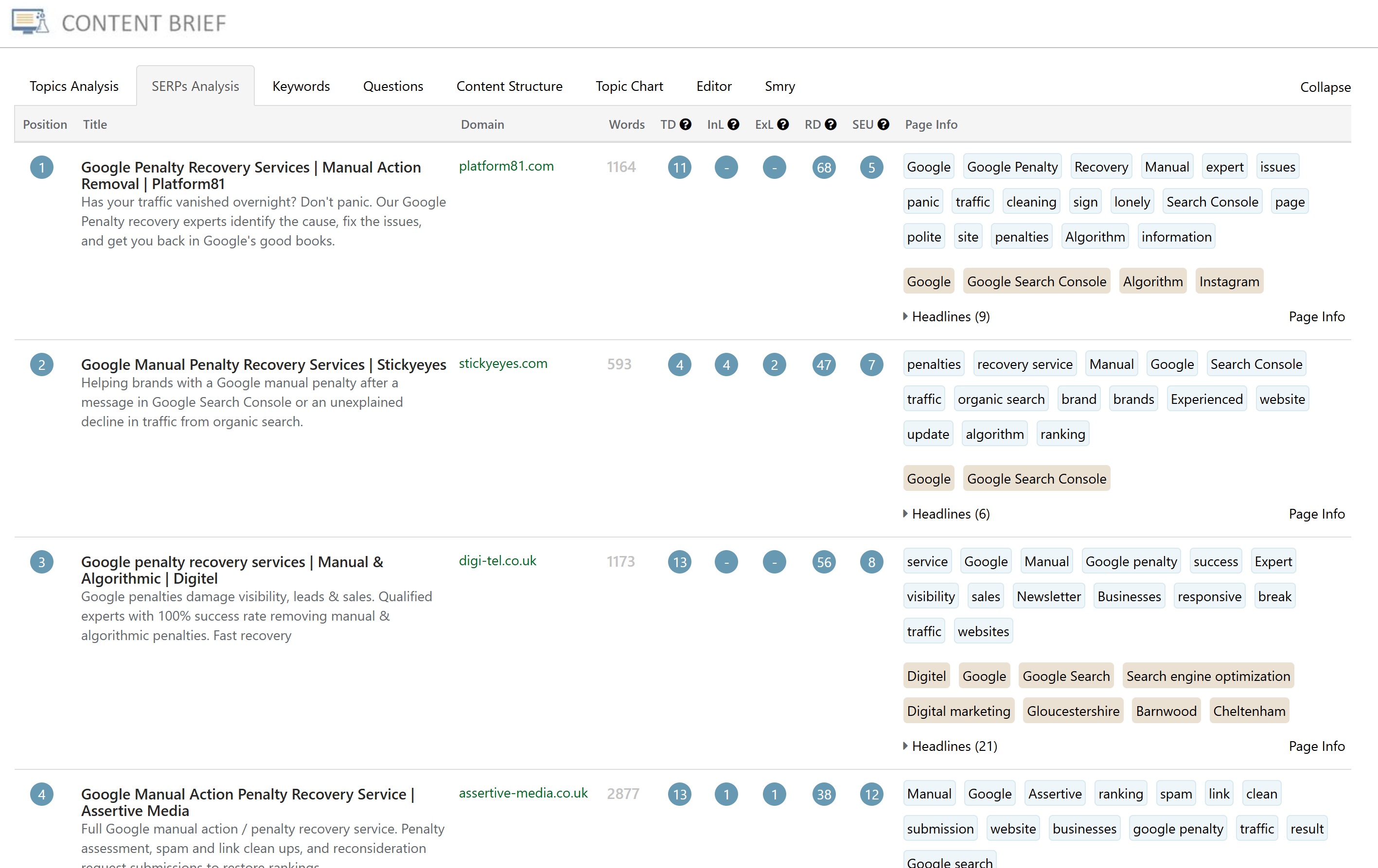
What the pages beating you actually look like
- Every ranking page with its position, title, meta description and domain
- Word count, topical density, internal links, external links and referring domains against each one
- A search engine understanding score for each competitor, not just for you
- The topics and entities detected on each page, listed out
- Their headline structure, expandable per result
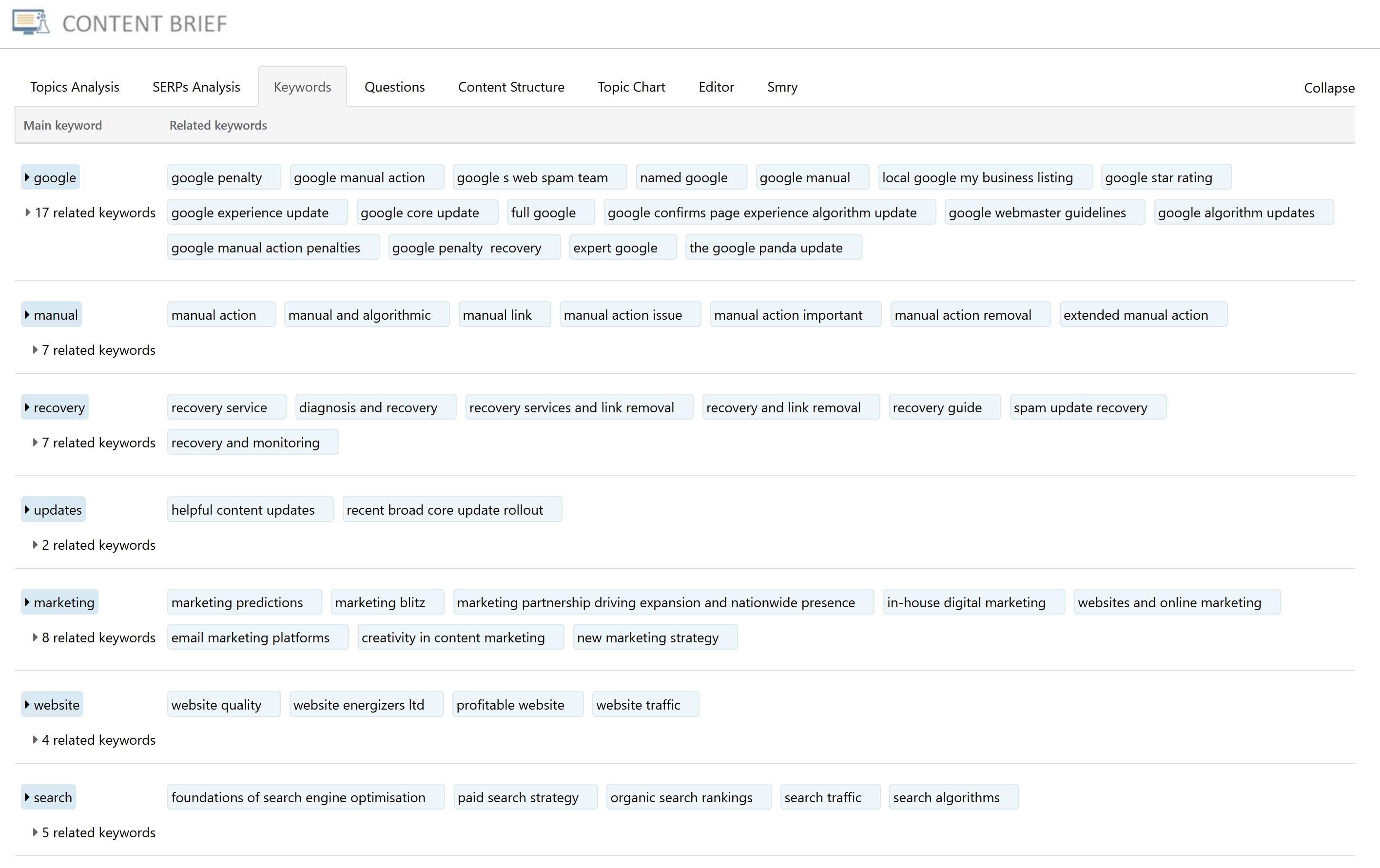
The phrases the ranking set is built on
- Main keywords with their related variants grouped underneath
- Pulled from the pages that already rank rather than from a generic volume database
- Grouped so you can see which are genuine variants and which are separate subjects
- Useful for headings and internal anchors as much as for the body copy
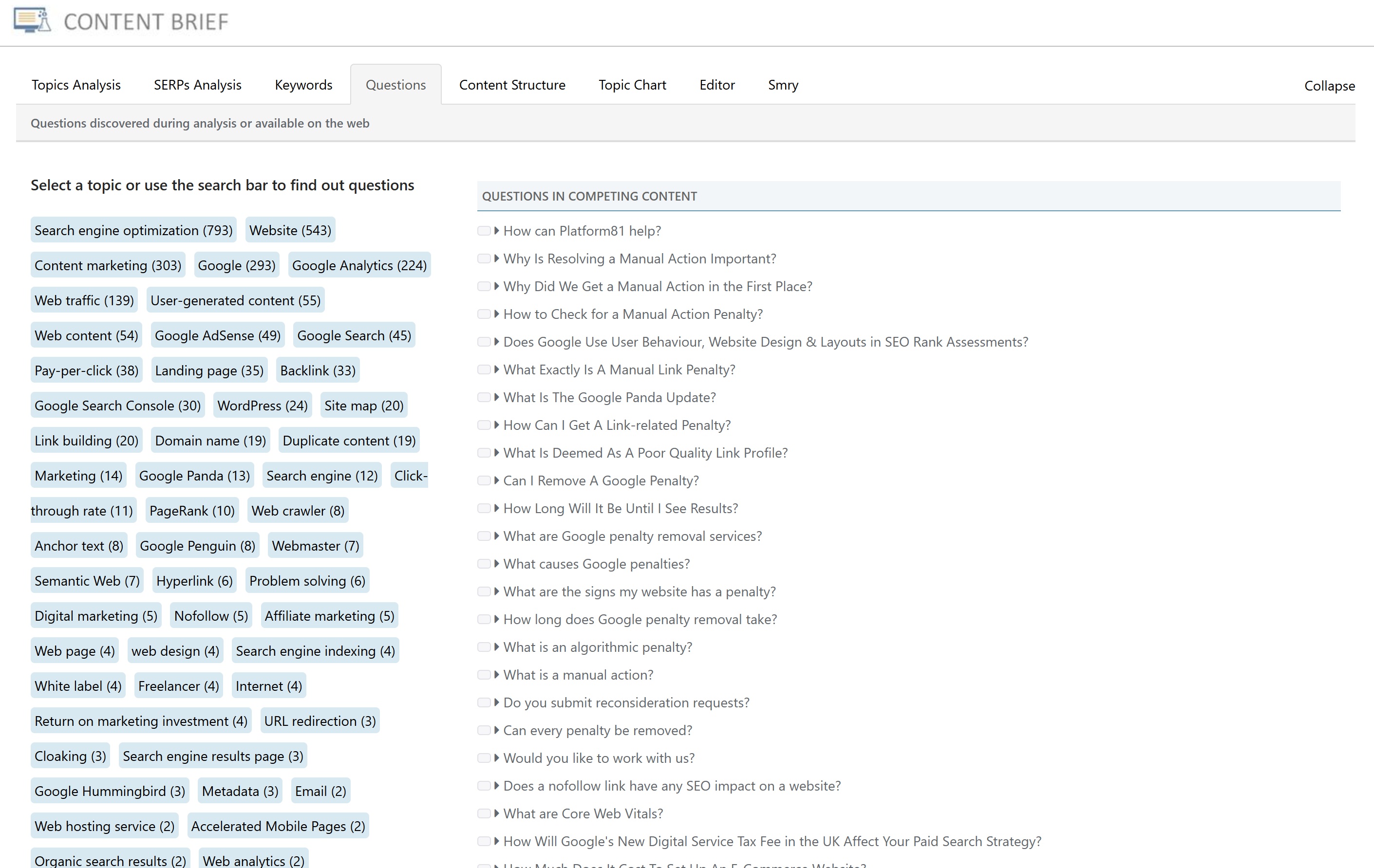
What people are asking, in their own words
- Questions discovered during the analysis and questions already on the web
- Topics down the left with a count against each, so you can see where the demand is concentrated
- Questions found in competing content listed on the right, selectable into the brief
- The fastest route there is to an FAQ section that answers something real
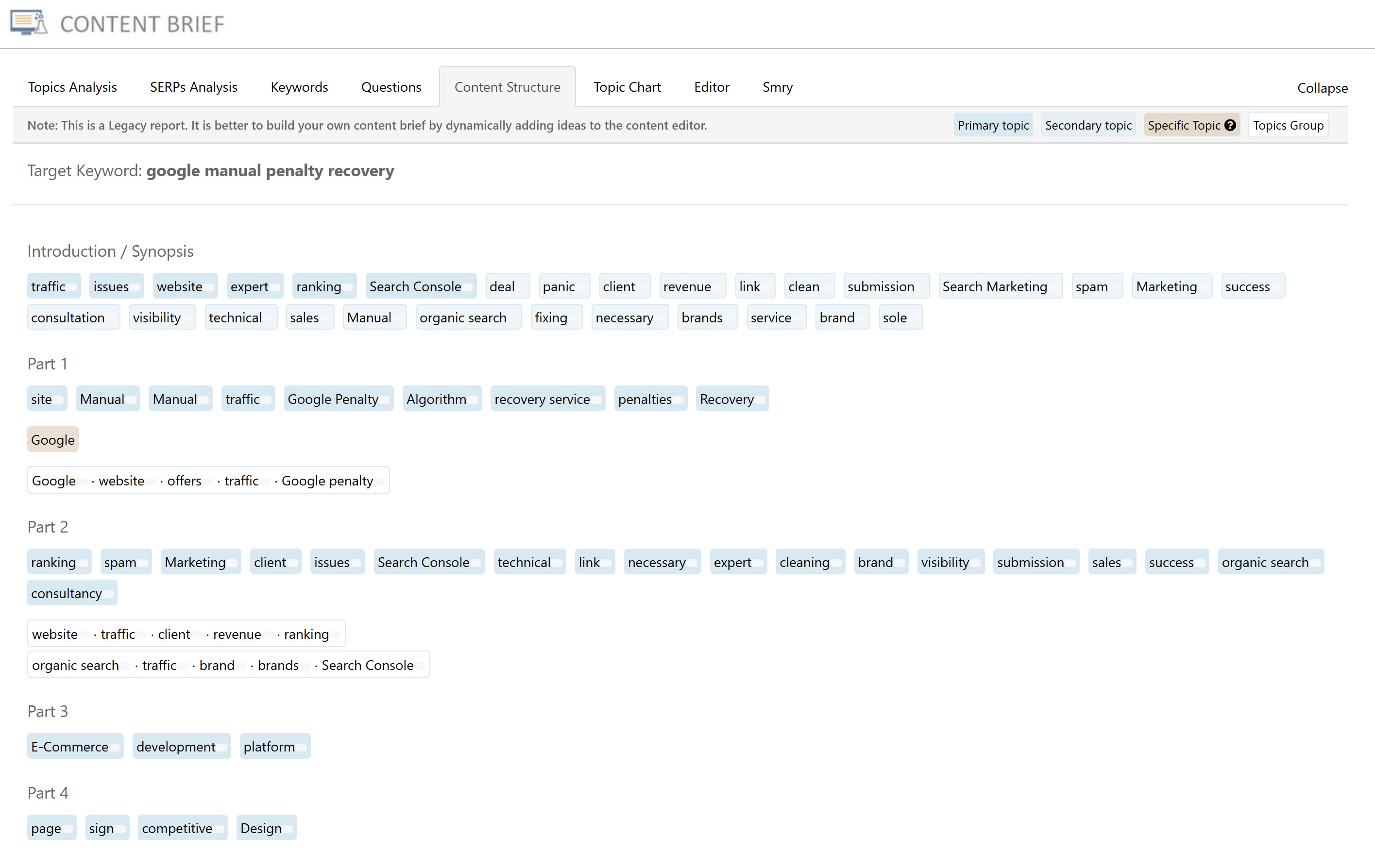
A section by section outline
- An introduction and a set of parts, each with the topics that belong in it
- Primary, secondary and specific topics distinguished, so weighting is obvious
- Topic groups shown together where they naturally belong in the same paragraph
- Something a writer can work straight from without interpreting a spreadsheet
The scores
What the top of the brief is telling you
Before any of the tables, the brief opens with a verdict, and the six readings that make it up each answer a different question about the page.
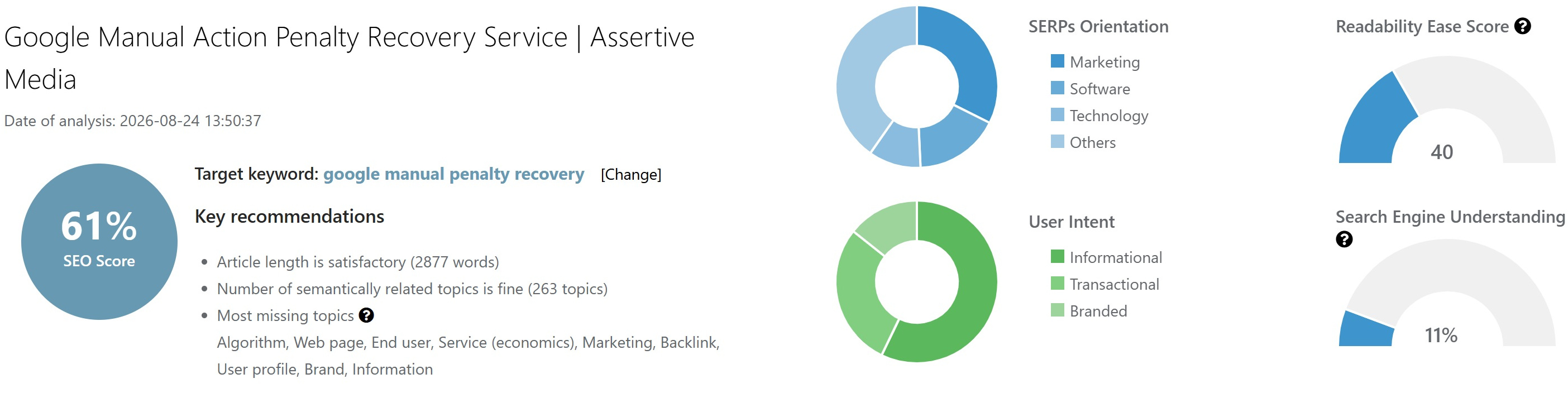
SEO score
How completely the page covers the subject compared with everything currently ranking for the query. A page can be long, well written and still score badly, because length is not coverage.
Search engine understanding
How clearly a machine can work out what the page is about from the entities on it. This is the score most people have never seen before, and it is usually the lower of the two by some distance.
Readability ease
How hard the copy is to read. Worth checking against the ranking set rather than against a target, because a technical subject with a readability score of 40 is normal and a consumer subject at 40 is a problem.
SERP orientation
What kind of subject Google thinks this query belongs to, i.e. marketing, software or technology, which tells you whose language you should be writing in.
User intent
The split between informational, transactional and branded intent across the ranking set. A page written as a brochure for an informational query will not perform however well it covers the topics.
Key recommendations
The headline verdict in three lines: whether the article length is satisfactory, whether the number of semantically related topics is sufficient, and the topics you are most obviously missing.
The topic chart
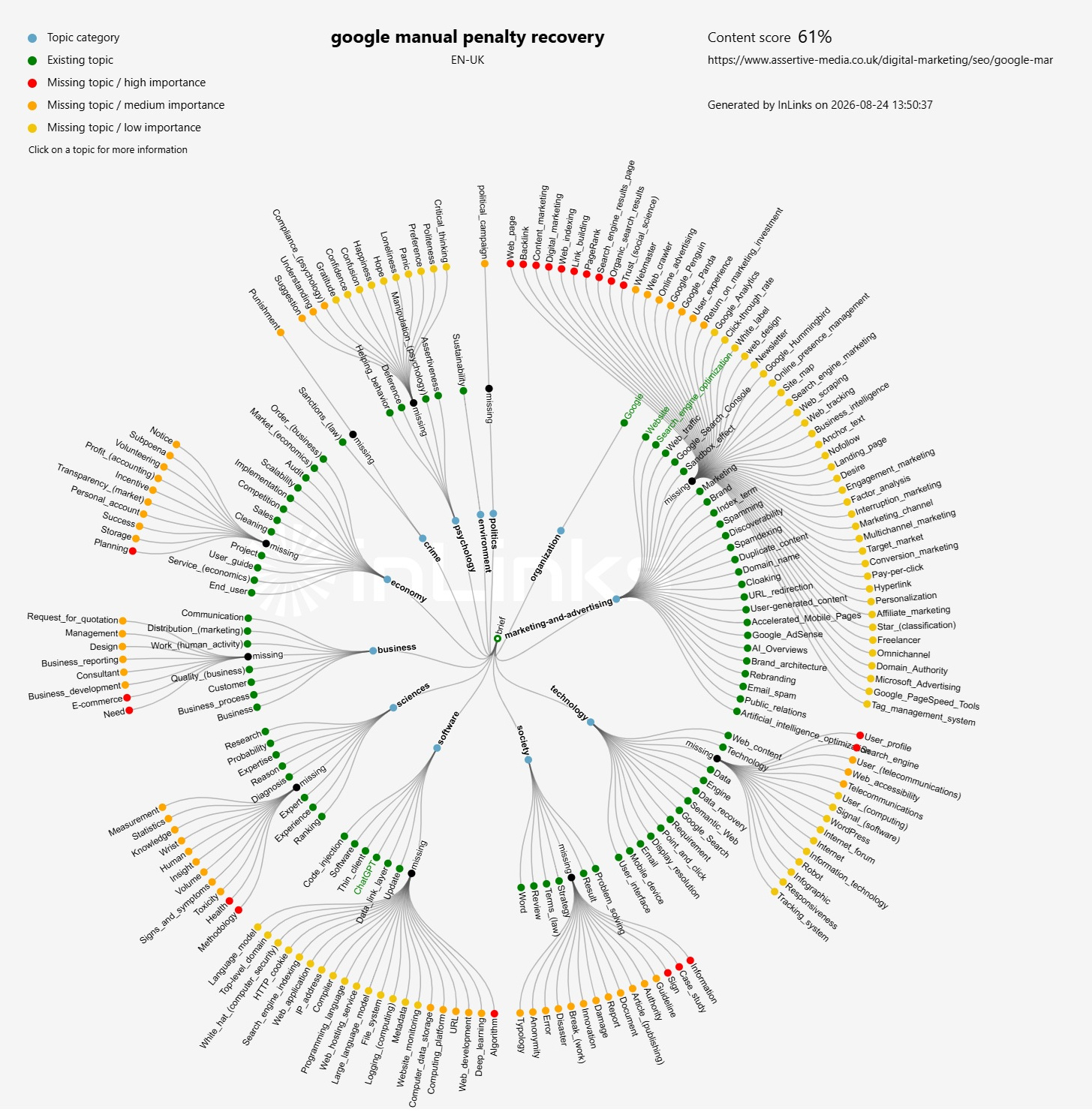
The whole subject on one map, with your gaps in colour
The topic chart plots every topic in the subject as a radial graph, branching out from the categories a search engine files them under, i.e. marketing and advertising, technology, business, society. Your existing topics are green and the missing ones are coloured by how important they are, red for high, orange for medium and yellow for low.
Typically this is the view that changes how people think about a page, because a table of missing topics looks like a list of small corrections whereas the chart shows you an entire branch of the subject that your page never touches. Naturally you are not going to write about all of it, but seeing where the red dots cluster tells you which section is worth adding rather than which sentence is worth rewriting.
- Existing topic, already on your page
- Missing topic, high importance
- Missing topic, medium importance
- Missing topic, low importance
The graph exports to PNG and the underlying data exports to CSV, for when it needs to go into a deck or a content plan.
Why content NLP matters
Search engines do not read your page, they parse it
Google stopped matching strings a long time ago. What it does now is pull entities out of your copy, work out which of them the page is really about, and decide which queries that makes you a sensible answer for, and NLP analysis is simply looking at your content the same way.
What the engine extracts
We are a trusted roofing company with over thirty years of experience. Our team is friendly, reliable and fully insured, and we pride ourselves on quality workmanship at a fair price. Whether it is a small repair or a large job, we treat every roof as if it were our own. Get in touch today for a free quote.
Three entities, none of them specific. A search engine can tell this page is about roofing and almost nothing else, so it will only ever be served for the broadest possible terms.
Entities found
3
- roofing companyService
- roofProduct
- quoteOther
The bar is salience, i.e. how central the engine thinks each entity is to what the page is about.
We install and maintain flat roofing for commercial buildings across Greater Manchester, including single ply membrane, EPDM and built-up felt systems. Every job starts with a roof survey and a core sample, and we hold SafeContractor accreditation, so planned maintenance contracts can be signed off without a separate approval process.
Eight entities, with materials, a location, a process and an accreditation among them. Exactly the same length of copy, but now there is something for a search engine to match against a real query.
Entities found
8
- flat roofingService
- single ply membraneMaterial
- Greater ManchesterLocation
- EPDMMaterial
- roof surveyService
- planned maintenanceService
- built-up feltMaterial
- SafeContractorOrganization
The bar is salience, i.e. how central the engine thinks each entity is to what the page is about.
Illustrative. Switch versions to see the same page rewritten against a brief, at roughly the same word count.
What it changes
Six reasons this is worth doing properly
Entities, not keywords
An engine breaks your copy into things it recognises, i.e. a place, a material, an organisation, a service, then works out how central each one is to the page. Repeating your target keyword eleven times does nothing for that, because the keyword is one entity and the page still has nothing else in it.
Topical coverage is how relevance is judged
If nine of the ten pages ranking for a query discuss the same eight subtopics and your page discusses three of them, an engine has a straightforward reason to consider your page a less complete answer, and no amount of on-page optimisation changes that arithmetic.
It decides what you get served for
The set of entities on a page is roughly the set of queries it can be served for. Thin entity coverage is the most common reason a page ranks for its brand term and nothing else, which is exactly the pattern you see in the query counting tools.
Questions are entities too
Answering the questions people actually ask gives an engine short, self-contained passages it can lift, and passage level retrieval is how a lot of featured snippets and AI answers get built.
It matters more now, not less
Language models retrieve and summarise rather than rank ten blue links, and the pages they can summarise confidently are the ones where the subject is stated plainly and the entities are unambiguous. Vague copy was survivable in 2018, it is a much bigger problem when a model is deciding whether to cite you.
It is measurable, which is unusual for content
Most content advice cannot be checked. Coverage against the ranking set can be, which means a rewrite can be judged on whether the score moved rather than on whether everyone agrees it reads better.
Worth being clear about
A brief is a map, it is not a checklist to be completed. Stuffing every missing topic into a page will produce something nobody wants to read, and an engine is perfectly capable of noticing that too. The sensible way to use it is to look at where the gaps cluster, decide which of those a real reader would expect you to cover, and write those properly, and it really does vary from page to page how many of them are worth acting on.
How SEOs use it
What Content NLP is actually good for
Brief a writer properly
The topics, the questions, the structure and the ranking set in one document, which is a far better starting point than a target keyword and a word count.
Decide what to refresh
Run briefs across a set of pages and the ones with the widest gap between their score and the ranking set are the refreshes worth doing first.
Work out why a good page will not move
When a page is well linked, technically fine and still stuck, coverage is very often the answer, and the topics table shows it in about thirty seconds.
Plan a new page before writing it
Run a brief on a custom query before the page exists and you get the structure, the questions and the entities to build it around rather than working them out afterwards.
Prove the edit worked
Regenerate after publishing. The score moving, and the missing topic count falling, is evidence you can put in front of a client.
Feed it into the content editor
Topics added to the brief flow into the content tools, so the writing happens against the analysis rather than in a separate document next to it.
What you get out of it
The outcome, not the feature list
Hand a writer a brief built on data rather than an opinion
Close the topical gaps that were holding a page back
Prove an edit improved coverage instead of hoping it did
Works well with
More in Content & Optimisation
Connect a property. Watch the data start stacking.
Warehousing begins the moment you connect your Search Console property, there is no Google Cloud project to set up, no BigQuery and no schema to design. You simply connect your property and SEO Stack starts storing every row of your data from that day onwards.
- Credit card required
- Cancel within the trial and you won't be billed
- No contracts