Discovery & Opportunity
See the intent composition of everything you rank for
Query Discovery takes every Search Console query for the period you choose, groups them by intent, and shows you the composition of your entire domain, then lets you filter down to a single intent and work through every query with its clicks, impressions, CTR and position.
- 100% data privacy
- 99.99% uptime
- Nothing to configure
- Export anytime, no limits
Trusted by leading companies
The problem
The best keyword research you will ever do is already sitting in your own Search Console data, and most of it is invisible because Google shows you 1,000 rows at a time with no way to group them by what people were actually trying to do.
The tool
Every query you rank for, grouped by what people wanted
Query Discovery reads your Search Console queries for the period you choose, sorts them into the four intent groups, and shows the composition of the whole domain before you drill into any of it.
Domain query intent
Last 3 months
Navigational triggers
Largely people looking for a specific brand or page. A very large navigational share usually means brand searches are carrying the domain.
- services4,500
- help128
- find122
- about37
- account30
- contact8
4,825 queries across these triggers alone. Select a segment to see another intent.
Illustrative composition. Yours will look completely different, and that is the point of looking at it.
Your composition at a glance
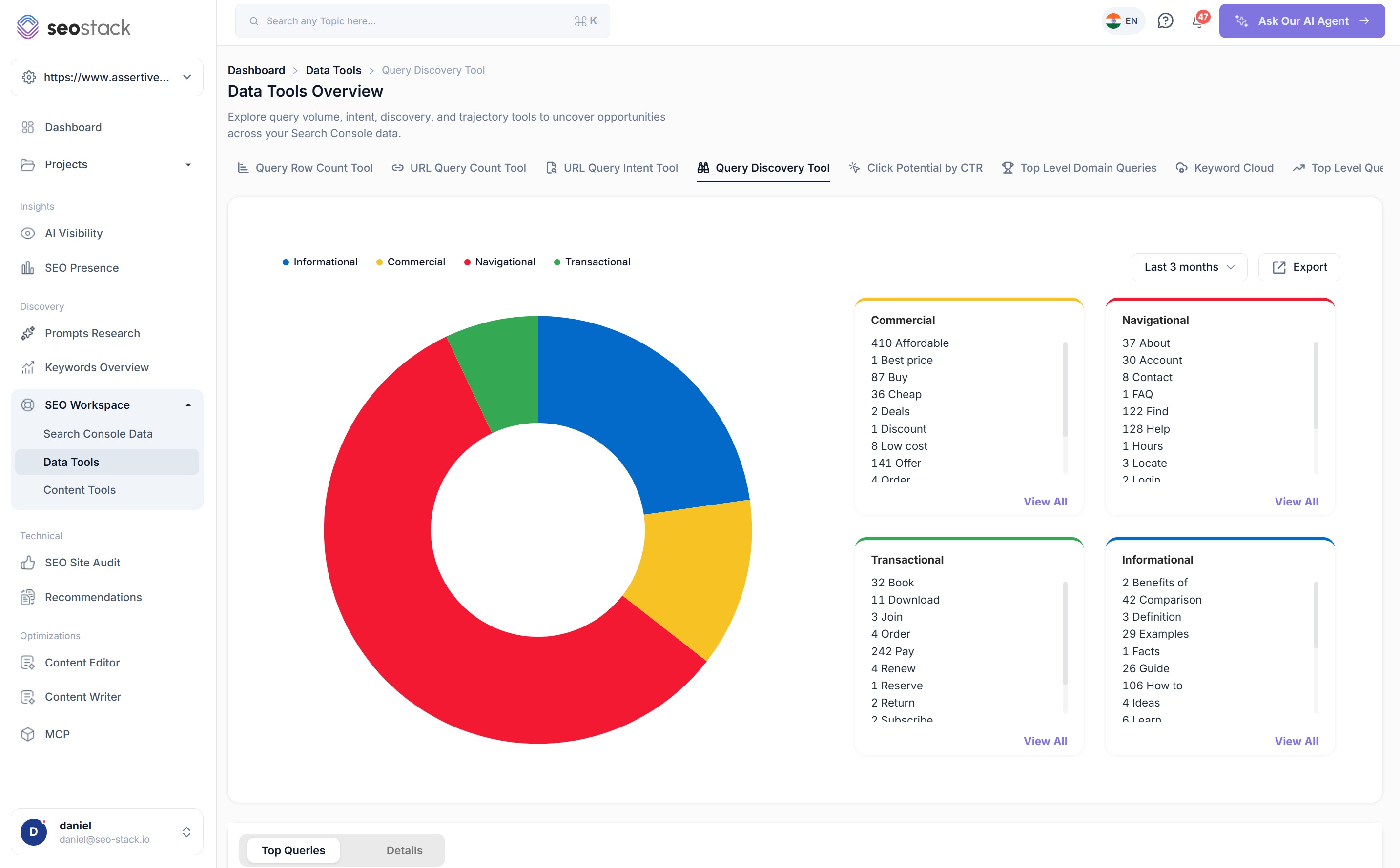
The donut is the headline. It takes every query for the timeframe you selected and shows you what share of your search footprint falls into each intent, which is a question most people have never actually been able to answer about their own site.
The trigger words behind each group
Each intent card lists the modifiers that put queries into that group, with a count against every one. The grouping is not a black box, you can see that 410 queries contained affordable and 106 contained how to.
Filter down and go through the lot
Pick an intent and you get every query inside it rather than a sample, with clicks, impressions, CTR and average position on each, sortable and searchable across the full set.
Inside the tool
From the composition down to individual queries
The donut and the four intent breakdowns
- Commercial, informational, navigational and transactional as a single composition chart
- One card per intent listing the trigger words that grouped the queries, each with a count
- View All on any card to see the complete set of triggers rather than the top few
- Set the timeframe to whatever period you are reporting on
- Export the whole thing to Sheets, Excel or PDF
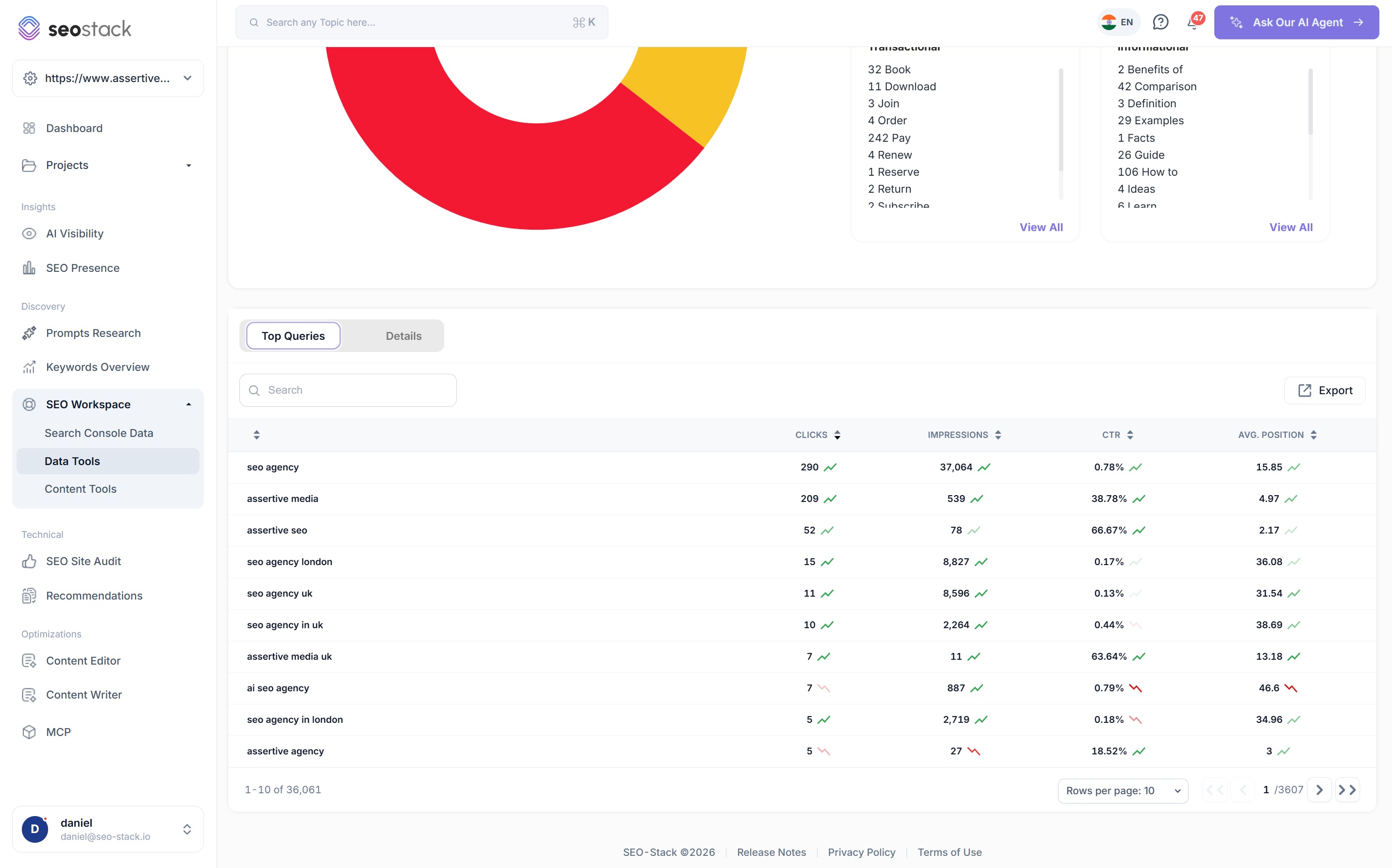
Your biggest queries, ranked
- Every query for the period ordered by clicks, with impressions, CTR and average position alongside
- Trend arrows on each metric so you can see direction without opening another report
- Search the set to jump to anything specific
- Paginated across the full query set rather than a truncated sample
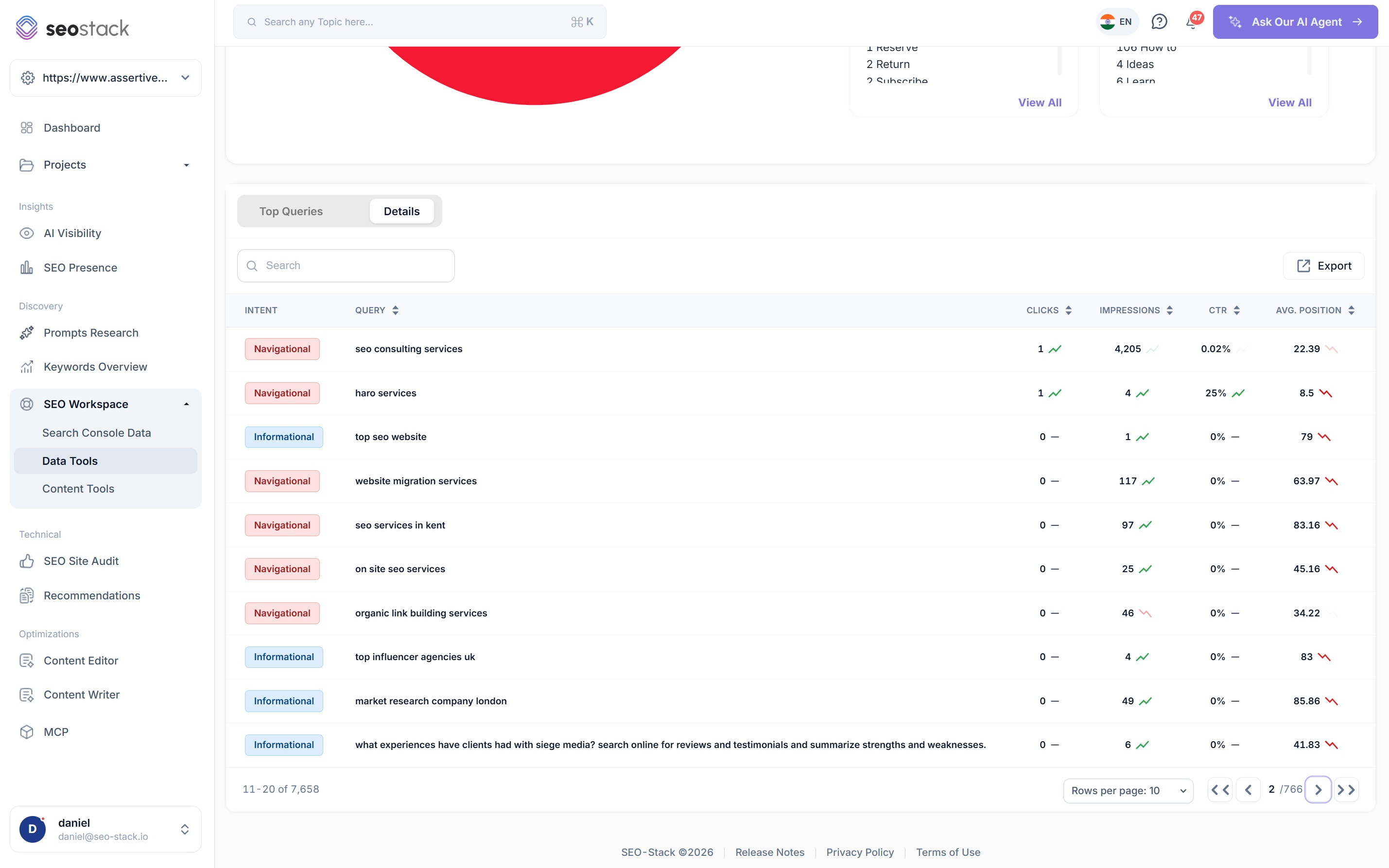
Every query with its intent attached
- An intent badge on every row, so you can see what each query was actually trying to do
- Clicks, impressions, CTR and average position on each, all sortable
- Sort by impressions to surface the queries earning visibility but no clicks
- Filter to a single intent to work through one group at a time
This is where the opportunities are
Queries with real impressions and no clicks, sitting in a commercial intent group, are usually the most valuable list you can hand a content team.
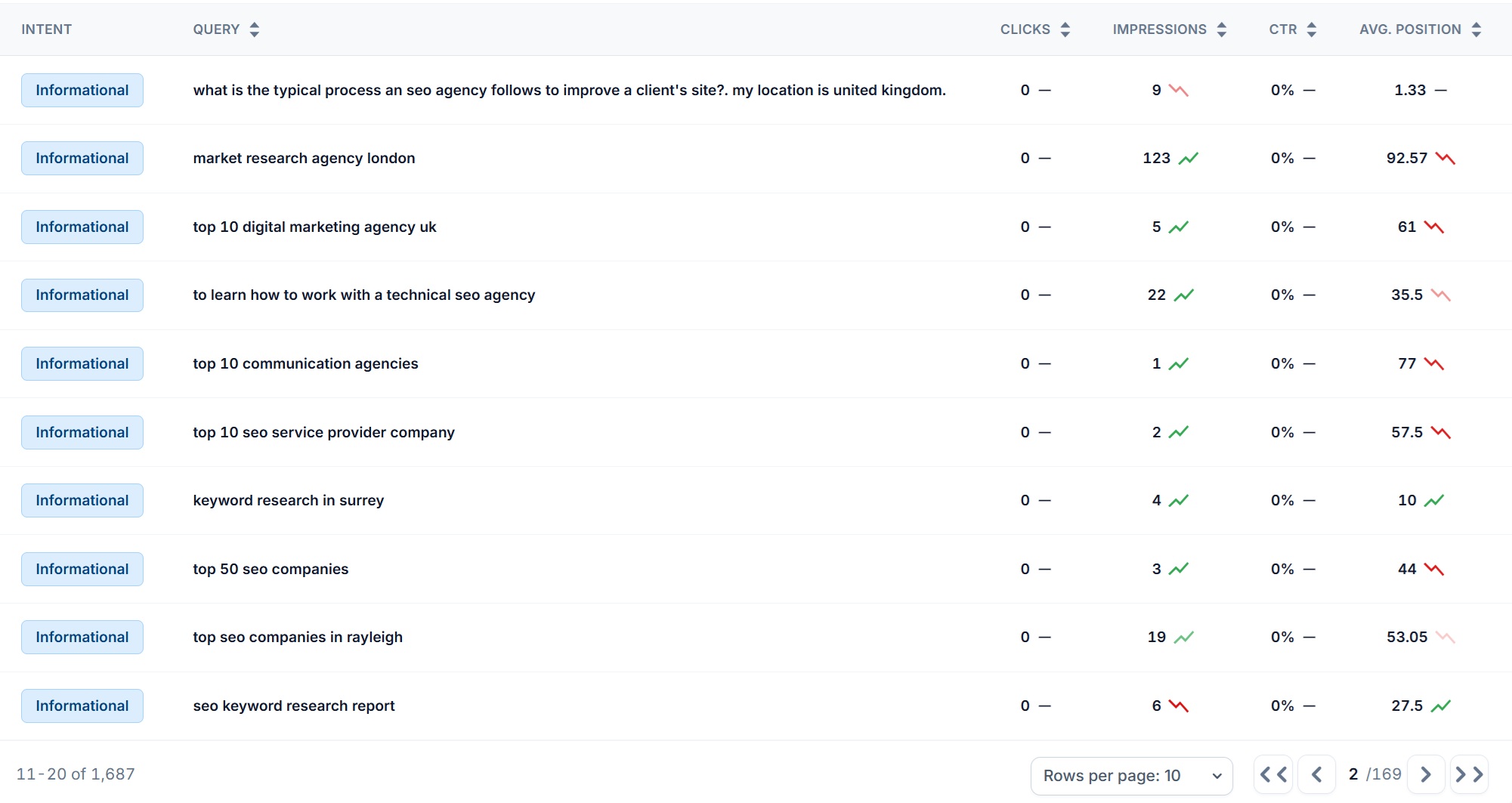
Work through a single group properly
- Narrow to informational, commercial, navigational or transactional and the whole table follows
- The query count updates so you know exactly how large the group is
- Long, conversational queries are included, which is where a lot of genuinely new opportunity sits
- Export the filtered set straight into a content brief
The basics
What query intent grouping actually is
Query intent grouping is the practice of sorting the searches your site appears for by what the person was trying to do, rather than by how many clicks they produced. Two queries can contain exactly the same words and want completely different outcomes, and the modifiers around those words are usually what gives it away.
Grouping thousands of queries by hand is not realistic, which is why most people never do it and end up treating their whole query set as one undifferentiated list. Query Discovery does the grouping for you across everything, then shows you the counts behind each group so you can see how it reached the answer.
Informational
Somebody is trying to learn something rather than buy it. How to, guides, comparisons, definitions and examples.
Commercial
Somebody is researching a purchase they intend to make. Affordable, cheap, best, offers, deals and sale.
Transactional
Somebody wants to act now. Buy, book, order, pay, download, subscribe and renew.
Navigational
Somebody is trying to reach a specific brand, page or account. Login, contact, about, find, help and services.
Why it matters
Why understanding query intent is worth the effort
Clicks tell you what happened. Intent tells you what people wanted, and those two things lead to completely different decisions about where to spend your time.
It tells you whether your footprint matches your business
A commerce site discovering that three quarters of its queries are informational has a structural problem worth knowing about, and a lead generation business finding almost no commercial queries has a different one. Neither shows up in a traffic report.
It changes what good looks like
Twenty thousand informational impressions and forty thousand commercial impressions are not the same result even if the traffic numbers match, because one of them is closer to revenue. Grouping by intent is how you judge growth properly.
It is the best content brief you can get
The queries in a group are the exact language people use when they want that thing. Writing to them beats writing to a keyword tool's suggestions, because these are searches your site was genuinely returned for.
It exposes misalignment between content and demand
If your commercial group is full of queries and your commercial pages are not ranking for them, you have found a specific and fixable gap rather than a vague sense that something is wrong.
How SEOs use it
What Query Discovery is actually good for
Keyword research from data you already own
The best keyword research available to you is sitting in your own Search Console, because these are searches Google has already decided you are relevant for. Grouped by intent, it becomes a usable list rather than an export nobody opens.
Find impressions with no clicks
Sort a commercial group by impressions and look for the rows with no clicks against them. Those are queries you are being shown for and losing, which is usually cheaper to fix than earning new visibility.
Align page content with the intent it serves
If a page is picking up commercial queries but reads like a guide, or the other way round, the fix is the content rather than the technical setup. Seeing the queries grouped is how you spot that.
Report the composition, not just the totals
Showing a client that their commercial query share has grown over six months is a far more meaningful result than a traffic line, especially when the traffic line is flat.
Separate brand from non brand properly
Navigational queries are largely brand searches. Pulling them out stops them flattering everything else, which matters when you are trying to judge whether non brand SEO is actually working.
Hand a writer something they can use
Export a filtered intent group and you have a brief built from real searches, with the impressions and positions attached so priorities are obvious.
What you get out of it
The outcome, not the feature list
Find high impression, low click queries worth a dedicated page
Check your search footprint actually matches your commercial goals
Build content briefs from the intent your pages are genuinely serving
Connect a property. Watch the data start stacking.
Warehousing begins the moment you connect your Search Console property, there is no Google Cloud project to set up, no BigQuery and no schema to design. You simply connect your property and SEO Stack starts storing every row of your data from that day onwards.
- Credit card required
- Cancel within the trial and you won't be billed
- No contracts