The Best Rank Tracking Solutions for 2026
Choosing a rank tracker used to be a fairly straightforward exercise, you decided how many keywords you wanted to track, picked your locations, compared the price and got on with it. In 2026
Choosing a rank tracker used to be a fairly straightforward exercise, you decided how many keywords you wanted to track, picked your locations, compared the price and got on with it. In 2026, I would spend considerably more time asking how the provider actually gets its data, how deep it checks and what happens when Google decides it doesn't particularly like the requests arriving at its servers.
Because Google has been making that job harder.
The removal of the useful num=100 behaviour, changes to result URLs and the dispute with SerpApi have all put more attention on something the SEO industry often takes for granted, the machinery behind the ranking number. A beautiful dashboard is lovely, but it is rather less useful if yesterday's position is being presented as today's check, or the tool has failed to recognise your URL.
So, these are the solutions I would shortlist for different requirements, including dedicated trackers, wider SEO suites and first-party reporting through Search Console. There isn't one winner for every business, and I am not going to pretend there is.
Disclosure: I am the founder of SEO Stack, which is included in this comparison. Its limitations are covered alongside its benefits. This is a researched comparison of published features, pricing and public feedback, not a claim that I ran a controlled accuracy test across every platform. Interface snapshots are vendor-published examples, not results from a shared test account.
Which rank tracker should you shortlist
Requirement | My shortlist | Why I would consider it |
Dedicated tracking and frequent checks | AccuRanker | Ranking analysis, segmentation and on-demand refreshes |
Daily tracking within a wider SEO suite | SE Ranking | Substantial entry allowance, audits and research tools |
Local campaigns and reporting | Nightwatch | Granular locations, keyword segmentation and historical SERP records |
Straightforward tracking for smaller teams | Wincher | Clear reporting and a lower entry cost than several suites here |
Flexible schedules and SERP presentation analysis | Advanced Web Ranking | Configurable checking, pixel positions and reporting options |
SEO and competitor research in one subscription | Semrush | Position Tracking alongside a broad research platform |
Tracking alongside backlink and keyword research | Ahrefs | A convenient option when its wider datasets already justify the subscription |
Own-site rankings connected to longer-term performance data | SEO Stack | Search Console analysis, warehousing, GA4 and other SEO tools |
Free first-party position reporting | Google Search Console | The starting point for understanding your own Google performance |
These are recommendations by use case, not an independently measured accuracy league table. The product and pricing sources are linked in the sections below.
Google has changed the economics of rank tracking
What happened to num 100
For years, adding &num=100 to a Google search request made it possible to request a larger set of results together. When that behaviour stopped working in September 2025, collecting deeper rankings became a more expensive and awkward process, with providers having to change how they requested and processed the results.
There is a very useful real example in AccuRanker's September 2025 update. It described daily checks of the top 30, with the top 100 checked every second week, and deeper positions carried forward from the most recent collection. That is a historical response to the disruption, not a statement that every current AccuRanker subscription still follows that exact schedule.
But it demonstrates why “daily rank tracking” needs a bit more questioning. Daily to what depth? Is position 76 freshly checked, or is it the most recent available observation? Both can be useful, provided you know which one you are reading.
A missing result also needs interpreting properly. If a provider searches 30 results and doesn't find you, that does not establish that you have disappeared from the top 100. It establishes that you were not found within the results it successfully checked.
Why Google goto URLs created another problem
The next complication was the expansion of google.com/goto result links during 2026. Instead of the link in a result pointing straight at the destination page, affected links went through a Google intermediary.
DemandSphere's August 2026 explanation describes the practical consequences when this is not handled correctly, including failed domain matching, wrong attribution and breaks in historical reporting. The issue is not necessarily that a result has moved, it can be that the collection process no longer identifies which website the result belongs to.
Providers have adapted. SerpApi reported restoring direct destination URLs in September, explaining that different result types required different handling. Its account says the change affected the usefulness of the link field rather than the visible rankings themselves. That distinction matters, because “Google changed its links” and “every rank tracker is now inaccurate” are VERY different claims.
More recently, AccuRanker's October 2026 investigation described normal-looking result pages with unusual sets of organic listings and the checks it uses to detect them. Nozzle has published its own research into what it calls poisoned SERPs. These are providers' observations and interpretations of their collection data, not proof that every unexplained ranking drop is artificial or confirmation from Google of a specific motive.
My concern is the reporting consequence. Before changing a client's website because a graph looks dreadful, establish whether the graph represents an SEO change, a collection failure or a change in methodology.
Did the SerpApi court fight make Google go harder
There is clearly a wider conflict over access to search data. Google announced its lawsuit against SerpApi on 19 December 2025, alleging circumvention of protections around copyrighted content in search results. SerpApi disputes Google's position and argues for access to publicly available information.
The chronology is important. SerpApi reported that the court granted its motion to dismiss on 20 July 2026. That was not the end of the dispute, Google filed an amended complaint, and SerpApi announced a second dismissal motion on 25 August. Those are the procedural developments verified for this article, not a claim that a final judgment has settled every scraping issue.
My reading is that legal pressure and technical restrictions belong to the same broader fight over who can collect and reuse search results. It is plausible that the commercial stakes encourage further restrictions, but there is no evidence here establishing that the July decision caused the later goto rollout. The September 2025 num change happened BEFORE Google's lawsuit, so it cannot sensibly be described as retaliation for losing that motion.
We can discuss the likely commercial incentives without inventing a causal link.
Scraped positions and Search Console averages are different measurements
A conventional tracker requests results for a specified keyword, location, device and time, then records what it finds. Search Console reports positions associated with impressions for a property you can access, aggregated across the selected period and filters. Google's position documentation explains that average position is calculated across impressions and that result elements can contain multiple links.
If you appear at position 3 for one impression and position 13 for another, the simple average in that illustrative example is 8. That does not mean that a person searching from Luton at 10am must find you in eighth place.
Question | Scheduled SERP tracker | Search Console based reporting |
Where was this domain for a configured search | Designed to answer this | Reports an impression-based average instead |
How did our actual recorded Google visibility change | Useful supporting evidence | Directly connected to impressions, clicks and CTR |
Can we monitor a competitor without property access | Usually, within the product's coverage | Not through that competitor's private GSC data |
Can we monitor a target term before it earns impressions | Yes, within collection depth | No query observation to analyse until data exists |
Can we reproduce a precise city or postcode check | Available from suitable providers | Country and device segmentation is not a postcode simulation |
Does it rely on collecting public search results | Normally, directly or through a supplier | GSC ingestion itself does not |
Neither method should be sold as a complete description of every person's search results. For many campaigns, the useful approach is to keep a controlled keyword set in a tracker and assess what actually happened to clicks and conversions alongside it.
Rank tracking pricing comparison
The figures below are published entry prices or explicitly qualified figures checked for this article. They are not currency conversions. Annual equivalents require an upfront commitment, taxes may apply, and the same number of “keywords” does not necessarily buy the same checking frequency or depth.
Solution and plan | Monthly billing | Annual equivalent | Entry tracking allowance and frequency |
AccuRanker Professional | $249 | $224 per month displayed | 2,000 keywords; daily advertised, confirm refresh depth |
SE Ranking Core | $129 | $103.20 per month | 2,000 keywords checked daily; 10 projects |
Nightwatch Starter | €99 implied by published savings | €79 per month, €948 yearly | 500 keywords daily; 5 websites |
Wincher Basic | $49 on vendor-supplied G2 listing | Confirm live currency and annual quote | 500 keywords; daily; up to 10 websites |
Advanced Web Ranking Pro | $139 | 10% annual saving advertised | 7,000 weekly units at 50-result depth, NOT 7,000 daily keywords |
Semrush SEO | $139 | $117.33 per month | 500 keywords daily; 5 websites |
Ahrefs Lite | $129 | Up to 17% annual saving advertised | 750 tracked keywords; weekly updates |
SEO Stack Basic | $129.99 | 17% annual saving advertised | Pricing lists 750 weekly tracked keywords; GSC-led feature page describes broader query coverage, see qualification below |
Google Search Console | Free | Free | Available property data; averages rather than scheduled SERP checks |
Pricing sources: AccuRanker and its vendor-supplied G2 listing, SE Ranking FAQ, Nightwatch, Wincher pricing and G2, AWR, Semrush, Ahrefs, SEO Stack.
Nightwatch's page displays €948 annually and €240 saved against monthly billing, which implies €99 per month without the annual commitment. Wincher's numeric prices did not load in the retrieved official page, so the dollar figure is identified as a vendor-supplied review-platform listing, not an independently confirmed checkout quote. SE Ranking also displayed €109 monthly and €87.20 annually in the euro version of its pricing page.
Read the allowance before comparing the price
AWR is a particularly good example of why the small print matters. Its keyword-unit guide defines a unit around a weekly query for one engine, device and 50-result depth. Daily checking consumes seven times the allowance, with additional consumption for extra devices, locations and depth. On that basis, 7,000 units equates to approximately 1,000 daily keywords under that specific single-device, single-engine, 50-result configuration.
So, if you need to track 500 terms on desktop and mobile across five locations, you are asking for 5,000 keyword, device and location combinations before considering frequency. That is an illustrative workload, not a promise that every provider bills those combinations identically.
AccuRanker
AccuRanker is where I would start a shortlist for a team that wants ranking analysis to be a serious part of its daily work. Its rank-tracking feature page describes local and country-level checking, pixel positions and on-demand refreshes, while the wider product includes tagging and filtering.
Pixel position deserves attention. Being third organically is not the same as being the third thing a visitor sees, particularly when a search result page has ads, an AI Overview and several other features above it. A report that helps you understand that difference is more useful than an argument about whether position three should automatically produce a particular CTR.
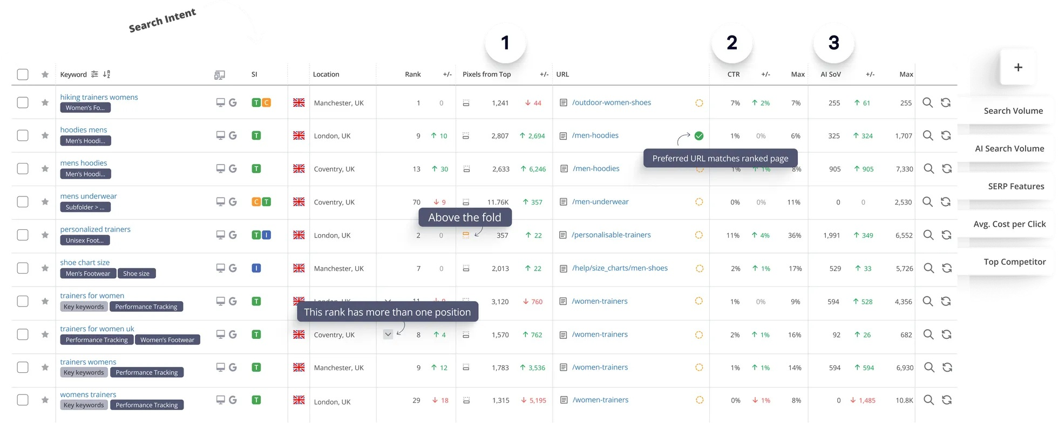
Vendor-published interface example from AccuRanker's rank-tracking page. It illustrates ranking and SERP metrics, not independently verified campaign performance.
The price is substantial if you only need to follow a small number of terms, and I would check which integrations and reporting functions sit in the tier you actually intend to buy. The current pricing page separates Professional, Expert and Enterprise features; do not assume an API feature mentioned elsewhere is included in every subscription.
Public G2 feedback praises the interface, granular tagging, bulk setup and reporting. Critical reviews mention cost, occasional refresh or display issues, and differing experiences with support. Some also find the naming of AI-derived visibility metrics confusing. These are reported experiences, not a failure rate or an accuracy benchmark.
For me, it is a strong dedicated-tracker candidate, provided the confirmed depth and refresh schedule match the campaign. I would ask about deeper positions explicitly, rather than infer their freshness from a daily-update label.
SE Ranking
SE Ranking has a compelling argument for agencies that need more than a list of positions. The Core plan combines daily tracking with keyword and competitor research, website auditing and integrations, so the subscription can replace several smaller purchases if you actually use those functions.
Its rank tracker advertises top-100 monitoring, desktop and mobile views, ranking URLs and SERP-feature analysis. That is the sort of coverage I would investigate when new service pages are still moving through lower positions, where a top-ten-only report tells you very little about whether the work is progressing.
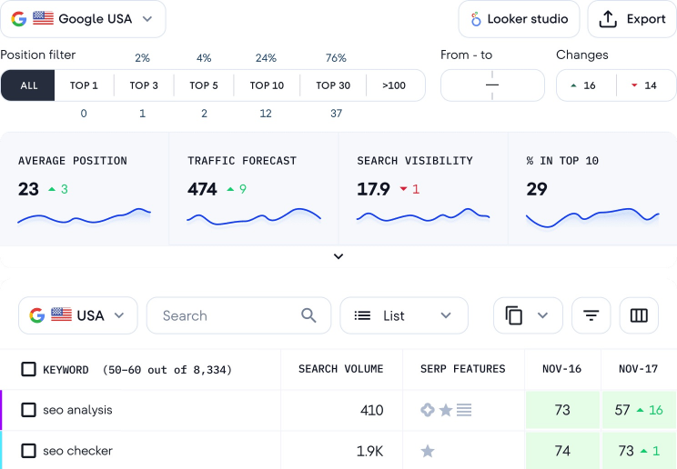
Vendor-published SE Ranking example showing position bands, dates and keyword movements. Source: SE Ranking's position-tracking page.
The 2,000-keyword entry allowance is attractive relative to the 500-term entry plans listed for some larger suites. But I would still build a real account specification before calling it cheaper, particularly if the agency needs extra users, client access, local work or additional reporting features. An entry price is not the same thing as the monthly cost of the setup you need.
The themes in G2 user feedback are fairly understandable: people value the breadth, ease of use and combined reporting, while objections include plan restrictions, add-on costs and the time needed to learn the platform. G2's review summary also notes complaints about performance on larger projects. Those wider-platform comments do not, by themselves, establish a defect in the rank-tracking dataset.
I would put SE Ranking high on the shortlist for a small or medium agency that wants daily tracking and a practical selection of other SEO tools, without assuming that every specialist function will be as deep as a product dedicated to that task.
Nightwatch
Local reporting becomes misleading very quickly when the location being checked bears little resemblance to the area the business serves. A national position for a local service is often an answer to a question nobody needed to ask.
That is why Nightwatch deserves consideration. Its rank-tracker page describes city and postcode-level targeting, daily updates, segmentation and historical SERP records. I would be interested in those records when a client asks why the page dropped, because being able to inspect what changed in the results is considerably better than guessing from a line chart.
The Starter plan lists 500 keywords, five websites, five competitors per site and 50 AI prompts, with unlimited seats advertised across the plans. That makes it worth pricing for a team that otherwise encounters extra-user charges elsewhere. Prompt tracking remains a separate measurement from organic ranking, even when both are sold together.
Public reviews praise client-friendly reports, usability and ranking detail. Some reviewers ask for deeper features or more integrations, and individual accounts mention reporting or audit issues. Much of the accessible detailed feedback predates the latest product changes, so I would treat it as background for a trial, not a complete appraisal of the current release.
My recommendation would be to test it against a real local campaign, with the actual places and devices the client cares about. Postcode targeting is useful, but it should not be confused with a full map-grid study of every point in a service area.
Wincher
There is a perfectly legitimate market for an SEO tool that gets you to the useful information without requiring a guided tour through forty menus. Wincher's appeal is its relatively straightforward approach, with daily ranking monitoring, competitor tracking and an interface aimed at making changes easy to follow.
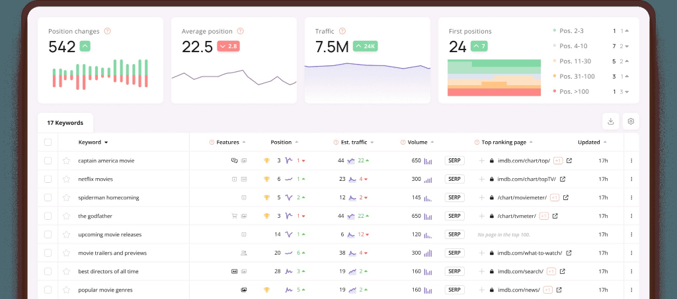
Vendor-published Wincher interface example. Source: Wincher's rank-tracker page. The numbers belong to the illustration, not this comparison's testing.
I would consider it for a consultant, website owner or smaller team whose main requirement is to follow a manageable keyword set and communicate progress clearly. The entry allowance covers up to ten websites on the official pricing page, although API access, on-demand checks and more advanced reporting should be checked against the selected tier.
The feedback on G2 repeatedly points to ease of use, clear dashboards and straightforward setup. Reservations include limited analytical depth compared with larger suites, keyword allowances and pricing for people who only need to follow a handful of terms. Several reviews discuss an older five-keyword free arrangement, which should not be treated as proof of a currently available free plan.
That trade-off is reasonable. A simpler interface can be a benefit, until the day you need a reporting breakdown it cannot provide. I would decide on the reports the business needs first, then check Wincher can produce them, rather than buy a large suite merely because it has more buttons.
Advanced Web Ranking
AWR is an interesting option when you want control over the checking configuration and how the results are presented. Its rank tracker includes local and device-based monitoring, pixel-position analysis and SERP-feature reporting, which makes it relevant to more demanding reporting work.
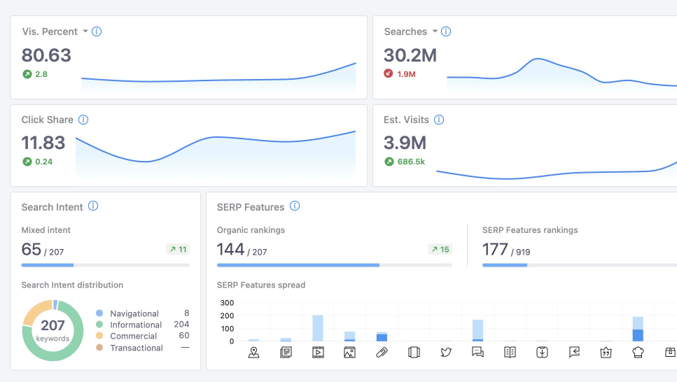
Vendor-published AWR report example showing visibility and SERP composition. Source: AWR's rank-tracker page.
I particularly like the logic of looking at visibility in the context of the page layout. A position report can look healthy while the available organic click opportunity has changed, and a client will rightly care more about the missing enquiries than a reassuring green arrow.
Its pricing includes unlimited projects and users, but checking units require careful calculation. The advertised 7,000-unit entry allowance is based on weekly checking, so comparing it directly with a competitor's 2,000 daily keywords would give a distorted impression of value. White labelling and API access also depend on the subscription arrangement.
G2 reviewers praise clear reporting, keyword grouping and tracking at scale. Criticisms include interface complexity, reporting friction and a desire for broader functionality. Some detailed reviews are several years old, and a 2026 reviewer explicitly refers to using an older version, so those opinions need their dates and context attached.
For an agency willing to configure its campaigns properly, AWR is a credible candidate. I would price the exact daily workload, locations and result depth before making a value judgement.
Semrush
If the team already uses Semrush for research, auditing and competitor analysis, its Position Tracking deserves a proper look before paying for another subscription. Keeping related work in one system can save time, particularly when the person investigating a ranking change also needs to research the competing pages.
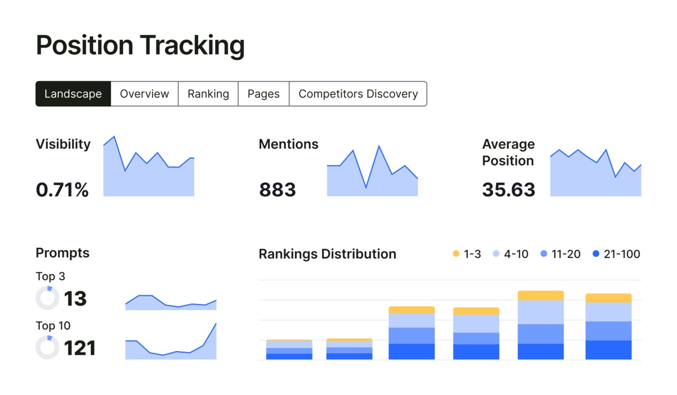
Vendor-published Semrush Position Tracking example. Source: Semrush's rank-tracking feature page.
The SEO entry plan lists 500 tracked keywords with daily updates and five websites. The higher-priced Starter bundle adds AI-search functionality, while Pro+ lists multi-location and device tracking. The distinction between the SEO plan and the broader bundle matters, because a comparison using the more expensive bundle as the only starting price would be unfair.
I would not buy Semrush purely because it is a familiar name if the only requirement is economical rank tracking across a large keyword set. Its stronger argument is the wider research environment, and that value depends on whether the team uses it.
The public review themes include appreciation for the range of tools, keyword research and position monitoring. Cost, additional charges and the learning curve appear among the objections. These are whole-platform reviews, which means a complaint about another module should not automatically be interpreted as criticism of Position Tracking.
My starting question would be simple enough, what are we already paying for, and what does the extra tracker solve that this account cannot? Buying overlapping tools without checking the existing allowance is an expensive habit.
Ahrefs Rank Tracker
Ahrefs has a similar practical advantage for teams already relying on its research tools. The Rank Tracker includes desktop and mobile monitoring, geographical targeting, SERP features, competitor comparisons and target-URL monitoring. Those functions become useful when you want to connect a movement in position with the pages and competing sites behind it.
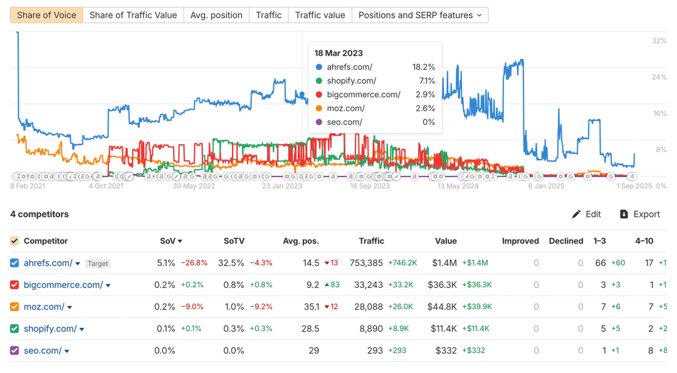
Vendor-published Ahrefs competitor-trend example. Source: Ahrefs Rank Tracker. Historical dates in the image are part of the vendor example.
There is one detail I would not bury, the current pricing table lists weekly Rank Tracker updates, including 750 keywords on Lite. If your reporting relies on checking yesterday's movement today, you need to resolve that requirement before paying, rather than assume the update frequency from an old review or a different product within Ahrefs.
For a business taking a longer view of competitive performance, weekly tracking may be adequate. For a campaign where rapid changes need investigating, it can be a significant limitation. That is a question of fit, not a declaration that weekly data is useless.
G2 feedback praises the research tools, backlink data and competitive analysis, with cost and usage restrictions among the recurring complaints. Again, that is feedback on the broader platform, not independent proof that its rank tracker is more accurate than another one.
I would consider it especially seriously when the wider subscription is already justified. A second tracker should earn its place by meeting a requirement the existing account does not cover.
SEO Stack
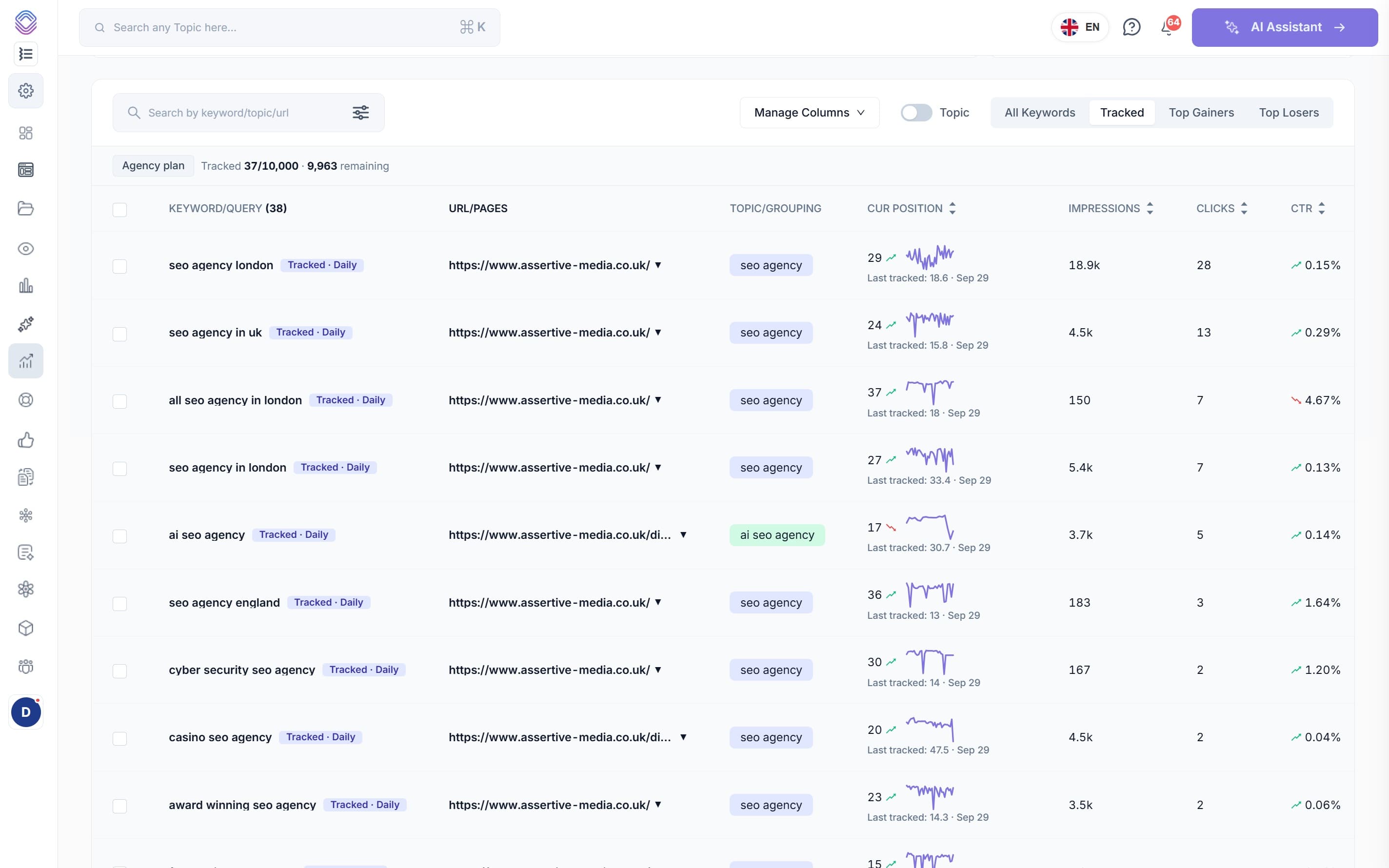
Now, my own platform. SEO Stack's rank-tracking page describes a GSC-led approach, with keyword groups, ranking URLs, gainers, losers and position trends alongside impressions, clicks and CTR. The value of that combination is being able to investigate a movement in the context of the traffic the site actually received.
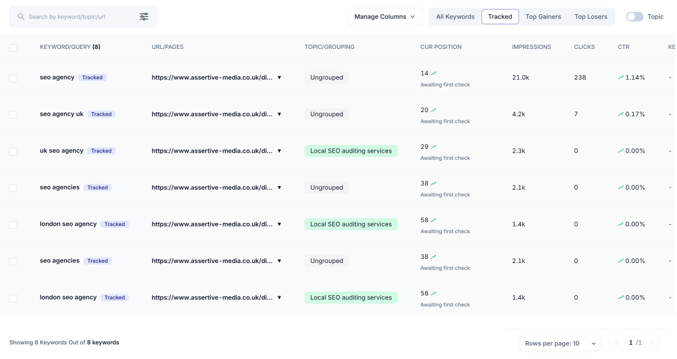
Vendor-published SEO Stack tracked-keyword example. Source: SEO Stack's rank-tracking page. It illustrates the interface and is not evidence of every customer's available data.
There is a useful distinction here. If a tracked term improves but clicks fall, I want to look at the surrounding data before telling a client the campaign is doing brilliantly. Equally, a keyword report becomes more informative when you can see which URL is receiving the impressions, rather than treating every movement as a change to the page you expected to rank.
The wider subscription is a substantial part of the proposition. The Basic pricing page lists ten websites, five team members and 60-month warehousing, alongside GA4 integration, AI visibility, content tools, auditing and MCP access, with feature-specific allowances. Rankings are one part of the account, rather than its only purpose. Longer retention means preserving data as it is collected, not conjuring up years of history that were never stored.
One qualification needs to be explicit. The feature page describes broad GSC query coverage without per-keyword pricing, while the pricing table lists 750 weekly tracked keywords on Basic and larger capped allowances on higher plans. Those descriptions do not establish clearly how the GSC reporting and scheduled tracking allowances relate. Buyers should confirm the distinction; this comparison does not treat the account as an unlimited daily SERP-checking service.
GSC-led reporting also cannot reveal a competitor's private Search Console data, reproduce a postcode-specific check or recover anonymised query strings. Google's API documentation describes limits and possible data loss, so bypassing scraping does not remove every reporting limitation. Broader query discovery means queries made available to the platform, not literally every search someone has ever made.
On G2, the small set of public reviews praises warehousing, filtering, AI-assisted analysis and easy setup. Criticism includes UI overlaps, chart presentation and requests to make some GSC information more prominent. The page showed four reviews, far too small a sample to claim broad market consensus, and those comments are not a test of the current rank-tracking implementation.
I would shortlist SEO Stack when the business wants to work with its own search performance in more depth and use the other tools alongside it. If the requirement is a precise independent check of a keyword from a particular location, I would retain a suitable SERP tracker as well.
Google Search Console
Before spending anything, make sure you are using the data you already have. Google Search Console is the free starting point for your own Google performance, with queries, pages, countries and devices helping you work out where changes are happening.
Its position metric is an average across impressions, with aggregation rules that need understanding. It is not a scheduled check from a location you have configured, and it does not tell you where an inaccessible competitor's property appears across its own private dataset.
I have not treated vendor endorsements as user reviews here, nor manufactured a likes-and-dislikes consensus for GSC. The benefit is first-party performance reporting without a subscription; the practical disadvantages for this comparison are the different measurement method, property-access requirement and the API's documented limits. Those are product constraints, not an independently sampled user survey.
The important point is that paid software should add something useful to this starting position, whether that is independent competitor tracking, better organisation, longer-term storage or more efficient analysis.
What users like and dislike across the trackers
These are paraphrased themes from the linked public reviews, not findings from a representative survey. Review platforms contain a mixture of organic, invited and sometimes incentivised submissions, and some comments describe older releases. Whole-suite feedback is labelled accordingly.
Product | Positive feedback | Reported frustrations |
AccuRanker | Tagging, usable interface, setup and reporting | Price, occasional refresh/display issues, mixed support experiences |
SE Ranking | Breadth, combined reporting, usability | Add-on costs, plan limits, complexity or performance on larger projects |
Nightwatch | Client reports, ranking detail, ease of use | Requests for more features/integrations; individual reporting or audit complaints |
Wincher | Simplicity, clear dashboard, quick setup | Analytical depth, keyword limits and cost for very small users |
AWR | Reporting, groups, tracking at scale | Interface/reporting friction; several detailed comments concern older versions |
Semrush | Research breadth and position tracking | Cost, paid extras and learning curve; whole-suite feedback |
Ahrefs | Backlinks, keyword research, competitive analysis | Cost and usage restrictions; whole-suite feedback |
SEO Stack | Warehousing, filters, AI analysis, setup | UI/chart issues and discoverability; only four public G2 reviews checked |
Review links: AccuRanker, SE Ranking, Nightwatch, Wincher, AWR, Semrush, Ahrefs, SEO Stack.
How I would choose a rank tracker in 2026
I would start with the reporting requirement, then trial the two or three tools that meet it. Use the same keywords, location, device and approximate checking window, include some queries outside the top ten, and keep a record of missing results and the dates attached to deeper positions. Do not simply count disagreements and announce that the tool closest to your own browser must be correct, your browser has its own location, history and result configuration.
Ask the provider how it handles collection failures. Does it show missing data, repeat the request, carry forward an older observation or use a modelled value? Any of those behaviours has implications for your report. I would much rather explain a genuine gap than confidently present a number whose origin nobody can describe.
I would also inspect whether the ranking URL is stored, whether the SERP can be reviewed later, and whether the platform flags changes in collection depth or methodology. A client paying for SEO needs to know that an apparent improvement is comparable with last month's result, not merely the product of a different checking process.
For independent daily tracking, my initial shortlist would be AccuRanker and SE Ranking, with Nightwatch particularly relevant to local requirements and AWR worth considering for configurable reporting. Wincher is a sensible simpler option, while Semrush and Ahrefs become more compelling when their wider research tools are already part of the work.
SEO Stack serves a different but complementary requirement, connecting own-site position reporting to stored GSC data and other analysis tools. I would judge that value on the whole workflow, not claim that a GSC average replaces every controlled SERP check.
Whichever route you take, keep the commercial outcome in the discussion. A ranking improvement needs to be investigated alongside impressions, clicks, enquiries and sales. The report should help you decide what to do next, and in 2026, understanding how the number was collected is part of that job.

Founder, SEO Stack
Daniel is the founder of SEO Stack. He has spent over 2 decades working on technical SEO and search data, and built SEO Stack after hitting the same Search Console limits on client work one time too many.
Daniel has extensive SEO experience having built SEO agencies, audit businesses & a thriving consultancy, in his spare time Daniel likes to run SEO experiments & to share findings.
Published 23 October 2026