Google Search Console Alternatives in 2026
Google Search Console is an essential tool for any website owner or SEO professional. It tells you how Google crawls, indexes, and ranks your site - and it does so with first-party accuracy…
Google Search Console is an essential tool for any website owner or SEO professional. It tells you how Google crawls, indexes, and ranks your site - and it does so with first-party accuracy that no third-party tool can match. But anyone who relies on it day-to-day knows the frustrations: 16 months of data before older records are purged, a 1,000-row query cap on exports, limited reporting flexibility, and an interface that makes multi-site management cumbersome at best.
The question isn't whether to use Google Search Console - you should. The question is what you use alongside it, or instead of it, to fill the gaps.
This guide covers the best Google Search Console alternatives across three categories:
• True alternatives - tools that rebuild or replace GSC's core architecture
• DIY data solutions - pipelines that extract and store your data on your own terms
• All-in-one SEO suites - broader platforms that include GSC-style data as one component
A note on 'alternatives' vs 'wrappers' Most tools marketed as GSC alternatives are actually wrappers - they pull data through the GSC API and repackage it with extra charts. This is fine for enhanced reporting, but it means you're still bound by GSC's own data limits and retention windows. A true alternative actually ingests and warehouses your search data independently. |
Why Google Search Console Has Its Limits
Before diving into alternatives, it's worth being specific about what GSC gets wrong - because different tools solve different problems:
Limitation | What It Means in Practice |
16-month data cap | Any keyword, page or trend more than 16 months old is gone forever. You cannot benchmark year-on-year beyond a single comparison window. |
1,000-row query limit | GSC's interface and standard exports cap at 1,000 rows. Large sites ranking for tens of thousands of keywords lose enormous amounts of insight. |
Data sampling | Impressions and clicks are subject to Google's own sampling methodology, introducing inaccuracies - particularly for long-tail queries. |
No multi-site overview | There is no dashboard view across multiple properties. Every analysis requires switching between accounts manually. |
No client-ready reporting | GSC produces no shareable reports. Getting data to a client means CSV exports, manual spreadsheet work, and endless reformatting. |
Branded/non-branded mixing | GSC does not natively separate branded from non-branded queries, making it harder to isolate organic performance from brand momentum. |
No historical API access | Once data ages out of GSC's 16-month window, the API cannot retrieve it - making historical analysis impossible without prior data exports. |
The Alternatives
1. SEO Stack The world's only true rebuild of Google Search Console's architecture |
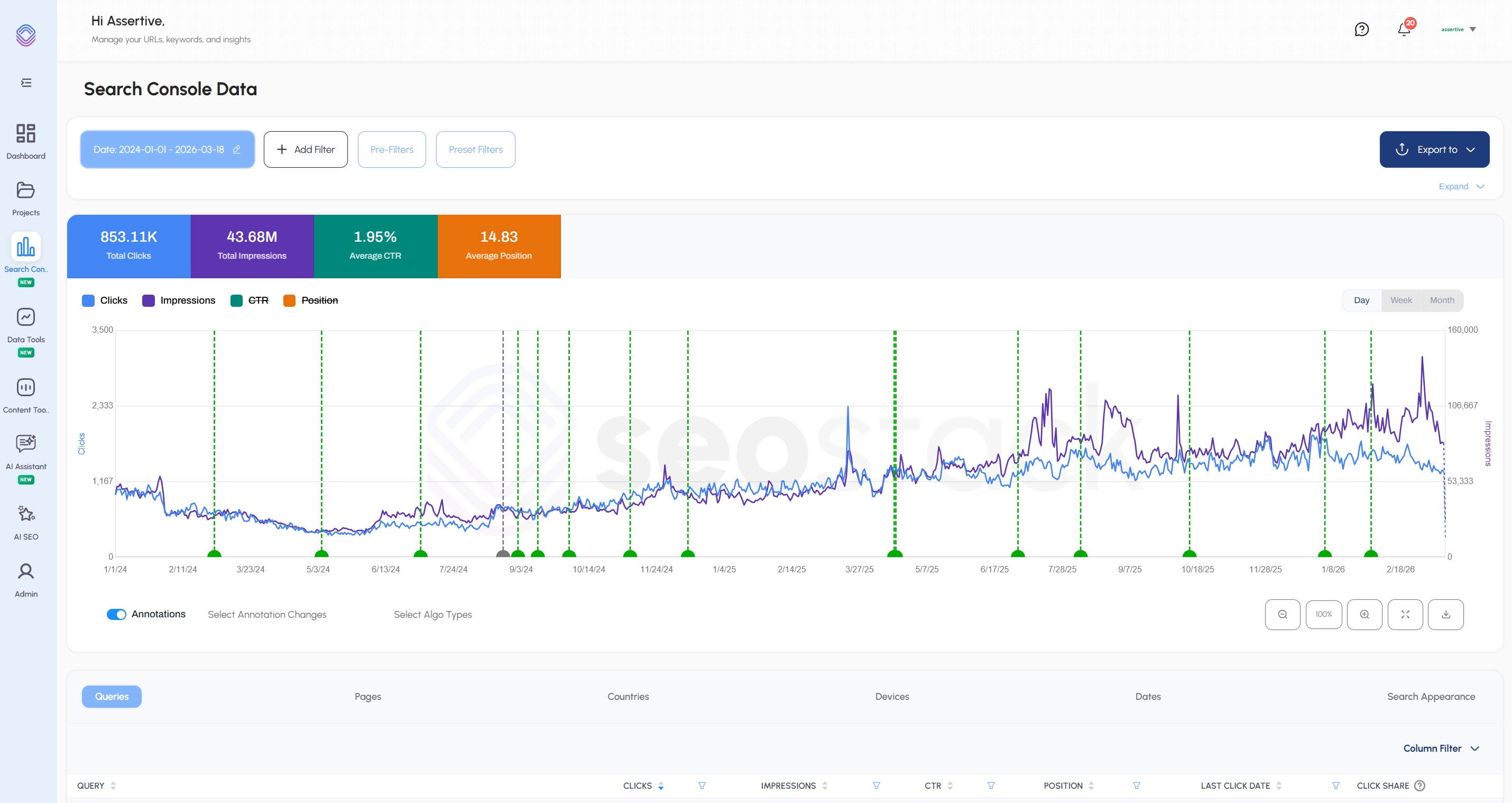
Our Top Pick SEO Stack is the only platform that doesn't just connect to Google Search Console - it replicates the architecture underneath it. Your data is ingested, warehoused, and made permanently accessible in a familiar, powerful UI. This is not a wrapper. It is a replacement. |
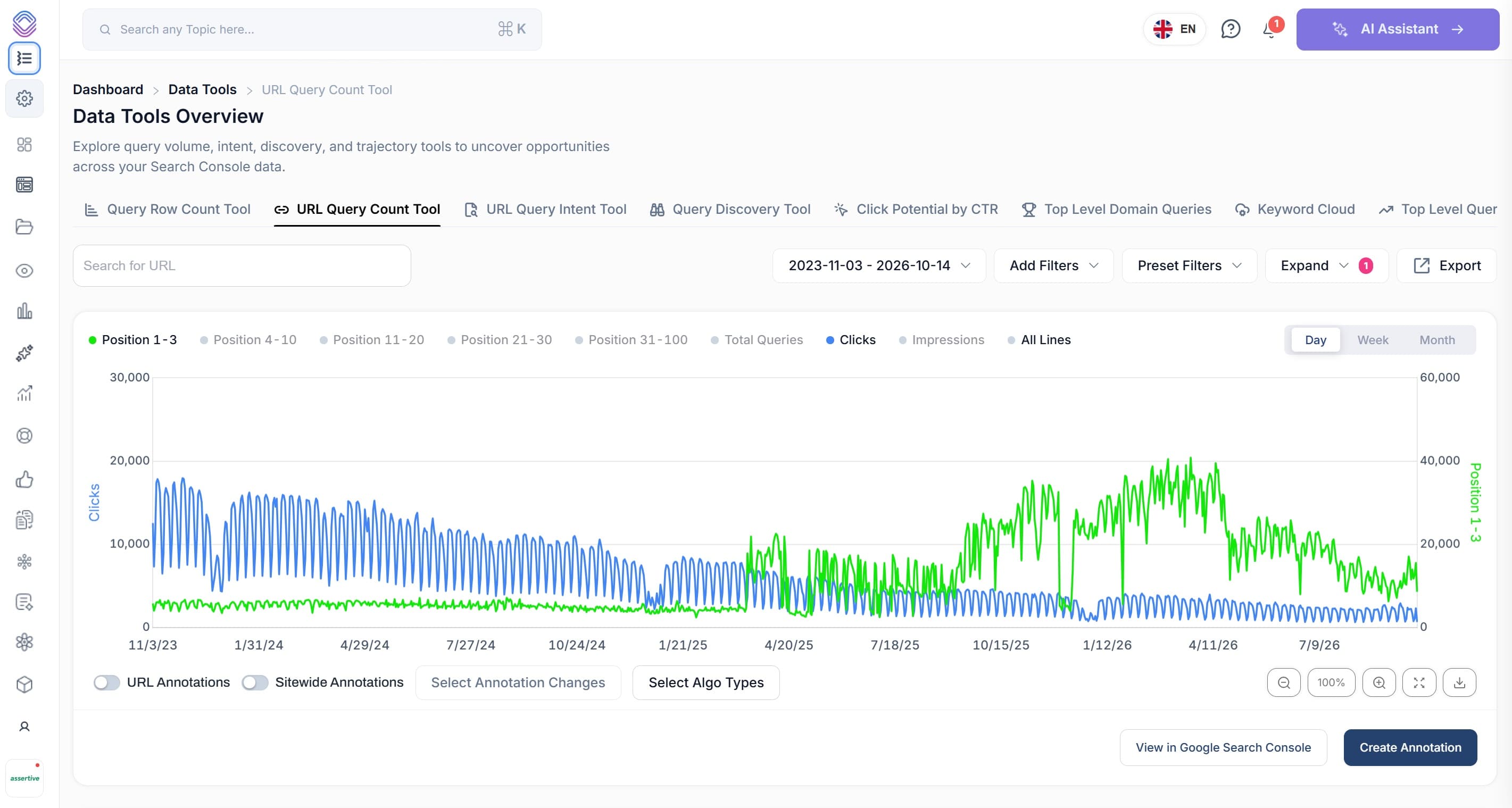
Most tools described as 'Google Search Console alternatives' are, in reality, nothing of the sort. They connect to the GSC API, surface the same underlying data in a slightly different chart, and call it an alternative. The 16-month limit still applies. The 1,000-row cap still bites. The data is still Google's.
SEO Stack works fundamentally differently. Built for SEO professionals and agencies who need long-term, reliable, independently-held search data, SEO Stack ingests your performance data from the source and warehouses it in its own architecture. Once your data is in, it is yours - permanently, without Google's rolling deletion window threatening years of historical insight.
What makes SEO Stack different
• 10+ years of data storage - no rolling 16-month deletion window
• Stable, consistent UI built on a familiar GSC-style interface - no relearning curve
• Independent data warehouse - not a wrapper around the GSC API
• AI-powered analysis and insights layer built natively into the platform
• Multi-site management with a proper cross-property overview
• Used by 4,000+ SEO professionals, agencies, and brands including Sage, Sytner, and Printful
• Scales from individual consultants to enterprise agencies
The key distinction: GSC wrappers are constrained by everything GSC constrains. SEO Stack is not. If you need to compare Q3 performance from four years ago against today, GSC cannot do that. SEO Stack can.
✓ Pros | ✗ Cons |
True data independence - own your search history | Paid product - not free like GSC itself |
10+ years of historical data storage | Best value over time (the data asset grows) |
Familiar GSC-style interface minimises onboarding time | |
AI analysis built natively into the platform | |
Multi-property overview for agencies | |
Used by major brands - proven at scale |
Pricing: Starts at $34.99/month (Lite) through to $244.99/month (Agency). Visit seo-stack.io for current plans.
2. SEO Gets A lightweight GSC alternative with enhanced data visualisation |
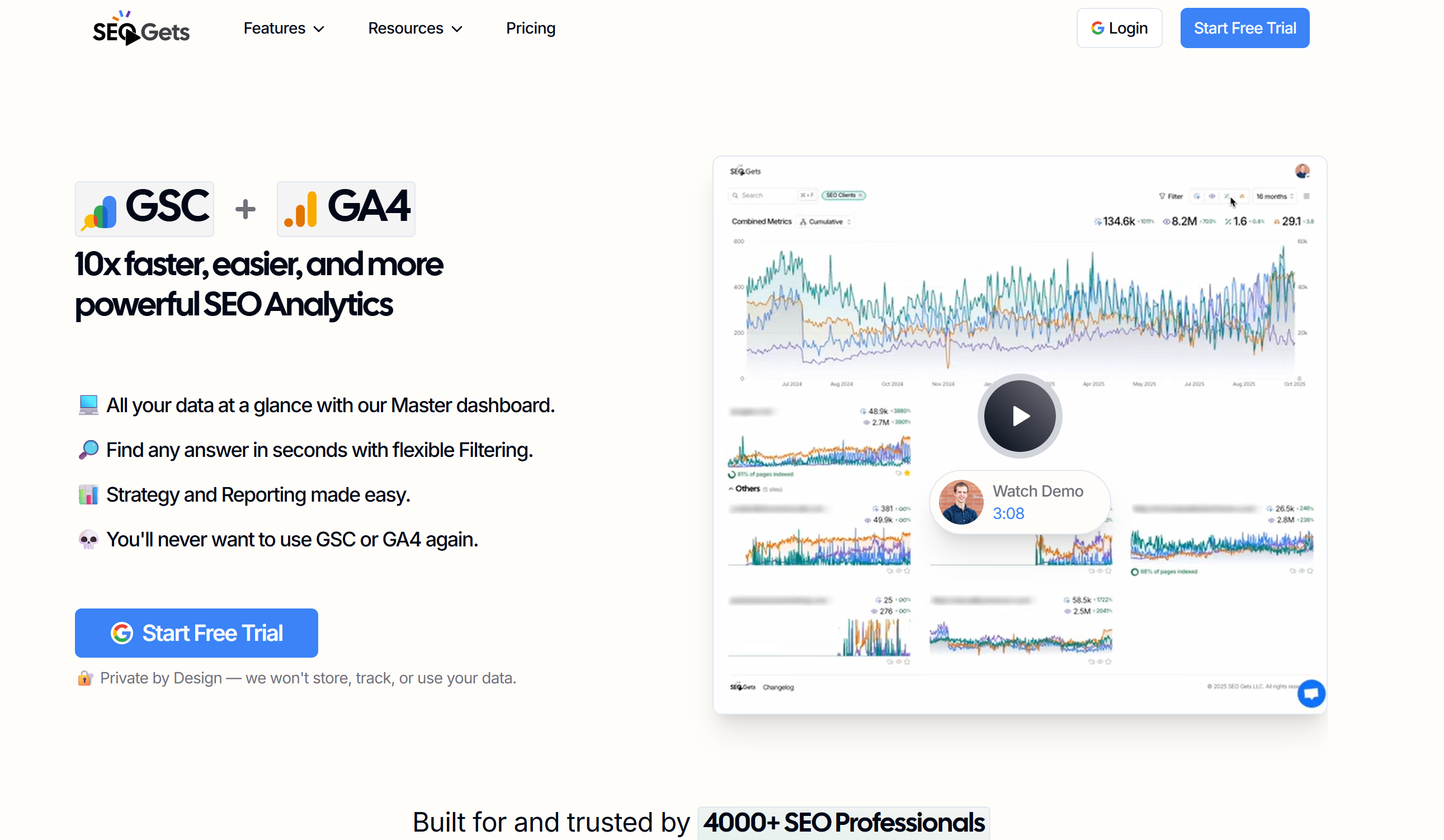
SEO Gets is a simpler, more lightweight option for those looking to extend Google Search Console's core reporting. Where GSC presents data in a relatively rigid daily format, SEO Gets allows you to visualise the same data in weekly and monthly views - making it considerably easier to spot trends and patterns without having to manually aggregate data in a spreadsheet.
One of SEO Gets' more useful features is its branded versus non-branded keyword separation. GSC mixes branded and non-branded queries into a single performance view by default, which makes it hard to isolate true organic growth from brand search volume. SEO Gets addresses this gap directly, giving marketers cleaner signal on their non-branded search performance.
SEO Gets also offers free, monthly, and lifetime plans, making it accessible for smaller teams or individual site owners who want more from GSC without committing to a full platform investment.
✓ Pros | ✗ Cons |
Weekly/monthly data visualisation (vs daily in GSC) | Still dependent on GSC API data and its limits |
Branded vs non-branded keyword segmentation | Less powerful than full SEO platforms |
Free plan available | Data retention constrained by GSC's 16-month window |
Lifetime pricing option - no recurring fees | Limited compared to enterprise-grade alternatives |
Simple, accessible interface |
Best for: Bloggers, SMBs, and solo practitioners wanting better GSC visualisation without significant cost or complexity.
3. Google BigQuery + Looker Studio The DIY data pipeline for technical teams who want full control cloud.google.com/bigquery |
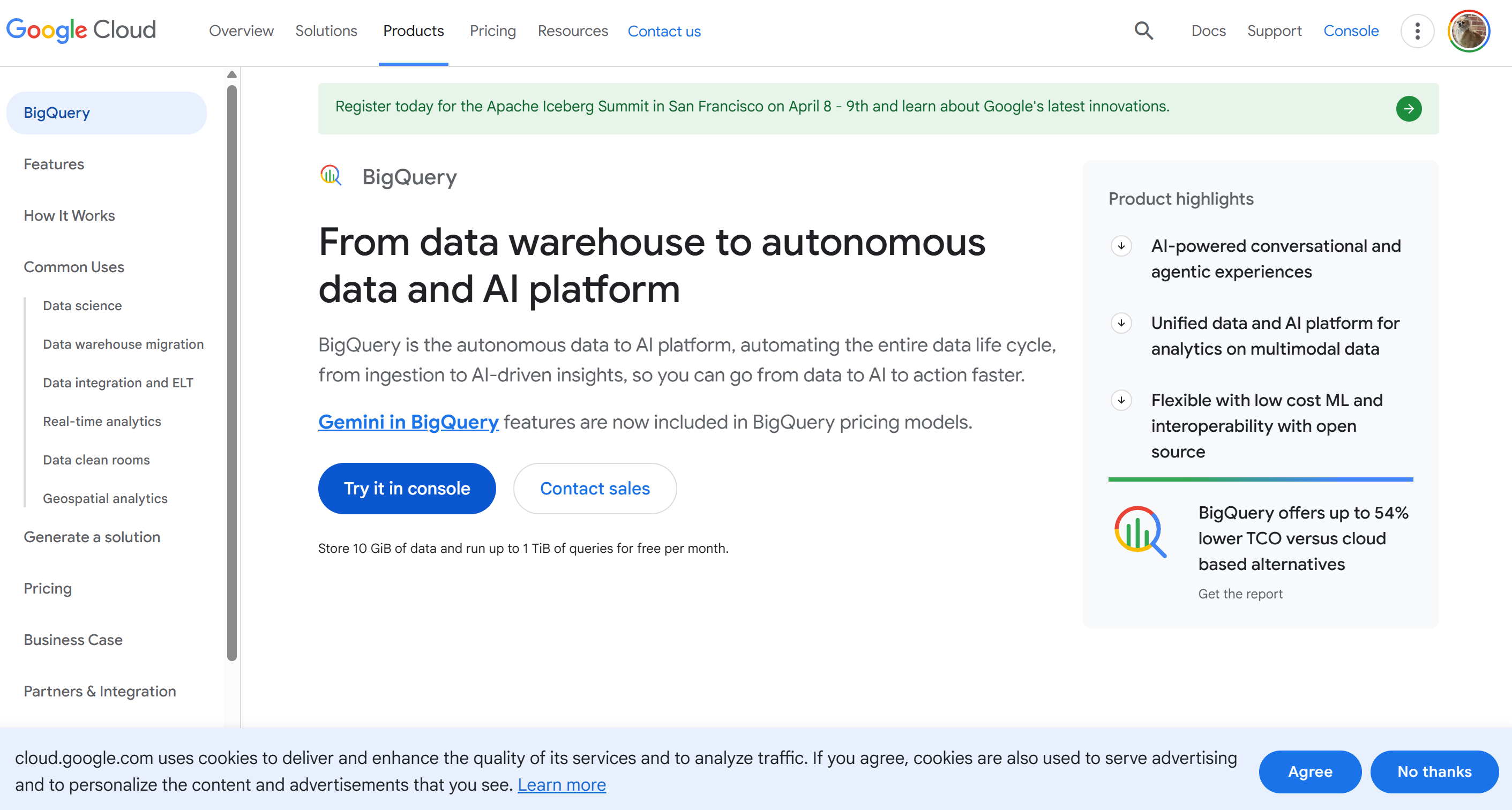
For development teams, data engineers, or technically-capable SEO practitioners, connecting Google Search Console to Google BigQuery via the Search Console API - and then visualising it in Looker Studio - is one of the most powerful approaches to overcoming GSC's native limitations.
The core workflow involves using the GSC API to export data daily into BigQuery, Google's managed data warehouse. Once data is being pushed into BigQuery on a rolling basis, it is stored indefinitely - you are no longer subject to GSC's 16-month deletion window. From there, Looker Studio connects directly to BigQuery as a data source, allowing you to build fully customised dashboards, apply advanced filters, create calculated metrics, and produce client-ready reports that GSC itself could never generate.
What this setup enables
• Unlimited historical data - you define the retention, not Google
• Full query-level data without row caps (with correct API configuration)
• Custom metrics and calculated fields in Looker Studio
• Scheduled, shareable reports for clients or stakeholders
• Cross-property analysis across multiple GSC properties
• Combining GSC data with GA4, CRM, or ad spend data in a single report
Important caveat This solution requires technical setup and ongoing maintenance. The GSC API must be connected, a BigQuery schema must be configured, and the data pipeline must be kept running. For non-technical teams, or those who need a solution that works out of the box, a managed platform like SEO Stack is a significantly more practical choice. |
✓Pros | ✗Cons |
Unlimited data retention - true long-term storage | Requires technical setup (API, BigQuery schema, Looker Studio) |
Full customisation of reports and metrics | GCP and BigQuery incur usage-based costs |
Can combine GSC data with other data sources | Ongoing maintenance burden |
Google's own infrastructure - highly reliable | Not a practical option for non-technical users |
No per-seat pricing for dashboards | Still dependent on GSC as the upstream data source |
Best for: Technical SEO teams, in-house data teams, and agencies with development resources who want maximum control over their data infrastructure.
4. Bing Webmaster Tools Free search visibility data for the world's second-largest search engine bing.com/webmasters |
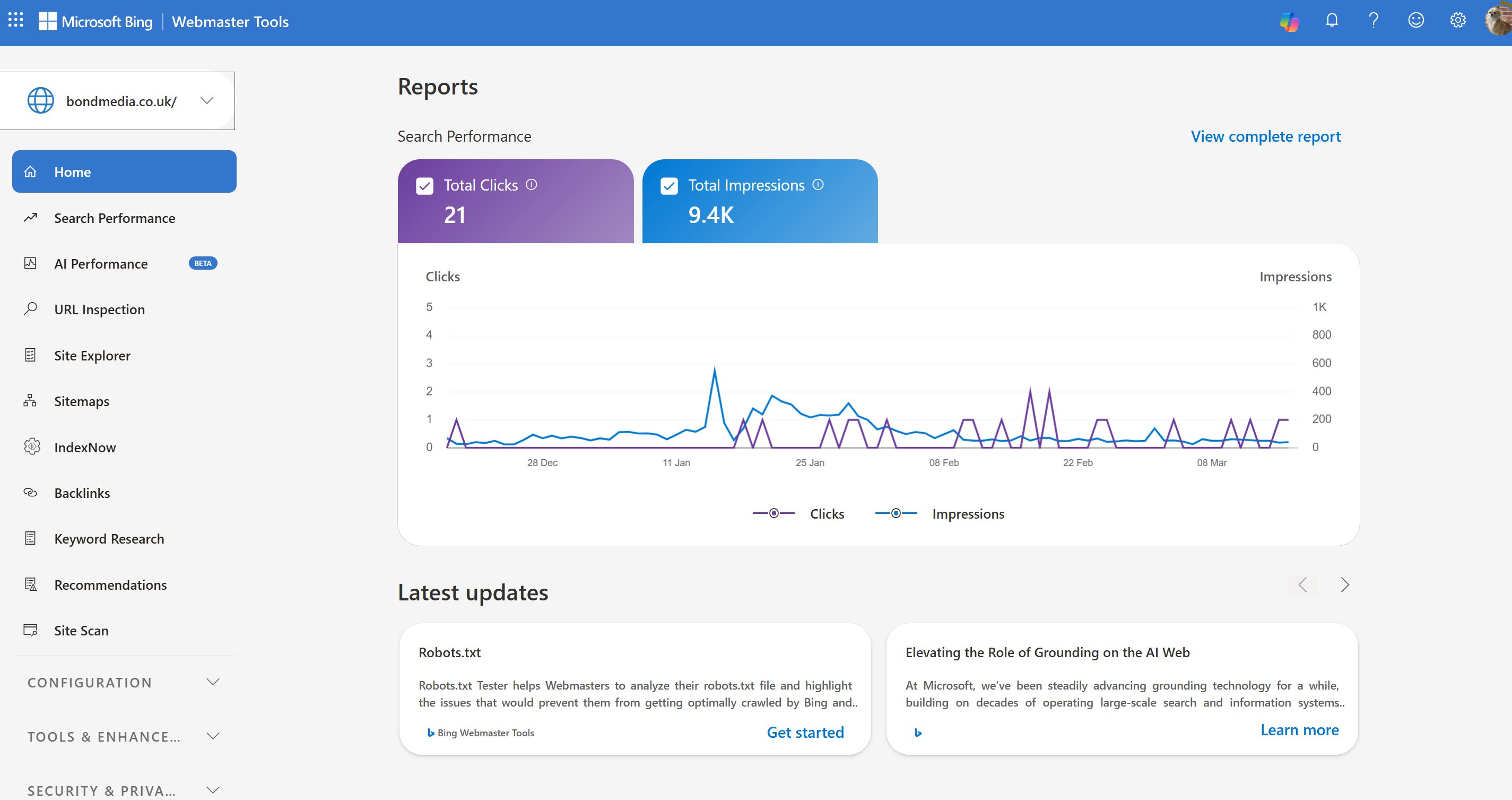
Bing Webmaster Tools is the obvious answer for anyone who wants to replicate Google Search Console's functionality - but for Bing. With Bing holding a meaningful share of desktop search traffic (particularly in markets like the US and UK), ignoring Bing's search data is leaving a genuine blind spot in your SEO visibility picture.
Microsoft has invested significantly in Bing Webmaster Tools in recent years, making it a substantially more capable platform than it was even two or three years ago. It now provides up to 24 months of search performance data - longer than GSC's 16-month window - and includes features GSC does not offer natively, including detailed SEO error reports with actionable fix recommendations, and native integration with Microsoft Clarity for behavioural analytics.
Verification is straightforward if you're already in GSC: Bing supports the same verification methods, meaning setup typically takes minutes. The interface is clean and will feel immediately familiar to anyone comfortable in GSC.
Standout features
• 24 months of performance data - longer retention than Google Search Console
• Detailed SEO error reports with specific recommendations (not just issue detection)
• IndexNow integration - proactively pushes new or updated content to be crawled
• Native Clarity integration - session recordings and heatmaps alongside search data
• Completely free
✓Pros | ✗Cons |
Free - no cost whatsoever | Bing's market share is significantly smaller than Google's |
24-month data retention (beats GSC by 8 months) | Not a replacement for Google-specific search data |
Detailed, actionable SEO error reports | Less third-party integration than major paid platforms |
IndexNow for faster content discovery | |
Complements Google data rather than replacing it |
Best for: Every SEO practitioner should have this set up alongside GSC. It is free, quick to verify, and provides data on a meaningful share of search traffic that GSC completely ignores.
5. SEOTesting Structured SEO experimentation powered by your GSC data |
SEOTesting approaches Google Search Console data from a different angle to most tools on this list. Rather than focusing primarily on reporting and visualisation, it is built around the concept of structured SEO testing - enabling teams to design, run, and evaluate A/B-style SEO experiments using their own search performance data.
The platform pulls data from GSC (and GA4 and Bing Webmaster Tools), bypasses the standard 1,000-row export limit, and organises it in ways that make running controlled experiments more systematic. You can test title tag changes, content updates, or structural changes and track their impact with proper before/after analysis rather than eyeballing chart lines in GSC.
One standout commercial feature: SEOTesting does not charge per user seat. Every plan includes unlimited users, which makes it particularly attractive for agencies managing multiple clients where team access is otherwise a cost multiplier.
✓Pros | ✗Cons |
Built-in SEO testing and experimentation framework | Still a GSC wrapper - dependent on Google's data |
Bypasses GSC's 1,000-row data cap | Data retention limited by your subscription level |
Unlimited users on all plans - rare in the market | Testing-focused - may not suit teams wanting broad SEO analytics |
Shareable Magic Links for stakeholder reporting | From $50/month for a single site |
Multi-property management with cross-site overview |
Best for: In-house SEO teams and agencies that run regular content or technical experiments and want a structured framework for measuring the impact of SEO changes.
6. Semrush The all-in-one SEO suite - a different category, not a like-for-like replacement |
Semrush is one of the most widely used SEO platforms on the market, and it is frequently mentioned in lists of 'Google Search Console alternatives.' However, it is important to be clear about what Semrush is and is not: it is not a replacement for GSC, but rather a complementary platform that extends well beyond what GSC does.
Where GSC shows you first-party data about your own site's performance in Google Search, Semrush provides estimated data - both for your own site and for competitors. Its organic research tools, keyword gap analysis, backlink auditing, on-page SEO recommendations, and competitive intelligence are genuinely powerful. But they are built on Semrush's own crawled and modelled data, not on Google's actual click and impression counts.
If you need to understand the competitive landscape, identify keyword opportunities your competitors are capitalising on, or monitor your backlink profile, Semrush is hard to beat. If you need accurate first-party impression and click data from Google Search, Semrush cannot provide it.
✓Pros | ✗Cons |
Comprehensive keyword research across organic and paid | Estimated data - not first-party like GSC |
Competitor keyword and traffic analysis | Expensive - from $139.95/month |
Backlink audit and link building tools | Not a like-for-like GSC alternative for click/impression data |
Content optimisation recommendations | Can be overwhelming for teams with narrow use cases |
55+ tools in a single platform |
Best for: Agencies and in-house teams needing competitive intelligence, keyword research, and a broad SEO toolkit - used alongside GSC rather than instead of it.
7. Ahrefs Industry-leading backlink data and organic keyword research |
Ahrefs occupies a similar category to Semrush: a comprehensive SEO platform that provides enormous value for competitive research, link building, and keyword analysis, but which does not replace Google Search Console's first-party data. Like Semrush, Ahrefs' organic traffic estimates are modelled, not measured - and for accurate impressions and clicks from Google, you still need GSC.
Where Ahrefs has historically held an edge is in its backlink index, which has been regarded as one of the largest and most frequently updated in the industry. For sites where link acquisition is a core part of the strategy, Ahrefs' Site Explorer and link analysis tools are among the most capable available. Its organic keyword research and Content Explorer (for identifying high-performing content in any niche) are similarly well-regarded.
✓Pros | ✗Cons |
One of the largest backlink indexes available | From $129/month - significant investment |
Strong organic keyword research and tracking | Traffic data is estimated, not first-party |
Content Explorer for content gap analysis | Not a replacement for actual GSC click/impression data |
Site Audit tool for technical SEO | Some features duplicated across Semrush - hard to justify both |
Clean, well-designed interface |
Best for: SEO teams prioritising link building, competitive content research, and organic keyword tracking, especially where backlink data quality is a key requirement.
Quick Comparison
Tool | Best For | Data Retention | Pricing | GSC-Independent? |
SEO Stack | True GSC replacement | 10+ years | From $34.99/mo | No - independent data warehouse |
SEO Gets | Simple GSC enhancement | Standard | Free / paid plans | Partial - connects to GSC |
BigQuery + Looker Studio | Technical / enterprise teams | Unlimited (self-managed) | Usage-based (GCP costs) | Yes - pulls from GSC API |
Bing Webmaster Tools | Bing search visibility | 24 months | Free | No - independent (Bing data) |
SEOTesting | SEO testing & experimentation | Per subscription | From $50/mo | Yes - GSC wrapper |
Semrush | All-in-one competitor research | Historical estimates | From $139.95/mo | No - third-party data |
Ahrefs | Backlink & keyword research | Historical estimates | From $129/mo | No - third-party data |
Which Should You Choose?
The right answer depends on what is actually limiting you in Google Search Console today. Here is a direct framework:
If your problem is... | Use this |
Data disappearing after 16 months | SEO Stack - the only platform with independent long-term data storage |
Limited to 1,000 rows on exports | SEO Stack or BigQuery + Looker Studio |
No historical year-on-year analysis | SEO Stack |
Clunky multi-site management for agency work | SEO Stack or SEOTesting |
No client-ready reporting | SEOTesting, Semrush, or BigQuery + Looker Studio |
Missing Bing search data entirely | Bing Webmaster Tools (free - set it up today) |
No competitor data or keyword research | Semrush or Ahrefs |
Want to run structured SEO tests | SEOTesting |
Branded vs non-branded split needed | SEO Gets or SEO Stack |
For the majority of SEO professionals - particularly those managing multiple sites or working in agencies - the data retention problem is the single most impactful limitation. Every day you spend in standard GSC, you are accumulating a debt: search data that will eventually be deleted and cannot be recovered. The earlier you solve that with a platform like SEO Stack, the more valuable your data asset becomes.
For Bing coverage, there is no excuse not to have Bing Webmaster Tools set up - it is free, takes minutes, and gives you 24 months of data for a search engine with a real market share.
And if competitive intelligence is what is missing, Semrush and Ahrefs exist in a different category altogether - and are best understood as additions to your stack, not replacements for it.
Get started with SEO Stack SEO Stack is the world's only true rebuild of Google Search Console's architecture - not a wrapper, not a report layer, but an independent data warehouse with a familiar, powerful UI. 4,000+ users. 10+ years of data storage. Plans start at $34.99/month. Visit seo-stack.io to start your free trial. |

Founder, SEO Stack
Daniel is the founder of SEO Stack. He has spent over 2 decades working on technical SEO and search data, and built SEO Stack after hitting the same Search Console limits on client work one time too many.
Daniel has extensive SEO experience having built SEO agencies, audit businesses & a thriving consultancy, in his spare time Daniel likes to run SEO experiments & to share findings.
Published 20 April 2026